


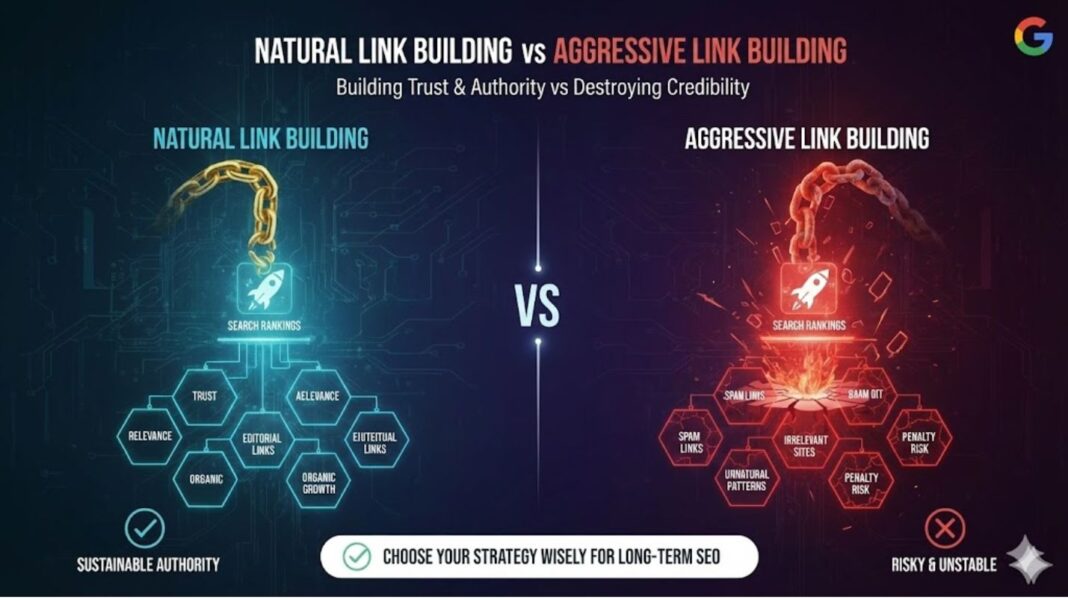
Link building remains one of the most debated aspects of SEO. While backlinks continue to influence rankings, the way they are acquired determines whether they support long-term visibility or create instability. The difference between natural link building and aggressive link building is not just tactical—it affects trust, authority, and sustainability.
Understanding this difference helps businesses choose strategies that align with modern search engine expectations.
What Natural Link Building Means
Natural link building focuses on earning links organically through relevance, value, and credibility. These links typically occur when other websites reference content because it is useful, informative, or authoritative.
Natural link building often involves:
- Publishing high-quality, helpful content
- Earning references through relevance
- Building visibility within a niche
- Supporting editorial intent
These links appear naturally within content and reflect genuine recognition rather than deliberate manipulation.
What Aggressive Link Building Involves
Aggressive link building prioritizes speed and volume. The goal is often to acquire as many backlinks as possible in a short period, regardless of relevance or context.
Common aggressive tactics include:
- Paid links without editorial value
- Automated link placements
- Irrelevant guest posting
- Over-optimized anchor text usage
While these approaches may show short-term movement, they often weaken long-term trust.
How Search Engines Evaluate Link Behavior
Search engines evaluate not just individual links, but overall link behavior patterns. They analyze how links are earned, where they come from, and how consistently they appear.
Natural patterns typically show:
- Gradual link acquisition
- Diverse sources
- Contextual placement
- Natural anchor variation
Aggressive patterns often display sudden spikes, repetitive anchors, and irrelevant placements—signals that reduce credibility.
Trust and Sustainability
Natural link building supports trust because it aligns with how search engines expect links to form. These links reinforce authority and strengthen credibility over time.
Aggressive link building can undermine trust. Even when rankings improve briefly, instability often follows as search engines reassess link quality.
Trust is cumulative. Once weakened, it can take significant time to rebuild.
Impact on Ranking Stability
Websites built on natural link profiles tend to experience:
- More stable rankings
- Stronger resistance to algorithm updates
- Gradual growth across related keywords
Aggressive link profiles often result in:
- Ranking volatility
- Sudden drops after updates
- Difficulty maintaining visibility
Stability is a key indicator of SEO health.
The Role of Relevance
Relevance is central to modern link evaluation. Natural links usually come from related industries or topics, strengthening topical authority.
Aggressive link building often ignores relevance, prioritizing quantity instead. This reduces contextual signals and limits long-term impact.
Search engines favor links that make sense within the broader topic ecosystem.
Short-Term Gains vs Long-Term Value
Aggressive link building may produce quick ranking changes, especially in low-competition environments. However, these gains are often temporary.
Natural link building focuses on long-term value:
- Authority compounds over time
- Links remain relevant
- Trust increases gradually
This long-term approach supports sustainable growth rather than rapid spikes.
Link Building and Content Quality
Natural links are closely tied to content quality. Content that explains topics clearly, answers real questions, and provides depth is more likely to attract organic references.
Aggressive strategies often treat links as standalone assets, disconnected from content quality. This disconnect limits effectiveness.
Strong content and natural links reinforce each other.
Risk and Algorithm Updates
Search engine updates are designed to reward relevance and penalize manipulation. Natural link profiles generally benefit from updates or remain stable.
Aggressive link profiles face higher risk:
- Links may be discounted
- Rankings may fluctuate
- Recovery can be slow
Risk increases when shortcuts replace strategy.
When Aggressive Tactics Appear to Work
In some cases, aggressive tactics seem effective, particularly in:
- Low-competition niches
- Short-term campaigns
- Temporary projects
However, as competition increases or algorithms evolve, these strategies often fail to scale or sustain results.
Choosing the Right Link Building Approach
The choice between natural and aggressive link building depends on business goals. Long-term brands benefit more from sustainable strategies.
Effective link building prioritizes:
- Relevance over volume
- Consistency over speed
- Value over manipulation
This approach aligns with how modern search engines evaluate trust.
Link Building in an AI-Driven Search Environment
AI-driven search systems rely heavily on trust signals. Natural link profiles help AI systems identify reliable sources for summaries and contextual answers.
Aggressive link building weakens these signals, limiting discoverability beyond traditional rankings.
Final Thoughts
The difference between natural link building and aggressive link building lies in sustainability. Natural links build trust, authority, and long-term visibility. Aggressive tactics may deliver short-term movement, but often create instability and risk.
As search engines continue to evolve, strategies that align with relevance, trust, and consistency remain the safest path forward. Businesses that invest in natural link building create stronger foundations for lasting SEO success.