

A lot of AI SEO advice online seems to assume you run a large company with a dedicated marketing team and a generous budget. If you run a small business, it is fair to wonder whether any of this actually applies to you, or whether it is just another trend built for companies much bigger than yours.
The honest, data-backed answer is that small businesses not only can benefit from AI SEO — in some specific ways, they are positioned to benefit more than large companies. This article explains exactly why, using the actual research rather than generic encouragement.
The Surprising Part: Authority Is Not the Only Path In
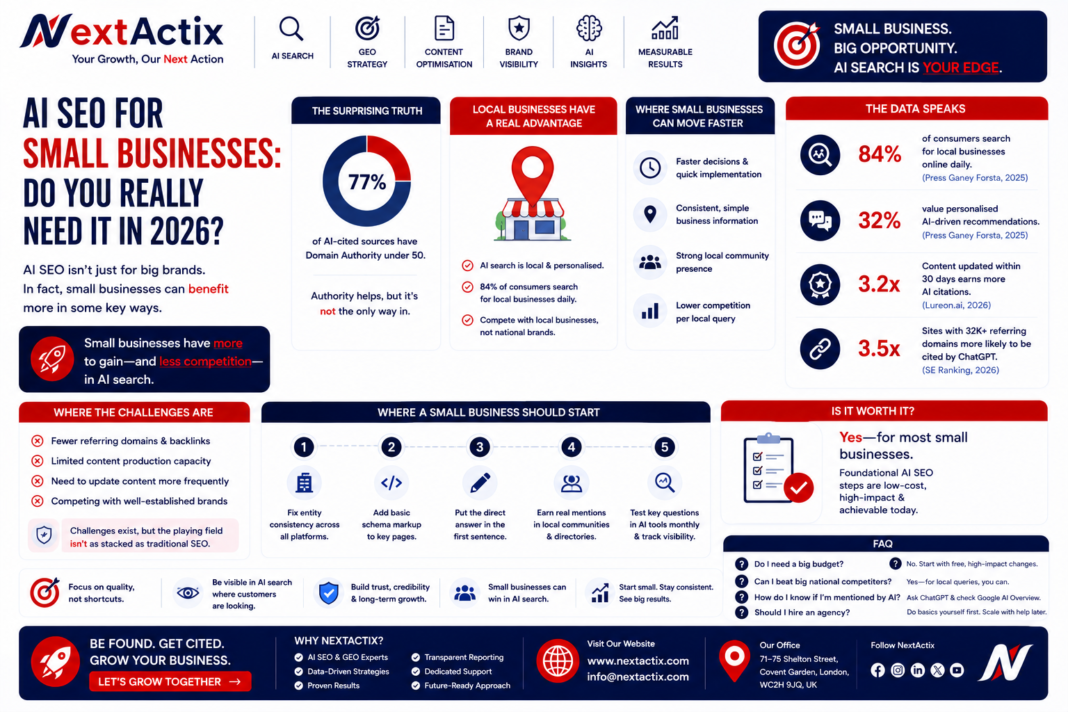
It would be reasonable to assume that AI systems only trust big, famous, high-authority websites. The data complicates that assumption in an interesting way. While sites with very high domain authority do see a citation advantage, one large analysis found that 77% of all sources actually cited by AI systems had a domain authority under 50 — meaning the overwhelming majority of citations are not going to giant, dominant websites at all.
This lines up with something Princeton University’s GEO research found directly: smaller and lesser-known sources benefited the most, proportionally, from applying proper optimisation techniques, because they had the most room to improve. A massive, already-famous brand tends to get cited somewhat automatically. A smaller business doing the structural work properly can close that gap faster than it could ever close an equivalent traditional SEO authority gap.
Why Local Businesses Specifically Have an Advantage
AI search has moved strongly toward localised, personalised answers rather than generic national ones. A 2025 survey from Press Ganey Forsta found that 84% of consumers search for local businesses online daily, and 32% specifically value personalised AI-driven recommendations as part of that experience.
When someone asks an AI assistant which plumber, dentist, or accountant to use nearby, the system applies real geographic context and draws on local entity data — consistent business listings, local citations, and review platforms — rather than returning a generic national answer. This is genuinely good news for a small, locally rooted business, because the competition at this level is your actual local competitors, not every large company in your broader industry nationwide.
Where Small Businesses Often Have a Real Structural Advantage
- Faster decision-making — a small business can restructure key pages and fix schema markup in days, not the months a large company’s approval process might require.
- More consistent, simple entity information — fewer locations, fewer service lines, and fewer historical website versions to clean up and make consistent.
- Genuine local community presence — authentic mentions on local forums, local press, and community platforms carry real weight, and small businesses are often naturally embedded in exactly these spaces already.
- Lower competitive density per query — “best accountant in [your town]” has far fewer realistic competitors fighting for the same AI citation than a broad national category term.
Where the Real Challenges Are
It would be dishonest to pretend there are no disadvantages. Small businesses typically have fewer referring domains overall, and SE Ranking’s research did find sites above 32,000 referring domains were roughly 3.5 times more likely to be cited by ChatGPT specifically. Content production capacity is also usually more limited, and research shows that content updated within the last 30 days earns roughly 3.2 times more citations — a more demanding update cadence than a small team may be used to maintaining.
The honest framing is this: small businesses face real resource constraints, but the playing field genuinely is not tilted as heavily toward big brands as it is in some areas of traditional SEO, particularly for local and niche-specific queries.
Where a Small Business Should Actually Start
- Fix entity consistency first. Make sure your business name, address, phone number, and core service description match exactly across your website, Google Business Profile, and any major directories. This is free, achievable in days, and forms the foundation everything else builds on.
- Add basic schema markup to your most important pages — your homepage, your main service pages, and any FAQ content you already have.
- Rewrite your top three pages so the direct answer to the obvious question appears in the first sentence, not buried in the third paragraph.
- Actively participate in genuine local community spaces — local Facebook groups, relevant subreddits, local press opportunities — rather than only posting on your own website.
- Test your own key questions monthly inside ChatGPT and Google’s AI Overview to track whether you are gaining or losing visibility over time.
Is the Investment Actually Worth It for a Small Business?
Given that 84% of consumers search for local businesses daily and a growing share of those searches are AI-assisted, and given that the foundational fixes above cost time rather than significant money, the realistic answer for most small businesses is yes — at least for the foundational steps. The more advanced, resource-intensive tactics like large-scale content production can be added later as the business grows, but the basics are accessible and worthwhile right now.
Frequently Asked Questions
Do I need a big budget to start with AI SEO as a small business?
No. The foundational steps — entity consistency, basic schema, answer-first content structure — require time and attention more than money, and are genuinely achievable without hiring a large agency.
Will big national competitors always beat me regardless of what I do?
Not for local, location-specific queries, where AI systems apply geographic context and your realistic competition is other local businesses, not every national company in your industry.
How do I know if my business is already being mentioned by AI tools?
Ask ChatGPT and check Google’s AI Overview for the kinds of questions your customers would naturally ask, in your specific location and industry, and see whether your business comes up.
Should I hire an agency or try this myself first?
Many of the foundational fixes are genuinely doable in-house with some focused time. An agency becomes more valuable once you are ready for ongoing citation tracking, content production at scale, and ongoing monitoring against competitor displacement.

