


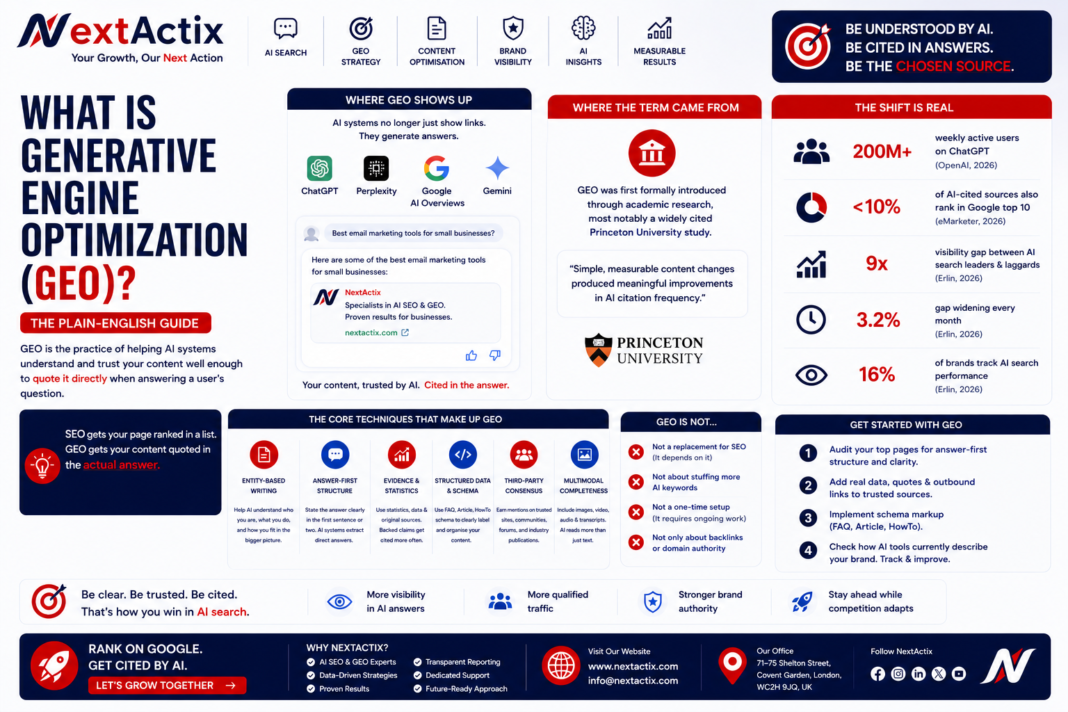
Generative Engine Optimization, almost always shortened to GEO, is one of those terms that sounds more complicated than it actually is. Strip away the jargon and the core idea is simple: GEO is the practice of helping AI systems understand and trust your content well enough to quote it directly when answering someone’s question.
This guide explains what that actually means in practice, where the term came from, and why — despite sounding niche — it is becoming one of the more consequential shifts in how businesses get found online.
Where the Term Comes From
GEO was first formally introduced through academic research, most notably a widely cited Princeton University study that systematically tested which content techniques improved visibility inside AI-generated answers. The researchers found that simple, measurable changes to how content was written produced meaningful, repeatable improvements in citation frequency — and the term stuck.
The Plain-English Definition
GEO is the set of techniques used to increase the chances that an AI system — ChatGPT, Perplexity, Google’s AI Overviews, Gemini, or similar tools — will reference, quote, or recommend your content when generating an answer to a user’s question.
eMarketer summarised the core distinction well: SEO results appear as a ranked list of links. GEO results appear as a narrative recommendation woven directly inside an AI-generated answer. The user experience for the end reader is completely different in each case, which is why the optimisation approach has to be different too.
Why GEO Exists as Its Own Discipline
The case for treating GEO separately from SEO comes down to one striking statistic: fewer than 10% of the sources cited by ChatGPT, Gemini, and Copilot also rank in the top 10 Google organic results for the same query, according to eMarketer’s 2026 research. If strong traditional SEO automatically produced strong AI citations, that overlap number would be far higher. It is not, which means a different set of factors is genuinely at play.
The Core Techniques That Make Up GEO
Entity-based writing, not keyword-based writing
Modern AI systems do not just match words. They build an internal map of entities — people, places, products, organisations — and the relationships between them. Writing that clearly defines who you are, what you do, and how you relate to your industry helps AI systems place you accurately on that map.
Answer-first structure
Generative engines are not interested in a slow build-up. They are extracting a direct, confident answer to summarise. Content that states the answer plainly within the first sentence or two after a heading performs significantly better than content that meanders toward the point.
Statistical and evidence-backed content
Princeton’s research specifically found that statistical content paired with the original data source, plus direct quotations, was among the strongest predictors of citation. A claim with a number and a source behind it consistently outperforms an unsupported general statement.
Structured data and schema markup
FAQPage, Article, and HowTo schema explicitly label what your content is and how it is organised, removing ambiguity for the AI system trying to parse it.
Multimodal completeness
AI platforms like Gemini and GPT-4o increasingly process and synthesise text, images, video, and audio together. A page with a vaguely titled image and no alt text, or a video without a transcript, is leaving real citation potential unrealised. Treating every page as a small cluster of reinforcing formats, not just body text, is becoming a genuine GEO factor.
How Big Is This Shift, Really?
Large enough that brand management platforms now treat it as a core function, not a side experiment. According to Erlin’s 2026 research tracking over 500 brands, the visibility gap between AI search winners and laggards currently sits at roughly nine times and is widening by about 3.2% every month. Yet the same research found only 16% of brands are systematically tracking their AI search performance at all.
That combination — a fast-widening gap, combined with very low current adoption — is exactly the kind of window where early, deliberate effort tends to pay off disproportionately, simply because so few competitors are doing the work yet.
Common Misunderstandings About GEO
- It is not a replacement for SEO — GEO depends on a solid SEO foundation to work at all.
- It is not just about stuffing in more keywords related to AI — the actual shift is toward topics and entities, not denser keyword usage.
- It is not a one-time setup — citation monitoring data shows that competitor activity displaces existing citations roughly 80% of the time, meaning GEO requires ongoing maintenance, not a single project.
Getting Started With GEO Today
The simplest starting point is auditing your existing top-performing pages against the techniques above. Pick your three most important pages, check whether they have a direct answer in the first few sentences, whether they include real statistics with named sources, and whether basic schema markup is in place. Fixing those three pages properly is a far better use of time than spreading thin effort across an entire website at once.
Frequently Asked Questions
Is GEO sometimes called something else?
Yes. You will also see it referred to as Answer Engine Optimisation (AEO) or AI Search Optimisation. These terms are generally used interchangeably to describe the same underlying practice.
Does GEO apply to voice assistants too?
The same underlying principles — clear entities, structured answers, verifiable claims — apply broadly across AI-driven discovery, including voice assistants, though most current research focuses specifically on chat and search-integrated AI tools.
How do I know if GEO is working?
Track citation frequency by regularly testing your key industry questions inside ChatGPT, Perplexity, and Google’s AI Overview, and note whether your brand appears, disappears, or moves over time.
Is GEO more important than SEO now?
Not more important — complementary. Since fewer than 10% of AI-cited sources also rank in the Google top 10 for the same query, businesses genuinely need to invest in both rather than choosing one over the other.