

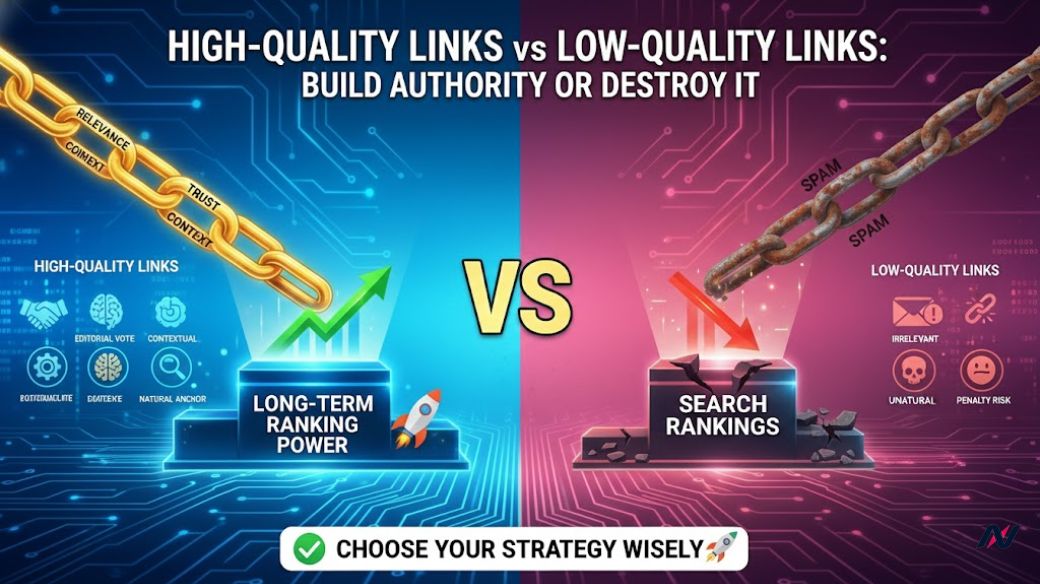
Links continue to influence how search engines evaluate websites, but not all links contribute positively to rankings. The difference between high-quality links and low-quality links often determines whether a website builds long-term authority or struggles with unstable visibility.
Understanding this difference helps businesses avoid outdated tactics and focus on link strategies that support sustainable search performance.
What Are High-Quality Links?
High-quality links are links that provide genuine value to users and signal trust to search engines. These links are typically earned rather than created through manipulation.
Strong links usually share several characteristics:
- They come from relevant websites within the same or related industry
- They are placed naturally within meaningful content
- They originate from credible, well-maintained sources
- They exist to support information, not to influence rankings
Search engines view these links as editorial references. They suggest that another website found the content useful enough to recommend.
Why High-Quality Links Strengthen Rankings
High-quality links help search engines understand that a website is trusted beyond its own domain. These links reinforce topical authority and increase confidence in content accuracy.
Over time, strong links contribute to:
- Improved ranking stability
- Better visibility across related keywords
- Higher resistance to algorithm updates
- Increased trust across multiple pages
Rather than pushing rankings quickly, high-quality links support gradual, consistent growth.
What Are Low-Quality Links?
Low-quality links are links that exist primarily for manipulation rather than value. They often lack relevance, context, or credibility.
Common examples include:
- Links from unrelated or spam-heavy websites
- Automatically generated directory links
- Excessive links placed in comments or forums
- Paid links without editorial intent
These links may increase link counts, but they rarely improve rankings in a meaningful way.
How Low-Quality Links Hurt SEO
Low-quality links do more harm than good over time. Search engines are increasingly effective at identifying unnatural link patterns and discounting them.
Problems caused by poor-quality links include:
- Reduced trust signals
- Ranking fluctuations
- Difficulty competing in competitive niches
- Increased vulnerability during algorithm updates
Even when penalties are not applied, low-quality links often fail to deliver any real SEO benefit.
Relevance Is the Key Difference
One of the most important differences between high-quality and low-quality links is relevance. Search engines evaluate whether the linking content aligns with the topic of the linked page.
A relevant link strengthens topical authority, while an irrelevant link weakens contextual signals. Even links from high-authority websites lose value if there is no meaningful connection between topics.
Relevance helps search engines understand why a link exists, not just where it comes from.
Context and Placement Matter
High-quality links are placed where they make sense within content. They support the discussion and add clarity for users. These contextual links signal genuine editorial intent.
Low-quality links are often placed:
- In footers or sidebars
- In unrelated articles
- Without any surrounding explanation
Search engines assign far less value to links that lack meaningful placement.
Anchor Text Patterns and Natural Language
Anchor text provides clues about the linked page, but balance is essential. High-quality links use natural language, branded terms, or contextual phrases.
Low-quality link profiles often show:
- Repetitive exact-match anchors
- Forced keyword placement
- Unnatural phrasing
Search engines evaluate anchor patterns at scale, not individually. Natural variation strengthens trust, while over-optimization weakens it.
Link Growth Over Time
High-quality link profiles grow steadily. Links are earned as content gains exposure, relevance, and recognition.
Low-quality link strategies often involve sudden spikes in link acquisition. These patterns can appear unnatural and reduce credibility rather than improve it.
Consistency signals authenticity, while aggressive growth often signals manipulation.
Long-Term Impact on Search Visibility
Websites built on high-quality links tend to experience stable rankings and gradual improvement. Their authority grows as trust accumulates across multiple signals.
Websites relying on low-quality links may see short-term movement, but long-term performance is often unstable. Rankings fluctuate, and progress becomes difficult to maintain.
Search engines favor reliability over speed.
Choosing the Right Link Strategy
The safest and most effective link strategy focuses on quality, relevance, and consistency. Instead of asking how many links are needed, businesses should ask whether a link makes sense in context.
Questions to consider include:
- Would this link exist without SEO incentives?
- Does it add value for users?
- Is the source credible and relevant?
Links that pass these checks are more likely to support long-term growth.
Final Thoughts
The difference between high-quality links and low-quality links lies in intent and value. High-quality links strengthen authority, trust, and ranking stability. Low-quality links weaken credibility and often limit long-term performance.
Businesses that prioritize relevance, context, and consistency build stronger SEO foundations. By focusing on link quality rather than quantity, search visibility becomes more reliable, resilient, and sustainable over time.