


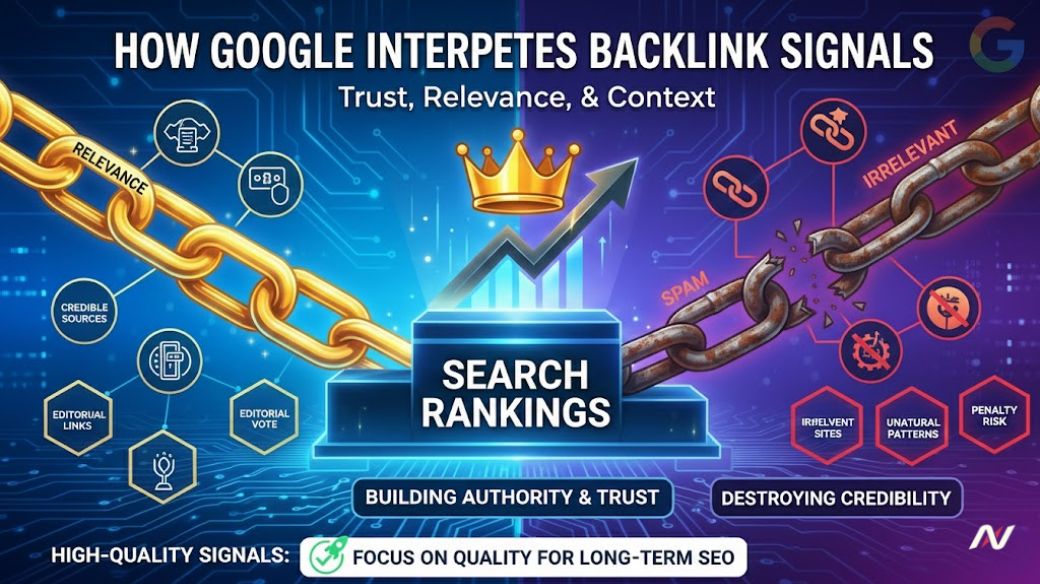
Backlinks play a key role in how Google evaluates websites, but their interpretation has become far more sophisticated over time. Google no longer treats all links equally. Instead, it analyzes a wide range of signals to understand what each link represents and how it should influence rankings.
Understanding how Google interprets backlink signals helps businesses focus on strategies that support long-term visibility rather than short-term gains.
Backlinks as Trust Indicators
At their core, backlinks act as trust indicators. When one website links to another, it signals recognition or reference. Google evaluates these signals to determine whether a website deserves visibility.
However, trust is not assigned automatically. Google examines the source, context, and intent behind each link to assess its value.
Source Quality and Credibility
One of the first elements Google evaluates is the credibility of the linking source. Links from established, well-maintained websites carry more weight than links from low-quality or spam-prone domains.
Google considers factors such as:
- Domain history and stability
- Content quality of the linking site
- Link profile health
- User engagement patterns
Links from trustworthy sources reinforce confidence, while links from unreliable sources may be discounted or ignored.
Relevance Between Websites
Relevance is a critical signal in link interpretation. Google analyzes whether the linking website and the linked page share related topics.
Relevant links:
- Strengthen topical authority
- Help Google understand subject relationships
- Improve ranking potential across related queries
Links from unrelated sites often carry less value, even if the source has high authority.
Contextual Placement Within Content
Where a link appears on a page influences how Google interprets it. Contextual links embedded naturally within relevant content are stronger signals than links placed in footers or sidebars.
Contextual placement indicates:
- Editorial intent
- Meaningful reference
- Content alignment
Links that exist without clear context are less likely to influence rankings.
Anchor Text Interpretation
Anchor text provides clues about the linked page, but Google evaluates anchor patterns rather than individual anchors. Natural variation is a positive signal.
Healthy anchor usage includes:
- Branded terms
- Descriptive phrases
- Natural language references
Over-optimized anchor text patterns may reduce trust rather than improve relevance.
Link Patterns and Acquisition Behavior
Google also evaluates how links are acquired over time. Natural growth patterns suggest genuine interest, while sudden spikes may indicate manipulation.
Signals Google considers include:
- Consistency of link growth
- Diversity of linking sources
- Frequency of similar anchor usage
Gradual acquisition supports long-term trust.
Relationship Between Links and Content Quality
Backlinks are evaluated alongside content quality. A strong link pointing to weak content may have limited impact.
Google assesses:
- Whether content fulfills user intent
- Clarity and depth of information
- Engagement and usefulness
Links amplify content that already demonstrates value.
Link Attributes and Signals
Google considers link attributes such as nofollow and sponsored tags. These signals help indicate intent, but they do not automatically nullify value.
Instead, Google interprets attributes as guidance rather than strict rules. Context and source credibility still matter.
Identifying Manipulative Link Signals
Google actively detects manipulative link patterns. Links created solely to influence rankings often fail to provide lasting benefits.
Common red flags include:
- Paid links without editorial context
- Automated link schemes
- Irrelevant placements
Such signals are often ignored or discounted.
Backlink Signals in Competitive SEO
In competitive environments, backlink signals help differentiate between similar content. When multiple pages provide comparable value, link signals often influence which page ranks higher.
Backlinks help establish:
- Relative authority
- Trustworthiness
- Stability over time
This makes them especially important in crowded search landscapes.
Backlinks and AI-Driven Search Systems
As AI-driven search evolves, backlinks remain relevant. AI systems rely on trust signals to identify reliable sources for summaries and contextual results.
Backlinks help:
- Validate credibility
- Support inclusion in AI-generated answers
- Reinforce authority beyond rankings
Their role is evolving but not diminishing.
Final Thoughts
Google interprets backlink signals through a lens of trust, relevance, and consistency. Links are no longer simple ranking factors but part of a broader system that evaluates credibility and authority.
Websites that focus on earning relevant, high-quality backlinks alongside strong content and structure are better positioned for stable rankings and long-term visibility. Understanding how Google interprets link signals helps businesses align their strategies with modern SEO expectations.