

Links remain one of the strongest signals search engines use to evaluate websites. However, the way links influence rankings has changed significantly. It is no longer about how many links a website has, but about where those links come from, how they are earned, and how naturally they fit within the web ecosystem.
Understanding link quality is essential for businesses that want stable rankings rather than short-term visibility spikes.
Why Search Engines Still Rely on Links
Search engines use links to understand relationships between websites. When one site references another, it acts as a signal of relevance or trust. Over time, search engines analyze these relationships to determine which websites are authoritative within a topic area.
Links help search engines:
- Discover new content
- Evaluate credibility
- Understand topical relevance
- Measure external validation
However, not all links carry the same value.
What Defines Link Quality
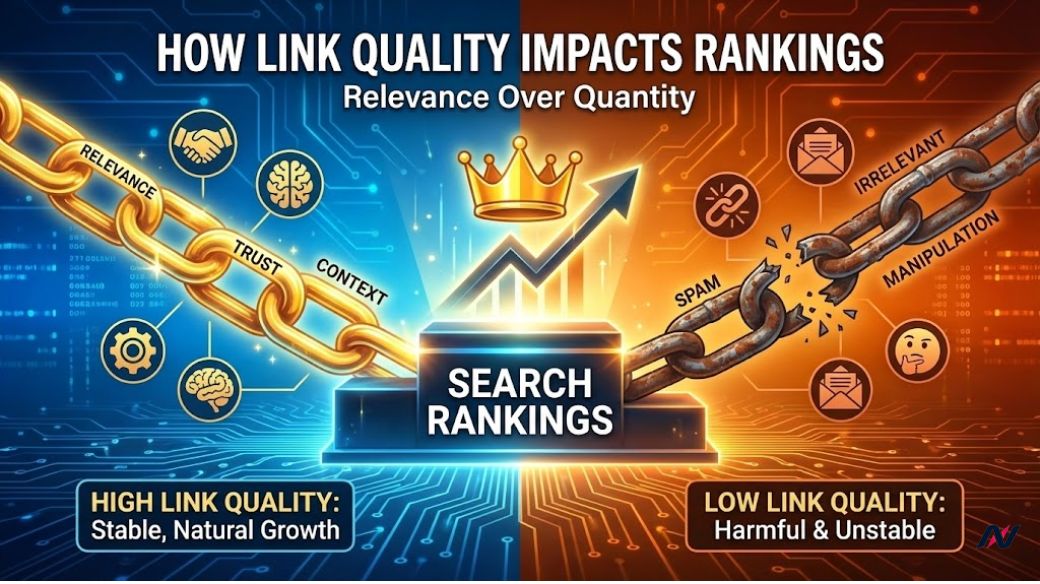
Link quality is determined by context, relevance, and trust—not by volume. A single strong link can often outperform dozens of weak ones.
High-quality links typically share these characteristics:
- Come from relevant websites within the same or related industry
- Are placed naturally within content
- Originate from trusted, established sources
- Add value to users rather than exist for manipulation
Low-quality links, on the other hand, often appear forced, unrelated, or purely promotional.
Relevance Matters More Than Authority Alone
One of the biggest misconceptions about link building is that authority alone determines link value. While authority plays a role, relevance is equally important.
A link from a moderately authoritative site within the same niche often carries more weight than a high-authority link from an unrelated source. Search engines evaluate how closely the linking page aligns with the topic of the target page.
Relevant links strengthen topical authority, helping websites rank across multiple related queries rather than just one keyword.
Contextual Placement Strengthens Impact
Where a link appears on a page matters. Links placed naturally within relevant content signal editorial intent. These contextual links are far more valuable than links placed in footers, sidebars, or unrelated sections.
Contextual placement tells search engines:
- The link supports the topic being discussed
- The reference is meaningful, not transactional
- The content relationship is intentional
Links that exist only for visibility or manipulation often fail to deliver long-term ranking benefits.
Anchor Text and Natural Language
Anchor text provides additional context about the linked page, but over-optimization can weaken link quality. Search engines now evaluate anchor text patterns rather than isolated instances.
Healthy link profiles include:
- Branded anchors
- Natural phrases
- Contextual references
- Occasional descriptive terms
Excessive use of exact-match anchor text can create unnatural patterns that reduce trust rather than improve rankings.
Link Velocity and Consistency
Search engines also evaluate how links are acquired over time. Natural link growth tends to be gradual and consistent, reflecting genuine interest in content.
Sudden spikes in link acquisition—especially from low-quality sources—can raise concerns. Consistency signals stability and long-term relevance, while erratic growth patterns often indicate manipulation.
Sustainable link building focuses on steady progress rather than rapid accumulation.
The Role of Trust and Source Credibility
Search engines assess not just the linking page, but the overall credibility of the linking domain. Websites with a history of quality content, clean link profiles, and strong user engagement pass more trust.
Links from untrustworthy or spam-prone domains can dilute authority, even if they appear harmless individually. Over time, a poor-quality link environment can limit ranking potential across an entire website.
How Poor Link Quality Hurts Rankings
Low-quality links do more than fail to help—they can actively harm performance. Issues often arise when websites rely on outdated tactics such as mass directory submissions, irrelevant guest posts, or paid links without editorial value.
Negative impacts include:
- Ranking instability
- Difficulty competing for competitive terms
- Reduced trust signals
- Increased vulnerability during algorithm updates
Search engines are increasingly effective at identifying unnatural link patterns.
Link Quality and Long-Term SEO Stability
Websites with strong link quality tend to experience more stable rankings during algorithm updates. This is because their authority is supported by genuine references rather than artificial signals.
High-quality links contribute to:
- Better crawl efficiency
- Stronger topical authority
- Increased trust across multiple pages
- Improved ranking resilience
This stability is especially important for competitive industries where small differences can significantly impact visibility.
How Content Supports Link Quality
Quality links are rarely built in isolation. They are often the result of strong content that earns attention naturally. Informative guides, in-depth resources, and well-structured service pages are more likely to be referenced by other websites.
Content that demonstrates expertise and clarity creates opportunities for organic link acquisition. Over time, this reinforces authority without relying on aggressive outreach.
Evaluating Link Quality the Right Way
Rather than focusing on metrics alone, businesses should evaluate links holistically. Questions to consider include:
- Does the link make sense contextually?
- Is the source relevant to the topic?
- Would the link exist without SEO incentives?
- Does it add value for users?
Links that pass these checks tend to support long-term ranking growth.
Final Thoughts
Link quality plays a critical role in how search engines evaluate websites. Strong rankings are built on relevance, trust, and consistency—not volume. High-quality links act as external validation, reinforcing authority and credibility across search results.
Businesses that prioritize link quality over quantity create a more resilient SEO foundation. By focusing on meaningful connections, natural growth, and content-driven authority, search rankings become more stable, scalable, and sustainable over time.