

Backlinks have been a core part of search engine ranking systems since the early days of SEO. As search algorithms have evolved, many have questioned whether backlinks still matter. While the way links are evaluated has changed, their importance has not disappeared.
Backlinks continue to play a significant role in how search engines assess trust, authority, and relevance.
What Backlinks Represent in Modern SEO
Backlinks are references from one website to another. From a search engine’s perspective, they act as external signals that help evaluate credibility.
In modern SEO, backlinks:
- Indicate external recognition
- Support authority beyond on-page signals
- Help search engines understand topic relevance
- Reinforce trust over time
Rather than functioning as simple ranking boosters, backlinks now operate as validation signals.
Why Search Engines Still Use Backlinks
Search engines aim to provide reliable results. Backlinks help them answer a critical question: Do other sources recognize this website as useful or credible?
Because backlinks come from independent websites, they serve as third-party validation. This makes them difficult to fake at scale, which is why search engines continue to rely on them as part of ranking evaluation.
Quality Over Quantity
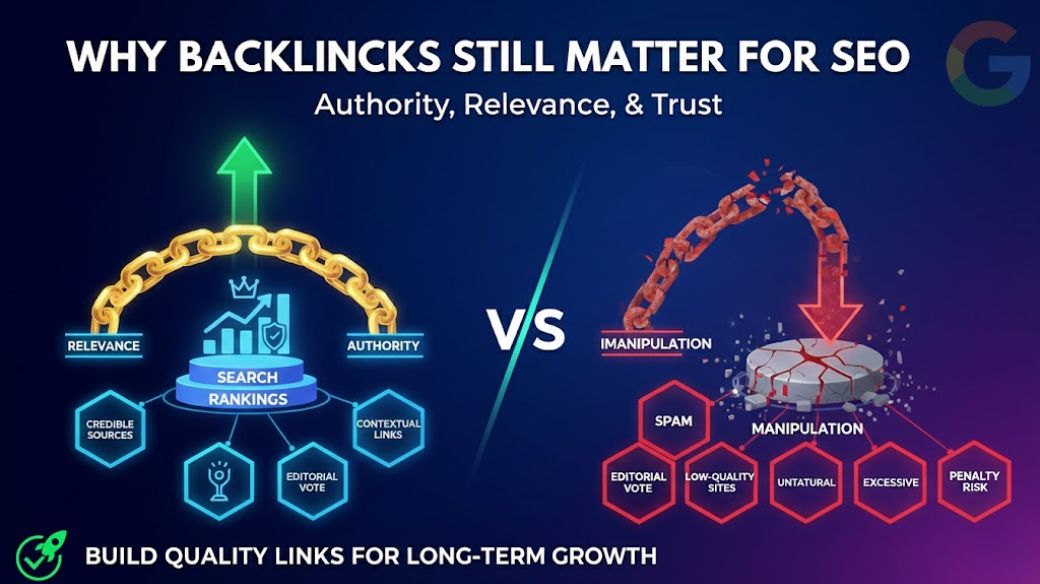
One of the biggest changes in link evaluation is the emphasis on quality. A small number of relevant, trustworthy links can be more impactful than hundreds of low-quality ones.
High-quality backlinks typically:
- Come from relevant websites
- Appear naturally within content
- Add value to users
- Reflect editorial intent
Low-quality links, on the other hand, often provide little benefit and may weaken trust.
Relevance Strengthens Link Value
Relevance is a key factor in link evaluation. Links from websites related to the same industry or topic carry more meaning than unrelated references.
Search engines analyze:
- Topic alignment between sites
- Context surrounding the link
- Relationship between content themes
Relevant backlinks strengthen topical authority, helping websites rank across broader keyword groups.
Backlinks and Trust Signals
Trust is built both internally and externally. While on-page factors help establish relevance, backlinks help establish credibility.
Websites with consistent, high-quality backlinks are often perceived as:
- More reliable
- More authoritative
- Less risky to rank
This trust supports ranking stability and resilience during algorithm updates.
How Backlinks Support Competitive Rankings
In competitive search environments, many websites produce similar content. Backlinks often become the differentiating factor.
When content quality is comparable, backlinks:
- Help search engines choose between similar pages
- Reinforce authority signals
- Support long-term visibility
Without backlinks, even strong content may struggle to compete against established sites.
Backlinks Are Not a Standalone Solution
While backlinks remain important, they are not effective in isolation. Search engines evaluate links alongside content quality, structure, and user experience.
Backlinks work best when:
- Content is clear and helpful
- Technical foundations are strong
- Internal linking supports relevance
Links amplify strong SEO foundations rather than replace them.
The Role of Natural Link Growth
Search engines pay attention to how links are acquired over time. Natural growth patterns signal genuine interest, while sudden spikes may raise concerns.
Healthy link profiles typically show:
- Gradual acquisition
- Diverse sources
- Natural anchor text variation
This pattern supports long-term trust rather than short-term gains.
Backlinks and AI-Driven Search
As AI-driven search becomes more prominent, backlinks remain relevant. AI systems still rely on trust signals to determine which sources are reliable enough to reference.
Backlinks help AI systems:
- Identify authoritative sources
- Validate content accuracy
- Support inclusion in AI-generated summaries
In this context, backlinks continue to support discoverability beyond traditional rankings.
Why Some Websites Rank with Few Backlinks
Some websites rank well with minimal backlinks, usually because:
- Competition is low
- Content fills a unique intent gap
- Strong internal authority exists
However, as competition increases, backlinks often become necessary to maintain visibility.
Avoiding Outdated Link Practices
Search engines have become effective at identifying manipulative link tactics. Strategies focused on volume rather than value often lead to instability.
Practices to avoid include:
- Paid links without editorial intent
- Irrelevant directory submissions
- Automated link schemes
Modern link building focuses on relevance, quality, and natural integration.
Backlinks as a Long-Term Asset
High-quality backlinks continue to provide value long after they are acquired. Unlike short-term tactics, strong links support sustained authority.
Over time, backlinks:
- Reinforce trust
- Improve ranking consistency
- Support new content discovery
This makes backlinks a long-term investment rather than a one-time tactic.
Final Thoughts
Backlinks still matter for SEO, but their role has evolved. They are no longer about quantity or manipulation, but about trust, relevance, and validation.
Websites that earn high-quality backlinks alongside strong content and technical foundations build more resilient SEO strategies. In an evolving search landscape, backlinks remain a key component of long-term visibility and sustainable growth.