

Every day, thousands of new websites go live with the same goal: to be found on Google. Yet most of them never achieve consistent visibility. Even sites with decent designs, regular content, and basic optimization often remain buried beyond the first few pages of search results.
This usually isn’t because Google is unfair or unpredictable. In most cases, websites fail to rank because they miss fundamental expectations around relevance, trust, and usability. Understanding these gaps is the first step toward building search visibility that lasts.
Ranking on Google Is About Value, Not Presence
Simply having a website does not guarantee visibility. Google’s role is to deliver the most useful and reliable results for each search query. Websites that do not clearly demonstrate value—either to users or to search engines—struggle to compete.
Ranking is earned through alignment. Pages that match search intent, provide clear answers, and offer a good experience are more likely to gain and maintain visibility over time.
Weak Search Intent Alignment
One of the most common reasons websites fail to rank is misunderstanding what users are actually searching for. Many pages are written around keywords rather than intent.
For example, some searches are informational, while others indicate comparison or purchase readiness. When content does not match the underlying purpose of a query, users leave quickly. These signals tell search engines that the page is not a good result.
Clear intent alignment means understanding:
- What users want to know
- What problem they are trying to solve
- What stage of decision-making they are in
Websites that ignore intent often attract traffic briefly, but rarely sustain rankings.
Thin or Generic Content
Content quality remains a core ranking factor. Many websites publish articles that repeat what already exists online without adding clarity or depth. This creates pages that look complete on the surface but offer little real value.
Google favors content that:
- Explains topics clearly
- Covers subjects in a structured way
- Answers related questions naturally
- Demonstrates understanding rather than repetition
A smaller number of well-developed pages often performs better than a large volume of shallow content.
Poor Website Structure
Search engines rely on structure to understand how information is organized. Websites with confusing navigation, unclear page hierarchy, or inconsistent internal linking make it harder for search engines to evaluate relevance.
Common structural issues include:
- Important pages buried too deep
- Weak internal linking between related topics
- Overloaded menus with no clear priority
- Pages competing with each other for the same intent
A clean structure helps search engines identify which pages matter most and how they relate to one another.
Technical Issues That Go Unnoticed
Technical problems are one of the most overlooked reasons websites fail to rank. These issues often exist quietly in the background, limiting performance without obvious symptoms.
Examples include:
- Slow page loading
- Mobile usability problems
- Crawl and indexing errors
- Broken pages or improper redirects
- Missing security signals
While content may be strong, technical barriers can prevent search engines from accessing or evaluating pages properly. Over time, this reduces visibility and crawl efficiency.
Over-Optimization and Keyword Misuse
Some websites fail because they try too hard to optimize. Excessive keyword repetition, forced phrasing, or unnatural headings reduce content quality and readability.
Modern search engines understand context, synonyms, and topic relationships. Pages written for humans—using natural language—perform better than those written to satisfy outdated optimization tactics.
Over-optimization often leads to:
- Reduced engagement
- Lower trust signals
- Inconsistent ranking performance
Clarity and usefulness matter more than exact keyword frequency.
Lack of Authority and Trust Signals
Search engines evaluate not only what a website says, but how it is perceived across the web. Websites with no external validation often struggle to compete, especially in competitive industries.
Authority is built through:
- Consistent publishing
- Ethical link acquisition
- Brand mentions
- Clear expertise signals
- Stable content over time
Websites that rely solely on on-page optimization without building trust beyond their own domain rarely achieve strong rankings.
Poor User Experience
User experience plays a significant role in ranking stability. When visitors struggle to navigate a site, read content, or find information quickly, engagement drops.
Negative experience signals may include:
- High bounce rates
- Short visit durations
- Low interaction with content
Search engines interpret these behaviors as dissatisfaction. Websites that prioritize clarity, speed, and usability tend to perform better in search results.
Inconsistent SEO Efforts
SEO is not a one-time activity. Many websites fail because optimization is treated as a short project rather than an ongoing process.
Common patterns include:
- Publishing content without updating it
- Ignoring performance data
- Reacting to algorithm changes instead of building fundamentals
- Pausing efforts after initial improvements
Consistency is a key trust signal. Websites that evolve, refine, and maintain quality are more likely to sustain visibility over time.
Competing Without a Clear Focus
Websites that try to target too many topics without a clear strategy often dilute their relevance. Search engines prefer websites that demonstrate depth within specific subject areas.
Without focus:
- Pages compete with each other
- Authority is spread too thin
- Rankings fluctuate frequently
Topical clarity helps search engines understand what a website is known for and which queries it deserves to rank for.
Why Some Websites Eventually Succeed
Websites that rank consistently are not perfect. They simply align better with how search engines evaluate value. They focus on users first, structure content clearly, and build trust gradually.
Success usually comes from:
- Intent-driven content
- Strong structure
- Technical stability
- Ethical authority building
- Long-term commitment
These elements work together to create visibility that survives algorithm changes.
Final Thoughts
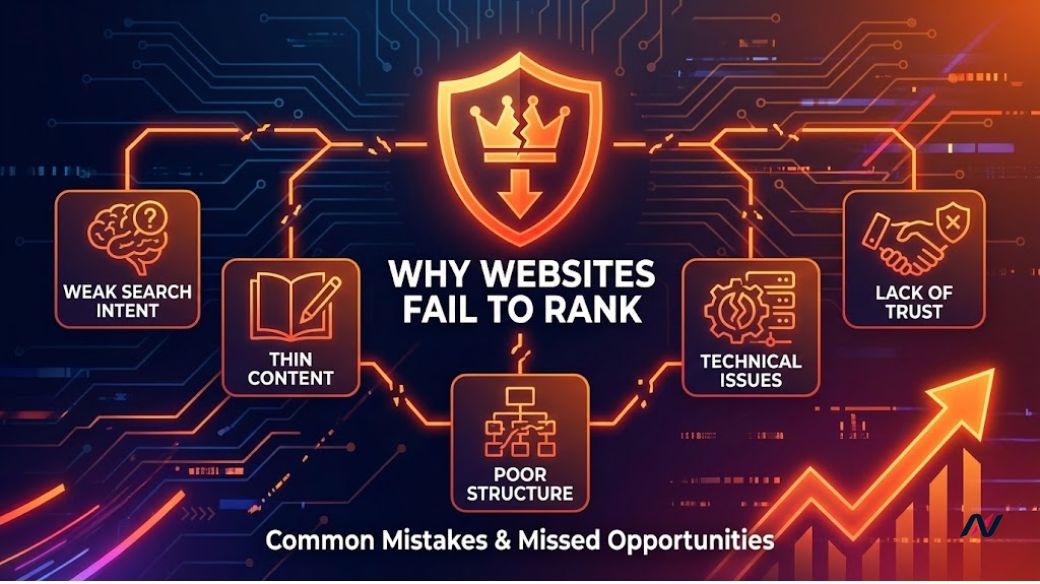
Most websites fail to rank on Google not because of a single mistake, but because of multiple small gaps that compound over time. Weak intent alignment, thin content, structural issues, technical barriers, and lack of trust quietly limit performance.
Ranking success comes from understanding how search engines evaluate relevance and credibility—and building websites that genuinely serve users. When clarity, consistency, and trust guide SEO efforts, rankings become a natural outcome rather than a constant struggle.