


Quick disclosure before we get into this: we had an older version of this article on our blog. It was thin, repetitive, and honestly read like it was written to hit a word count rather than answer a real question — the kind of content Google has been actively de-ranking across the web over the last two years. We pulled it and rebuilt it from scratch, checked against what’s actually ranking for this topic right now, and checked against the current state of Google’s own algorithm rather than advice that’s been copy-pasted since 2022. Here’s what’s actually true about ranking on Google Maps in 2026.
First, a factual correction most articles still get wrong
If an article talks about “Google My Business” in the present tense, that’s your first sign it’s outdated. Google retired the Google My Business brand back in 2022 and folded it into what’s now called Google Business Profile (GBP). It’s a small naming detail, but it tells you something bigger: if a blog hasn’t caught up on the name, it almost certainly hasn’t caught up on the ranking factors either, and those have moved a lot more than the name.
The three things Google actually measures
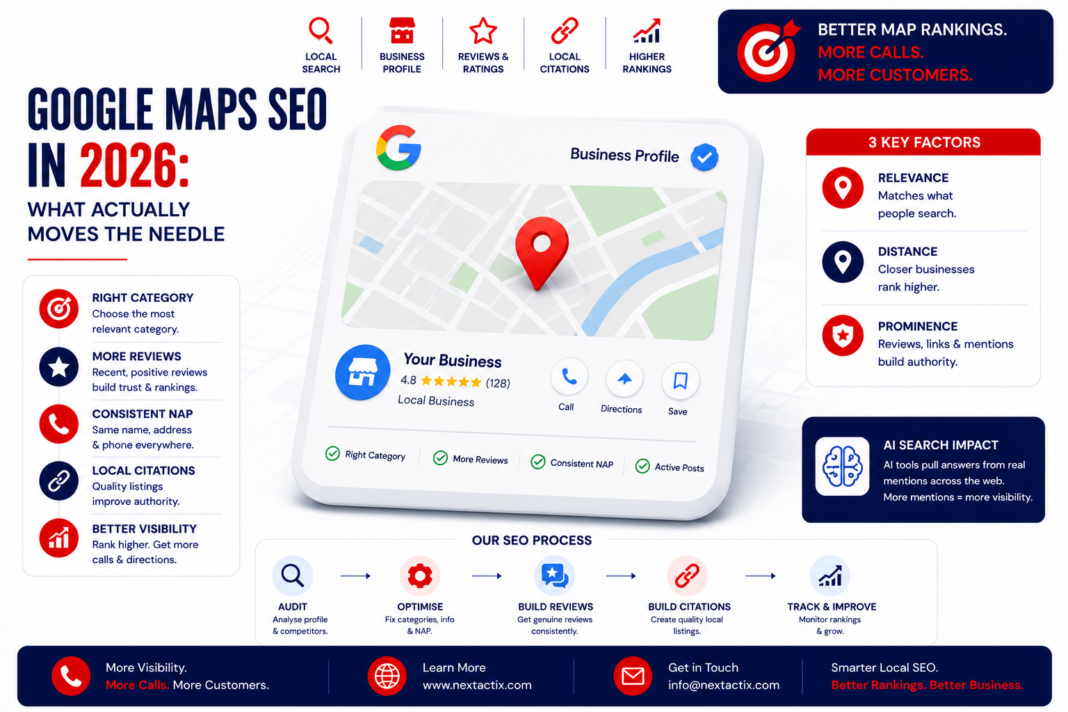
Strip away the jargon and Google Maps ranking comes down to three factors, and understanding them properly explains almost everything else in this article:
Relevance — does your business profile genuinely match what someone searched for. This is mostly decided by your category selection and how well your services and description describe what you do, in plain terms a customer would use.
Distance — how physically close your business is to the person searching. You can’t change your address to game this, but you can make sure Google has the correct one, and that it’s tagged accurately down to the exact building, not just the street.
Prominence — essentially, how well-known and trusted Google considers your business to be, based on reviews, links, citations, and general web presence.
A late-2021 update, generally referred to in the industry as the Vicinity update, pushed the weight of distance up significantly. In practice that means a mediocre business two streets away can now genuinely outrank a better-optimised one two miles away for the exact same search — which is a big shift from how things worked a few years ago, and it’s why obsessing over on-page tricks without checking your actual profile location and service area settings is often wasted effort.
Where the real ranking weight sits right now
Based on the most recent Whitespark local ranking factors survey, the majority of what decides your position in the local pack — a large majority — comes directly from your Google Business Profile itself, not your website. That’s worth sitting with for a second: a lot of businesses pour money into website redesigns while their actual GBP listing sits half-finished.
Inside that, here’s roughly how the weight breaks down:
- Primary category is the single heaviest lever on the entire profile. Picking “Contractor” when you should have picked “Kitchen Remodeler” is one of the most common, and most costly, mistakes we see when we audit a new client’s listing.
- Reviews — quantity, how recently they’ve come in, the actual keywords mentioned inside them, and whether the owner replies — account for a meaningful chunk of local pack ranking on their own, and businesses with 100+ reviews that consistently reply tend to outrank businesses with a similar review count that never respond.
- NAP consistency (Name, Address, Phone matching exactly everywhere you’re listed online) still quietly wrecks rankings when it’s wrong. Google cross-checks your details against hundreds of sources, and something as small as “St.” versus “Street” on one old directory listing can chip away at trust signals you don’t even know exist.
- Local backlinks and citations still matter, the same way they always have for organic SEO — Maps isn’t a separate universe.
- Behavioural signals — how often people click through, call, or request directions from your listing — feed back into the algorithm too, which is part of why photos, complete information, and an inviting profile aren’t just cosmetic.
The new factor most agencies aren’t talking about yet
Here’s the part that’s genuinely new for 2026, and most competing articles on this topic haven’t caught up on it: unstructured business mentions — meaning your business being talked about naturally on forums, local news, community pages, and social platforms, without a direct link back to your site — now factor into how visible you are in AI-powered search results, and that signal is climbing fast in importance. This connects directly to how Google’s AI Overview and Search Generative Experience pull information: instead of just crawling your GBP fields, these systems are increasingly synthesising an answer from everything genuinely being said about your business across the web. A profile stuffed with keywords but with zero organic mentions elsewhere looks thin to a system built to cross-reference multiple sources before trusting one.
What actually moves rankings, in order of effort-to-payoff
If you’re doing this yourself and want to know where to spend your first few hours, this is roughly the order we’d tackle it in for a new client:
- Fix your primary and secondary categories first. Search your main service on Maps, look at who’s already ranking in the top 10-20 results, and note which category comes up most often among them. That’s usually your correct primary category, not the one that sounded closest when you first set the profile up.
- Audit your NAP across the web. Search your business name and old phone numbers to find outdated directory listings still floating around, and correct or remove them.
- Build a review system, not a review request. A single ask after a sale converts far fewer reviews than a simple, consistent process — a text or email sent at the right moment, every time, works better than remembering to ask occasionally.
- Reply to every review, good and bad. This is one of the cheapest, most overlooked ranking actions available, and it costs nothing but a few minutes a week.
- Post to your profile weekly. Google Business Profile posts show up directly in search and Maps and expire after about a week for most post types, so consistency matters more than any single post being perfect.
- Get your website’s technical basics right. Page speed, mobile usability, and local business schema markup all feed into the same ecosystem — Maps and organic search aren’t as separate as people assume.
What we do differently when we run this for a client
We don’t treat Google Business Profile as a form you fill in once. We run it as an ongoing account: correcting category and NAP issues in week one, setting up a genuine review generation system rather than a one-off ask, building the specific local citations that carry weight for your industry and city, and layering in the on-page and technical SEO work that supports the profile rather than sitting disconnected from it. We also track your visibility inside AI Overview and similar tools now, since that unstructured-mention signal is only going to matter more from here, not less.
If you want an honest look at where your listing currently stands — categories, review health, NAP consistency, the lot — get in touch and we’ll run the audit before you spend a penny on anything else.