


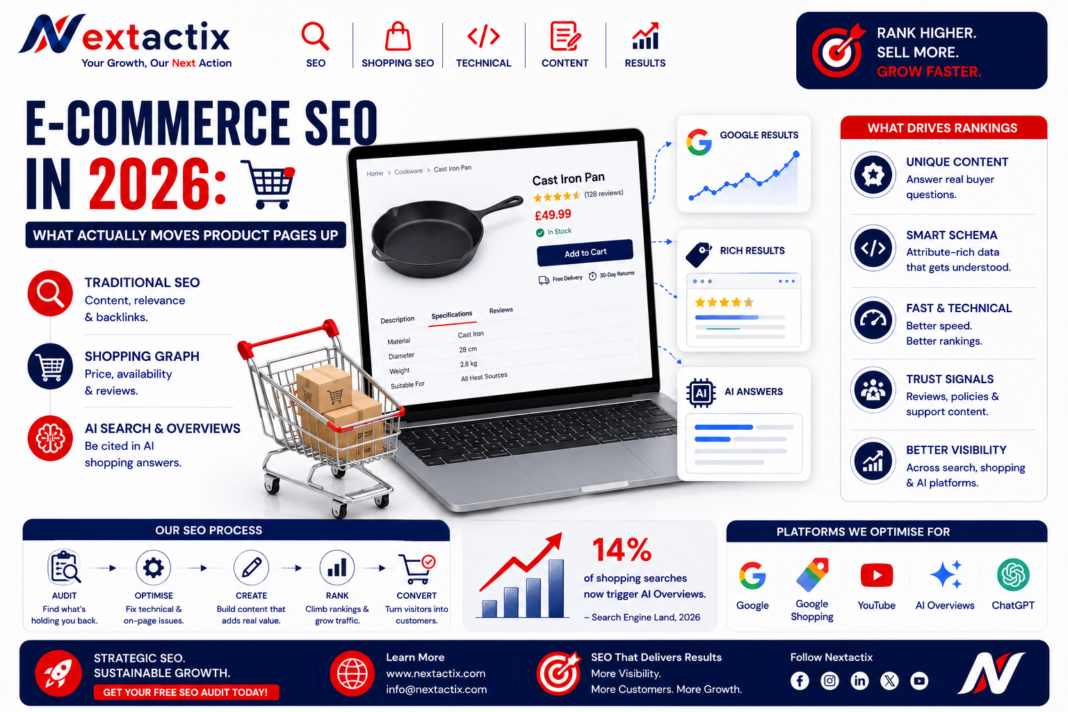
Open ten articles about e-commerce SEO this year and most of them will tell you the same three things: write unique descriptions, add schema, make the site fast. All true. None of it explains why two stores can do exactly that and still get completely different results.
The honest answer is that product-page SEO has split into three separate games running at once, and most stores are only playing one of them.
The Three Places a Product Page Gets Judged Now
The first is the one everyone already knows — the traditional organic result, where relevance, content depth, and backlinks still decide who ranks. The second is Google’s Shopping Graph, the system tracking price, availability, and reviews across roughly 45 billion product listings, which increasingly decides whether a product shows up in the shopping-specific results and rich snippets rather than a plain blue link. The third, and the one moving fastest, is AI Overviews and AI-generated shopping answers. Search Engine Land’s analysis of nearly 21 million shopping-related searches found AI Overviews appearing on about 14% of shopping queries by March this year, up from roughly 2% just four months earlier.
A page can win on one of these and lose on the other two. Good written content with no structured data behind it will rarely earn a rich result. Perfect schema on a page nobody would bother reading won’t get picked up as a citable source in an AI-generated answer. This is why some stores that were “doing SEO properly” a year ago are still watching a competitor pull ahead.
Product Schema Matters More Than It Used To, But Not Any Kind of Schema
Basic Product schema — a name, an image, a price — has become table stakes rather than an advantage. What seems to actually move the needle is what gets called attribute-rich schema: GTIN or MPN identifiers, a genuine brand node rather than just the manufacturer’s name, complete offer details including availability and shipping, and a structured spec table using additional property fields for things like dimensions or materials.
The reason this matters more now than it did two years ago is straightforward. AI systems building a shopping answer need to compare products against each other reliably, and thin, inconsistent schema makes that comparison harder to trust. A washing machine listing with a proper spec table is easier for an AI system to place next to a competitor’s listing and describe accurately than one with just a name and a price.
Content Still Has to Say Something New
The oldest trap in e-commerce SEO is still the most common one: taking the manufacturer’s product description, changing a few words, and calling it done. Search engines have gotten noticeably better at spotting this, and rewritten manufacturer copy with minimal added insight has been quietly losing ground in recent algorithm updates.
What tends to hold up is content that actually answers something the manufacturer’s copy doesn’t — who the product suits, what trade-offs a buyer should know about, what it’s commonly paired with, where it falls short compared to a similar option. That last point matters more than store owners expect. A product page willing to say “this isn’t the right choice if you need X” reads as more trustworthy, both to a shopper and, increasingly, to the systems deciding whether to cite the page at all.
A Realistic Example
Picture an independent homeware store selling kitchenware online, competing against both big retailers and a handful of similar boutique stores. Their product pages have decent photography and reasonably written descriptions, but traffic has been flat for a year.
A closer look usually finds the same pattern: product images are shot on plain white backgrounds, descriptions repeat spec-sheet information without answering anything a buyer would actually wonder about, and the schema only includes the bare minimum fields. Fixing this isn’t about rewriting everything at once. It starts with adding lifestyle photography — a cast iron pan shown actually on a stovetop rather than floating on white, since AI image models have been shown to read contextual product photos far more reliably than studio shots. It continues with rewriting a handful of the store’s best-selling product pages to include real buying guidance — which pan size actually suits a two-person household, what the seasoning process involves, how it compares to a cheaper alternative. And it means going back through the schema to add identifiers, a proper brand node, and genuine first-party reviews rather than an aggregated star rating pulled from elsewhere.
None of this is exotic work. It’s slow, unglamorous, page-by-page effort — which is exactly why most competitors haven’t done it yet.
The Part of the Page Most Stores Ignore Completely
A meaningful share of what gets cited in AI-generated shopping answers doesn’t come from the product page at all. Independent research tracking citations across several e-commerce categories found that support articles, size guides, return policies, and general buying-guide content made up a significant portion — often a fifth to nearly half, depending on the category — of the pages an AI system actually pulled from.
That’s a genuinely different way of thinking about content strategy. A store with a clear, well-written sizing guide, a straightforward returns policy page, and a handful of comparison or buying-guide articles is building the kind of supporting content an AI system can pull answers from when a shopper asks something the product page alone doesn’t cover — “what size should I get if I’m between sizes,” for instance.
Where Technical Work Still Pays Off
Large catalogues create their own problem: filters for colour, size, and price can generate thousands of near-duplicate URLs if the site’s architecture doesn’t handle it carefully, quietly burning through the crawl budget search engines allocate to a site. Fixing this — through proper canonical tags, careful faceted navigation rules, and a clean sitemap — doesn’t directly help AI citability much, but it protects the traditional organic side of the equation, and it’s usually cheaper to solve early than to unpick later once a catalogue has grown into the tens of thousands of pages.
Page speed still matters too, particularly on mobile, where a slow-loading product page loses shoppers before they ever see the content worth reading.
Getting the Order Right
Stores with limited time and budget generally get more from fixing schema and rewriting weak content first, since those changes affect both traditional rankings and AI citability. The larger technical projects — Core Web Vitals work, faceted navigation cleanup — are worth doing, but they mostly protect the organic side rather than accelerating AI visibility, so they’re usually the second wave of work rather than the first.
Frequently Asked Questions
Does adding schema markup directly improve product page rankings? Not on its own. Schema mainly unlocks rich results and shopping features, and increasingly supports AI citability by making product data easier to compare, but it isn’t treated as a direct ranking signal by itself.
How long does e-commerce SEO take to show results? Technical fixes like schema and page speed can show measurable change within weeks. Content-driven ranking improvements typically take three to six months. Visibility inside AI-generated answers can shift faster, sometimes within a couple of months, as AI systems re-crawl and update their sources.
Is AI-generated shopping content actually replacing traditional product search? Not entirely, but it’s taking a growing share. AI Overviews now appear on a meaningful percentage of shopping searches, and that share has grown quickly over the past year, so a store relying purely on traditional rankings is missing a real and growing part of the picture.
Do small or independent stores stand a real chance against big retailers in AI search? In some ways, a better one than in traditional search. AI systems tend to reward specificity and genuine expertise, which a smaller store with deep knowledge of its niche can often demonstrate more convincingly than a large retailer selling thousands of unrelated categories.
What should a store with limited resources fix first? Product schema and the weakest-performing product descriptions, since both affect traditional rankings and AI visibility at once. Larger technical projects like Core Web Vitals and faceted navigation cleanup are worth scheduling next, once the immediate content and data issues are addressed.