

If you have searched anything on Google lately, you have probably noticed something different. Above the usual list of websites, there is now a written summary that answers your question directly. You read it, you get your answer, and sometimes you never click on a single website at all.
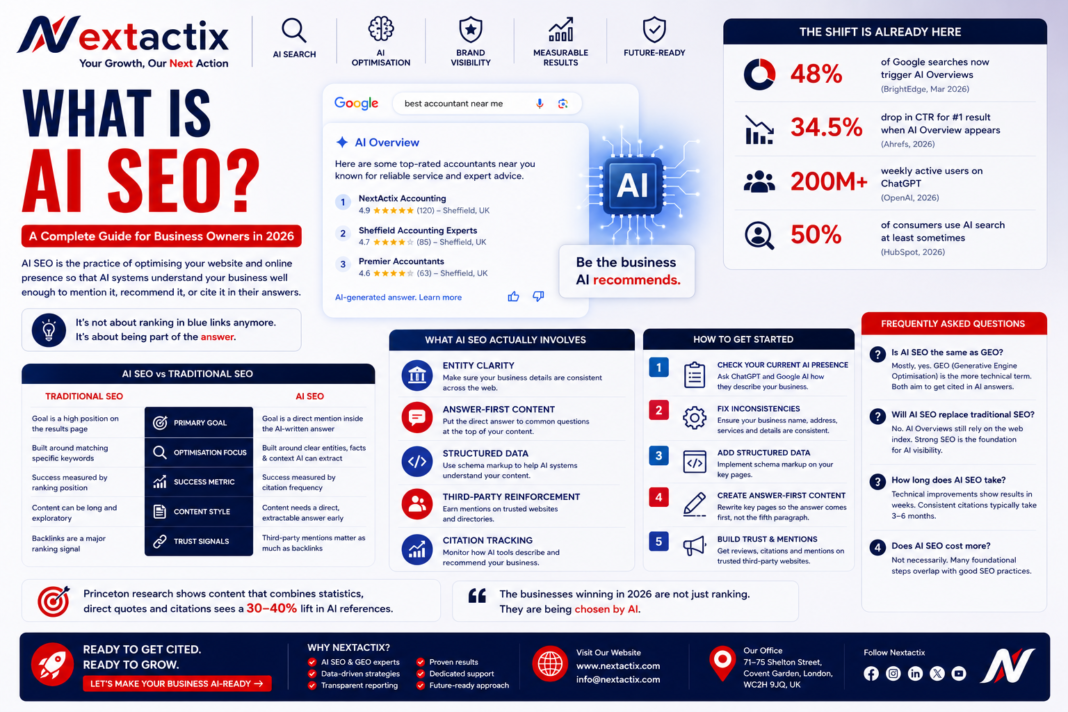
That summary is called an AI Overview, and it now appears on roughly 48% of tracked Google searches, according to BrightEdge’s industry tracking through March 2026 — a 58% increase from the year before. For some topics like health and education, that number climbs closer to 80%.
This single change has quietly rewritten the rules of online visibility. Ranking first on Google used to be the finish line. Now it is just one part of a bigger picture. AI SEO is how businesses are adapting to that bigger picture, and this guide explains exactly what it means, in plain words, with no jargon.
AI SEO, Defined Simply
AI SEO is the practice of optimising your website and online presence so that AI systems — including ChatGPT, Google’s AI Overviews, Gemini, and Perplexity — can understand your business well enough to mention it, recommend it, or cite it when someone asks a relevant question.
Think of it this way. Traditional SEO tries to win a spot among ten blue links on a results page. AI SEO tries to win a spot inside the actual sentence the AI writes back to the user. One is about being listed. The other is about being quoted.
This is not a replacement for normal SEO. It builds directly on top of it. The same things that make your website trustworthy and easy to understand for Google also make it easier for AI systems to read, trust, and cite. AI SEO simply adds a second, more specific layer of work on top of the SEO foundation you likely already have.
Why This Matters Right Now
The numbers explain the urgency better than any opinion could. A few data points worth sitting with:
- AI Overviews now appear on approximately 48% of tracked Google searches as of March 2026, according to BrightEdge’s nine-industry tracker.
- When an AI Overview is present, the average click-through rate on the number one organic result drops by 34.5%, based on Ahrefs’ analysis of 300,000 keywords.
- ChatGPT alone now handles over 200 million weekly active users, many of whom are using it the way they used to use a search engine.
- Roughly 50% of consumers now use AI-powered search at least sometimes, according to HubSpot’s 2026 State of Marketing report, and 44% say it is their primary tool for discovering new products.
Put simply, a meaningful and growing share of your potential customers are no longer scrolling through search results. They are reading a single AI-generated answer and deciding what to do next based on what that answer says. If your business is not part of that answer, you are invisible to that entire group of people, regardless of how well you rank in the old-fashioned sense.
How AI SEO Is Different From Regular SEO
| Traditional SEO | AI SEO |
| Goal is a high position on the results page | Goal is a direct mention inside the AI-written answer |
| Built around matching specific keywords | Built around clear entities, facts, and context AI can extract |
| Success measured by ranking position | Success measured by citation frequency |
| Content can be long and exploratory | Content needs a direct, extractable answer near the top |
| Backlinks are a major ranking signal | Third-party mentions and brand consistency matter just as much as links |
One especially useful fact comes from Princeton University’s GEO research: content that combines clear statistics, direct quotations, and citations together drives a 30 to 40% lift in how often it gets referenced by AI systems. That is a concrete, testable thing you can apply to your own content starting today.
What AI SEO Actually Involves
In practice, AI SEO work usually covers five areas:
- Entity clarity — making sure your business name, location, services, and key facts are described consistently everywhere online, so AI systems form one clear, confident picture of who you are.
- Answer-first content structure — writing the direct answer to a question in the first sentence or two after a heading, rather than building up to it slowly.
- Structured data (schema markup) — adding behind-the-scenes code that explicitly labels your content as an FAQ, a service, a review, or an organisation, so AI systems do not have to guess.
- Third-party reinforcement — getting your business mentioned accurately on other trusted sites, since AI tools weigh outside confirmation heavily, not just your own claims about yourself.
- Citation tracking — regularly checking how AI tools currently describe your business, so you know whether you are gaining or losing ground.
A Quick Example
Imagine two accounting firms in the same city. Both have decent websites and rank on page one of Google for “accountant near me.”
Firm A has a wall of text describing their history and values. Firm B has a clearly structured FAQ section that says, in the very first line, exactly what services they offer, their typical pricing range, and which industries they specialise in — all backed by FAQ schema markup.
When someone asks ChatGPT or Google’s AI Overview to recommend an accountant, Firm B’s content is far easier for the AI to extract and summarise confidently. Firm A might still rank fine on Google. But Firm B is the one more likely to get named in the answer. That gap is the entire idea behind AI SEO.
Is AI SEO Only for Big Companies?
No, and this is an important point. Several studies, including Princeton’s GEO research, found that smaller and lesser-known sources actually benefit the most from AI optimisation techniques, because they have the most ground to gain. Large, already-famous brands tend to get cited regardless. Smaller businesses that do the structural work properly can close that gap faster than they could ever close a traditional Google ranking gap against a national competitor.
Getting Started
If you want to know where your business currently stands, the simplest first step is checking how AI tools describe you right now. Ask ChatGPT a question your customers would ask, in your industry and city, and see whether your business comes up. Then do the same with Google’s AI Overview. Whatever the answer says — or does not say — about you is your starting point.
From there, the priority order is usually: fix any glaring inconsistencies in how your business is described online, add clear structured data to your most important pages, and rewrite your top content so the answer appears in the first sentence, not the fifth paragraph.
Frequently Asked Questions
Is AI SEO the same as GEO?
Mostly, yes. GEO (Generative Engine Optimisation) is the more specific term used in research circles for getting cited inside AI-generated answers. AI SEO is the broader, more commonly searched term that covers the same idea. Most agencies, including ours, use the terms interchangeably in casual conversation.
Will AI SEO replace traditional SEO?
No. AI Overviews and chat tools still rely heavily on the existing web index. A site with poor technical SEO and weak content will struggle in both traditional and AI search. AI SEO adds to your SEO work, it does not replace it.
How long does AI SEO take to show results?
Technical fixes like schema markup can influence how AI reads your site within weeks. Consistent citations inside AI answers typically take three to six months to build, similar to the pace of traditional SEO.
Does this cost more than regular SEO?
It depends on your starting point. Many of the foundational steps, like fixing inconsistent business information and adding schema, overlap with good traditional SEO work and do not require a separate budget.