


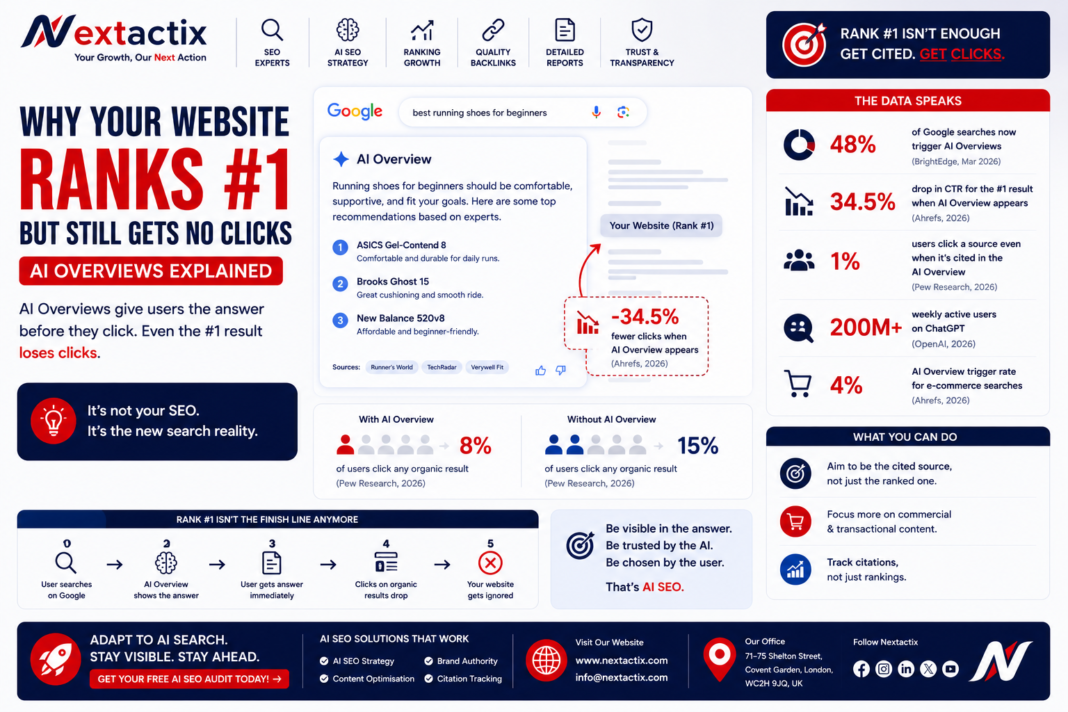
It is one of the most frustrating moments in modern SEO. You check Google Search Console, and there it is — your page sitting in position one for a keyword you have worked hard to earn. Impressions are healthy. But the click count next to it barely moves.
If this sounds familiar, you are not imagining it, and you have not done anything wrong. This is happening to thousands of websites right now, and there is a specific, well-documented reason for it: Google’s AI Overviews.
What Is Actually Happening
An AI Overview is the written summary Google now places above the normal list of search results for many queries. Instead of clicking through ten different websites to piece together an answer, the user reads a short, AI-generated paragraph and often stops there.
Pew Research Center studied this directly, tracking 68,879 real Google searches. The finding was stark: when an AI Overview is present, users click through to any organic website in just 8% of visits. When there is no AI Overview, that number rises to 15%. A single feature on the results page nearly cut click behaviour in half.
Even more strikingly, the same study found that users clicked on a source that was actually cited inside the AI Overview itself only 1% of the time. People read the citation, trust it enough to act on the information, and simply do not feel the need to click through and verify it themselves.
The Numbers, Across Multiple Studies
Different research teams have measured this from different angles, and while the exact percentages vary by methodology, they all point the same direction:
| Study | Finding |
| Ahrefs (300,000 keywords) | Position 1 CTR drops 34.5% when an AI Overview appears |
| Pew Research (68,879 queries) | Organic clicks drop from 15% to 8% with an AI Overview present |
| Seer Interactive (2.43B impressions) | Organic CTR fell from 1.76% to as low as 0.61% on AI Overview queries before partially recovering |
| Amsive Digital (700,000 keywords) | A more conservative 15.5% average CTR decline |
Figures compiled from publicly published 2025–2026 studies by Ahrefs, Pew Research Center, Seer Interactive, and Amsive Digital.
Here is the detail that matters most for your strategy going forward: Seer Interactive’s longitudinal data found that brands actually cited inside the AI Overview earned roughly 120% more organic clicks per impression than brands that were not cited, even on the exact same search results page. Being cited does not fully restore your old click volume, but it puts you in a meaningfully better position than being left out entirely.
Why This Hits Some Pages Harder Than Others
AI Overviews are not evenly spread across every type of search. They overwhelmingly trigger on informational queries — questions, explanations, comparisons, and “how to” content. One large-scale study found that 88% of keywords that trigger AI Overviews are informational in intent.
Transactional searches like “book a table near me” or “buy running shoes online” rarely trigger an AI Overview at all. E-commerce product searches sit at roughly 4% trigger rate, down sharply from when AI Overviews first launched. So if your traffic loss is concentrated on blog posts, guides, and explainer content rather than your service or product pages, that pattern lines up exactly with what the data predicts.
What You Can Actually Do About It
There is no way to opt out of AI Overviews appearing on relevant searches. But there are three practical responses that change your position within this new reality, rather than fighting against it.
1. Try to become the cited source, not just the ranked one
Content that is clearly structured, directly answers the question in the first sentence, and backs claims with specific data is far more likely to be the source the AI Overview actually quotes. Being cited, as shown above, recovers a meaningful share of the clicks you would otherwise lose entirely.
2. Shift effort toward commercial and transactional content
Since AI Overviews rarely appear on transactional searches, your product pages, service pages, and location pages are still a relatively safe and high-value place to invest content effort. The purely informational blog post that used to reliably bring in traffic is the category under the most pressure.
3. Track citations as a real metric, not just rankings
Ranking position alone no longer tells the full story. Start regularly checking whether your brand is mentioned inside AI Overviews and chat tool answers for your most important search terms, separately from your normal rank tracking.
A Realistic Way to Think About This
It is tempting to read these numbers and panic, but the more useful framing is this: search did not shrink, it changed shape. People are still asking the same questions and still making the same decisions. The difference is where that decision-making conversation now happens. Adjusting your content and tracking to meet people in that new conversation is the actual fix, not waiting for the old click volume to come back on its own.
Frequently Asked Questions
Will my traffic ever recover?
Some recovery is already visible in the data. Seer Interactive recorded organic CTR on AI Overview queries climbing from a low of 1.3% in December 2025 to 2.4% by February 2026, an 85% jump in two months. But this is a partial rebound, not a full return to pre-AI Overview levels.
Does this affect every industry equally?
No. Verticals with heavy informational search behaviour, such as health, education, and general research, see AI Overviews on closer to 80% of queries. E-commerce and highly transactional categories are affected far less.
Should I stop writing blog content altogether?
No, but it is worth being more selective. Original research, unique data, and genuinely useful comparison content still perform well and are more likely to be the cited source rather than the bypassed one.
How do I check if I am being cited inside an AI Overview?
Search your own target keywords directly and read the AI Overview text carefully to see whether your brand or domain is named or linked as a source. There are also paid tools emerging specifically to track this at scale.