


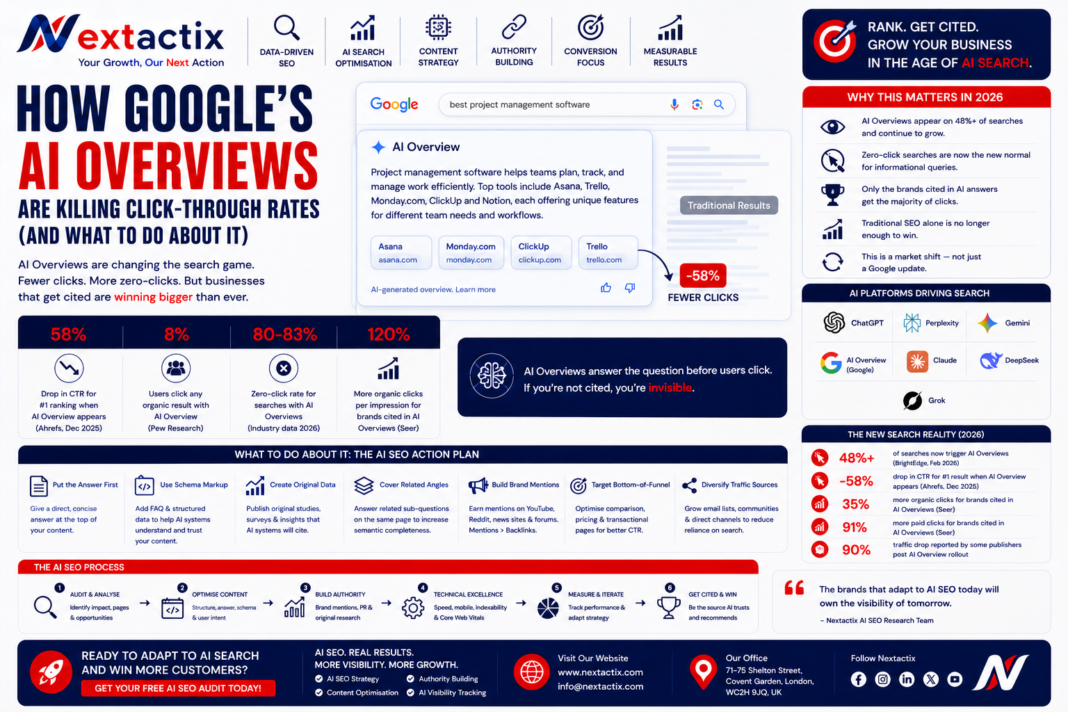
Here’s a strange thing that’s happening to website owners right now: their Google Search Console impressions are going up. Their rankings haven’t moved. And their actual traffic is falling off a cliff.
If that sounds familiar, you’re not imagining it, and you’re not alone. There’s even a name for it now in the SEO world — “the Great Decoupling.” It describes the moment when impressions keep climbing while clicks fall away, because Google is showing your page in an AI Overview, counting that as an impression, and then answering the question itself before anyone reaches your site.
This article walks through the actual numbers behind this shift, shows you how to check whether it’s happening to your own website right now, and then gets into what genuinely works as a response — not vague “embrace AI” platitudes, but specific moves backed by real recovery data.
The Numbers Are Worse Than Most Businesses Realise
Let’s start with what’s actually been measured, because the scale of this shift tends to surprise even people who’ve been paying attention.
Ahrefs gathered data in December 2025 and found that when an AI Overview appears above the search results, the page ranking in position one — historically the most valuable spot in all of search — loses 58% of its expected clicks. That’s more than half the traffic a top-ranked page would normally pull in, gone, with the ranking itself unchanged.
Pew Research Center backed this up from a different angle. Tracking 68,000 real searches, they found that when an AI Overview shows up, people click on an organic result only 8% of the time. Without one, that number is 15%. A single feature on the page nearly cut click behaviour in half.
For queries where an AI Overview actually appears, things get more extreme still. Industry tracking now puts the zero-click rate for those specific searches somewhere between 80% and 83%. In plain terms: for four out of five searches where Google decides to show an AI summary, the person gets their answer and leaves without visiting a single website — yours or anyone else’s.
And some individual publishers have reported damage well beyond the average. DMG Media — which owns MailOnline and Metro — told the UK’s Competition and Markets Authority that click-through rates dropped by as much as 89% on certain searches once an AI Overview appeared. Their desktop CTR reportedly fell from 25.23% down to 2.79% on affected queries, with mobile traffic down a similar amount.
This isn’t a one-off. A separate tracking analysis of ten major tech and media outlets found that combined US Google search referrals for those sites fell from 112 million to 50 million visits a month between early 2024 and January 2026 — a drop researchers described as one of the clearest signs yet that AI Overviews represent a structural, not temporary, shift in how search sends traffic.
This Has Gotten Big Enough to End Up in Court
It’s worth knowing the wider context here, because it tells you this isn’t a minor SEO inconvenience — it’s reshaping the economics of the entire web.
Penske Media filed an antitrust claim against Google over exactly this issue, arguing that AI Overviews broke the long-standing exchange where Google indexed a publisher’s content in return for sending it traffic. Google has tried three times to get that case dismissed, most recently in January 2026, arguing that AI Overviews are simply a lawful product improvement, not anti-competitive behaviour. Chegg filed a separate antitrust suit making a similar argument the year before.
Whichever side of that legal argument you find convincing, the underlying business reality is the same for the rest of us: large, well-resourced publishers are spending real money on lawyers specifically because this traffic loss is severe enough to threaten their business models. The travel blog The Planet D told Bloomberg it lost half its traffic in the months after AI Overviews rolled out, laid off staff trying to absorb the hit, and then lost another 90% on top of that. Conversation around Condé Nast’s 2025–2026 staff reductions has also pointed to search traffic decline as a contributing factor.
If outlets with dedicated SEO teams and legal departments are struggling to absorb this, it’s worth taking seriously as a small or mid-sized business, even if your scale is completely different.
How to Check If This Is Happening to You
Before you do anything else, confirm whether AI Overviews are actually the cause of any traffic drop you’re seeing — because the fix is different depending on what’s really going on.
Open Search Console and look for this specific pattern: impressions flat or rising, clicks falling, and average position roughly unchanged. That divergence — sometimes called the Great Decoupling — is the signature of an AI Overview intercepting your traffic rather than a genuine ranking loss. If impressions and clicks are falling together, you’re more likely looking at an algorithm update, a technical issue, or lost backlinks, and the fix needs to be different.
It also helps to know which of your pages are most exposed. Informational, how-to, and simple comparison content takes the heaviest hit, because that’s exactly the type of question an AI Overview is built to answer directly. Transactional searches, “near me” searches, and anything with strong local or commercial intent are noticeably more resistant, because an AI summary genuinely can’t complete a purchase, book an appointment, or finalise a quote on someone’s behalf.
The Part Most Articles on This Topic Leave Out
Here’s the detail that changes the whole picture, and it’s the reason this article isn’t just bad news: getting cited inside an AI Overview is genuinely valuable, even though appearing in one at all used to feel like pure loss.
Seer Interactive’s research found that brands cited inside an AI Overview earn 35% more organic clicks and 91% more paid clicks than competing brands sitting in position one underneath that same AI answer. A separate piece of their research, published in April 2026, measured the gap even wider — 120% more organic clicks per impression for cited brands compared to brands that weren’t mentioned at all.
So the honest summary of where things stand in 2026 isn’t “AI Overviews are killing all traffic everywhere.” It’s narrower and more useful than that: AI Overviews are killing traffic for businesses that aren’t the one being cited, while quietly rewarding the businesses that are. The traffic hasn’t vanished completely — it’s been redistributed toward whoever the AI decides is the most trustworthy, well-structured, clearly written source for that specific question.
That’s a fight you can actually compete in.
What Actually Works: A Realistic Recovery Plan
There’s a lot of recycled advice circulating about this topic, much of it vague. Here’s what the better, more specific data actually supports.
Restructure your most important pages so the answer comes first. AI systems extract information from the parts of a page that answer the question most directly and most quickly — burying your answer under three paragraphs of brand history is a habit worth dropping immediately, on every page that matters.
Add structured data, specifically FAQ schema, to your key pages. Multiple 2026 recovery studies point to schema markup as one of the highest-leverage technical fixes available, with some agencies reporting CTR recovery in the 45%-plus range on pages where it was properly implemented. It doesn’t guarantee a citation, but it makes your content dramatically easier for an AI system to parse and extract cleanly.
Shift more of your content investment toward bottom-of-funnel pages. Comparison pages, pricing pages, and anything close to an actual buying decision hold their value far better than top-of-funnel explainer content, because an AI Overview can summarise a definition perfectly well but can’t replace a genuine sales conversation or a side-by-side comparison built on your own client experience.
Build channels Google doesn’t control. Email lists, WhatsApp communities, and a direct-to-customer relationship don’t disappear when a SERP feature changes. Several recovery case studies from 2026 point to diversifying traffic sources as the single most durable response — not because it replaces search traffic, but because it stops one company’s product decision from being able to wipe out your entire customer pipeline overnight.
Pursue digital PR and original research over generic link-building. A survey of more than 500 SEO professionals in 2026 found that publishing proprietary studies, benchmark reports, or original datasets was rated the most effective tactic for earning new links and citations — because other sites and AI systems alike need somewhere to point when they reference a number, and a unique stat from your own business is exactly the kind of thing that gets borrowed and credited.
Treat the loss as a 60 to 120 day project, not an overnight fix. Realistic recovery playbooks consistently set this kind of timeframe. You won’t win back every click you lost, and some of those clicks were never worth much to begin with — the realistic goal is recovering the clicks that matter: the ones from people who were actually going to become customers, not the ones who just wanted a quick definition.
The Honest Bottom Line
AI Overviews have genuinely changed how much traffic a top Google ranking is worth, and the data on that point isn’t in dispute anymore — it’s been measured from too many directions, by too many independent researchers, to argue otherwise. But “less traffic from ranking alone” is not the same as “no path forward.” The businesses absorbing this best are the ones who’ve stopped treating position one as the goal and started treating the AI’s actual answer as the real prize — restructuring their content to be the thing that gets quoted, not just the thing that used to get clicked.
If you’re not sure whether your own traffic drop is coming from AI Overviews specifically, or from something else entirely, that diagnosis is worth getting right before you change anything on your site.