

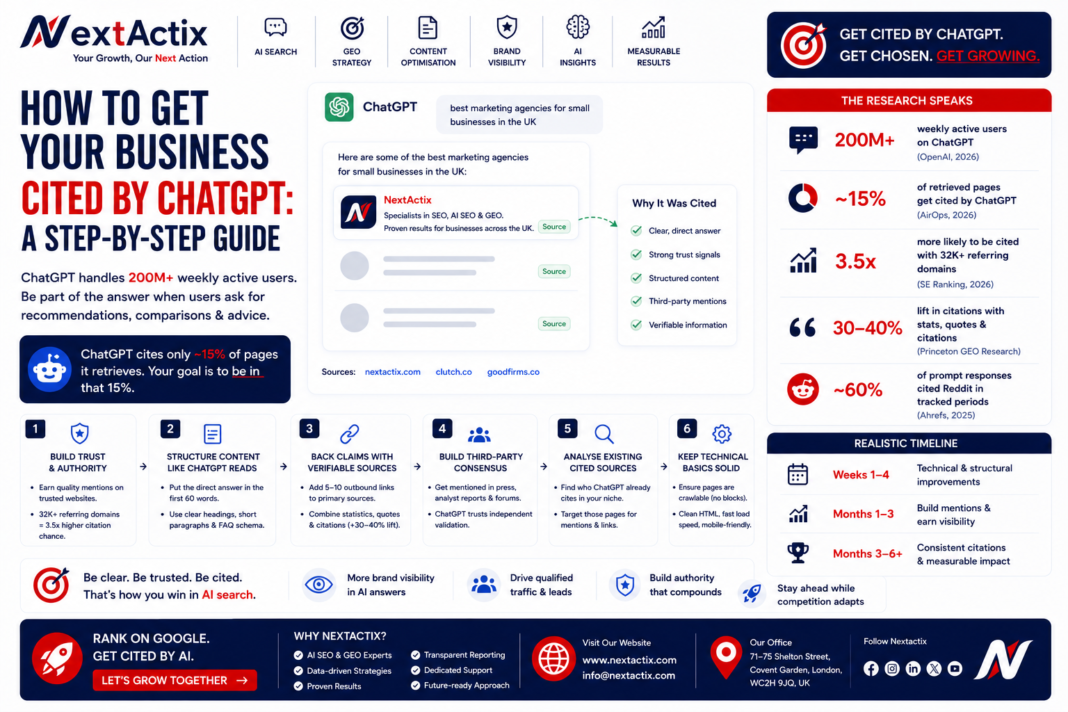
ChatGPT now handles over 200 million weekly active users, and a growing share of them are using it the way they used to use Google — asking for recommendations, comparisons, and advice. If your business is never mentioned in those conversations, you are losing a real and growing source of attention, regardless of how well you do anywhere else.
The good news is that ChatGPT’s citation behaviour has been studied extensively over the past year, and the patterns are clear enough to act on. This guide walks through exactly what the research shows, step by step.
Understand the Odds You Are Working With
Before changing anything, it helps to understand the baseline. An AirOps study analysing 548,534 pages across 15,000 prompts found that ChatGPT cites only about 15% of the pages it retrieves and considers. Separately, a 2026 analysis of more than 34,000 AI responses found ChatGPT names a specific brand in only around 0.59% of responses overall, compared to roughly 13% for Perplexity in the same dataset.
This tells you something important: getting cited by ChatGPT specifically is harder and more selective than other AI platforms, which makes the structural fixes below worth doing properly rather than half-heartedly.
Step 1: Build a Genuine Trust Threshold
SE Ranking’s analysis of 400,000 URLs found a striking pattern. Sites with over 32,000 referring domains were roughly 3.5 times more likely to be cited by ChatGPT than lower-authority sites. Sites with fewer than 2,500 referring domains averaged just 1.6 to 1.8 citations, while sites above 350,000 referring domains averaged 8.4.
This does not mean small businesses are locked out — interestingly, 77% of all cited sources in one large analysis had a domain authority under 50, showing that raw authority is not the only path in. But it does mean that earning genuine mentions on other trusted websites, rather than relying purely on your own site’s content, is one of the highest-leverage moves available.
Step 2: Structure Content the Way ChatGPT Actually Reads It
Research consistently points to the same structural pattern winning citations:
- A direct, standalone answer within the first 60 words of the relevant section
- Short paragraphs, typically two to four sentences
- Clear H1, H2, and H3 headings that match the way real people phrase questions, not stiff keyword phrases
- FAQPage and Article schema markup applied correctly
One useful, concrete tip from current B2B research: write your headings the way a person would actually type into ChatGPT. “How much does a website redesign cost in 2026?” reflects real usage. “website redesign cost” does not, and reads as a keyword fragment rather than a real question an AI model is trying to answer.
Step 3: Back Every Claim With Something Verifiable
Princeton University’s GEO research found that combining citations, statistics, and direct quotations together drives a 30 to 40% lift in how often content gets referenced by generative AI systems. The mechanism makes sense once you think about it — an AI model is more confident citing a claim that already points to its own primary source, because that reduces the model’s own risk of repeating something false.
A practical target worth aiming for: include five to ten outbound links per long-form page to primary sources — official documentation, government data, original research, or recognised industry bodies — rather than relying purely on your own unsupported assertions.
Step 4: Build Real Third-Party Consensus
ChatGPT often credits the publication that independently verified a claim, not the original business making the claim about itself. This is why earning analyst mentions, press coverage, and consistent factual references across multiple credible sites matters more here than it ever did for classic SEO.
Community platforms deserve particular attention. Reddit and Wikipedia have remained two of ChatGPT’s most heavily cited domains, with Reddit appearing in close to 60% of prompt responses in some tracked periods before a brief adjustment in late 2025. Authentic participation in relevant community discussions, where real questions get real answers involving your brand, compounds over time in a way a single piece of owned content cannot replicate.
Step 5: Find Out Exactly Who ChatGPT Already Trusts in Your Category
This is one of the most underused tactical moves available. Search your most important category prompts — “best [your category] tools,” “[competitor] alternatives,” common comparison questions your customers ask — directly inside ChatGPT, Perplexity, and Google’s AI Mode. Note exactly which domains and specific URLs get named as sources.
Those specific pages are now your most valuable outreach targets. A mention on a roundup article that ChatGPT already actively pulls from is worth significantly more than a generic backlink from a site ChatGPT never references at all.
Step 6: Keep the Technical Basics Solid
None of the above matters if a crawler cannot reach or properly parse your page in the first place. Confirm your site is not accidentally blocking GPTBot or other AI crawlers in your robots.txt file, and that your pages load cleanly without depending entirely on JavaScript to render the core content.
Putting It Together: A Realistic Timeline
None of these steps produce overnight results. Expect technical and structural fixes to take effect within a few weeks, third-party mention building to take one to three months to show movement, and consistent, repeatable citation behaviour to build over three to six months of sustained effort. This mirrors the pace of solid traditional SEO work, not a faster shortcut around it.
Frequently Asked Questions
Does paying for ads help get cited by ChatGPT?
No. ChatGPT’s citation behaviour is based on retrieval and trust signals, not advertising spend. There is currently no paid mechanism to directly buy a citation.
Is it worth blocking ChatGPT’s crawler if I do not want to be cited?
Generally no. Blocking AI crawlers offers minimal protection since major models are already trained on large portions of the existing internet, and blocking simply removes your chance of being cited going forward without meaningfully protecting your content.
Does ChatGPT cite the same sources every time for the same question?
No. ChatGPT’s responses vary because the underlying models are predictive rather than deterministic, which is one reason researchers test prompts at scale rather than relying on a single result.
How is this different from getting cited in Google’s AI Overview?
They overlap in some principles, like clear structure and good schema, but the retrieval mechanics differ. Google’s AI Overview leans heavily on the existing organic search index, while ChatGPT combines training knowledge with live retrieval through Bing for many queries.