

A client called us a few months ago with a question we had been hearing more often. She typed her service category into ChatGPT, asked for recommendations, and her business — which she had spent three years building and ranking on Google — did not appear. A competitor she knew was spending half what she was on marketing came up first.
She assumed it was a glitch.
It was not. And the reason behind it is something a lot of business owners are only beginning to understand.
Google Rankings and ChatGPT Recommendations Are Two Different Things
This is the part that catches most businesses off guard. The instinct is to assume that if you rank on page one of Google, the AI will pick you up automatically. It makes sense on the surface — Google feeds data into many systems, so surely it feeds into this one too.
But ChatGPT does not rank websites. It does not produce a list of links for a user to evaluate. What it does is assemble a short, confident answer — usually naming two or three businesses — based on everything it has learned about your category. If you are not part of what it has learned, you are not in that answer. There is no page two.
That distinction matters enormously, because the signals that determine your position on Google and the signals that determine whether ChatGPT recommends you are genuinely different systems, reading different evidence, producing different outcomes.
SOCi’s 2026 Local Visibility Index looked at nearly 350,000 business locations and found that while 35.9% of them appeared regularly in Google’s local results, only 1.2% were recommended by ChatGPT. Read that again. The businesses winning on Google were not the ones the AI was putting forward. Almost half of the top performers in Google local results were absent from AI recommendations entirely.
What ChatGPT Actually Looks For
The AI is not reading your website the way a search engine crawler does. It is synthesising everything it has encountered about you — or, more specifically, everything it has encountered about businesses in your category, in your location, and it is asking itself a quiet question: how confident am I that this business is a real, legitimate, trusted option?
That confidence comes from one thing more than anything else: how consistently and how credibly other sources talk about you.
AI doesn’t discover new brands — it selects from known entities. If the model hasn’t been taught who you are through independent sources, you simply don’t exist at the moment someone asks.
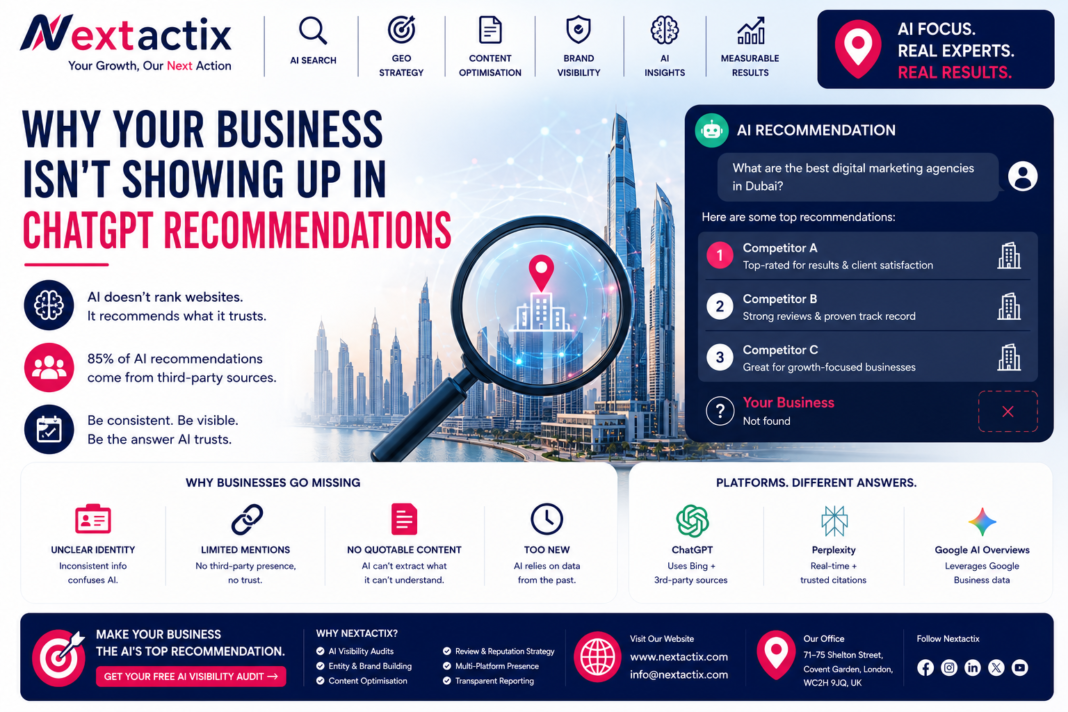
Your website is your own content. ChatGPT treats that differently from what other people say about you. It is looking for corroboration — mentions on industry publications, reviews on platforms it trusts, directory listings where your details are consistent, forum discussions, podcast appearances. Research from AirOps found that 85% of brand mentions in AI answers come from third-party pages, not brand-owned content. Your homepage is the least powerful signal you have with an AI.
The Four Reasons Businesses Go Missing
Your brand doesn’t have a clear identity across the web
ChatGPT builds what researchers call an entity profile — its internal understanding of who you are and what you do. If your business is listed as a ‘marketing agency’ on your website, a ‘creative studio’ on LinkedIn, a ‘digital consultant’ on a directory, and a ‘growth partner’ on a review platform, those inconsistencies make the AI uncertain. When it is uncertain about you, it defaults to a competitor whose identity is sharper and more consistent. Vague positioning punishes you here in a way it never did on Google.
Your business has limited third-party presence
This is the most common root cause. If your brand primarily exists in content you control — your own website, your own blog, your own social profiles — then the AI has very little independent evidence to draw on. A business that has been mentioned in five industry roundups, reviewed on Trustpilot, cited in a local newspaper, and discussed in a relevant Reddit thread is a business the AI can confidently recommend. A business that exists only on its own site, however well-built that site is, gives the model almost nothing to verify against.
Your content doesn’t give the AI anything to quote
AI engines need to be able to extract a specific, citable answer from your content. If your homepage says you are ‘passionate about delivering results for ambitious businesses’ — which is a sentence that could belong to any of ten thousand agencies — there is nothing specific enough to pull into an answer. The businesses that consistently get recommended have content that answers concrete questions directly: what exactly you do, who exactly you serve, where you serve them, and what specifically makes you different. Clarity is a ranking signal in AI search.
Your content is too new or your niche lacks coverage
Industry data suggests that 71% of citations in ChatGPT come from content published between 2023 and 2025. If you were not building external presence during that window, competitors who were are now part of the model’s foundation in a way that takes time and sustained effort to match. This is not a reason to give up — it is a reason to start now rather than later, because the businesses investing in AI visibility today are building exactly the kind of structural advantage that will be hard to erode.
A Simple Test You Can Run Right Now
Open ChatGPT — not Google, not Bing, ChatGPT specifically — and type the query a potential customer would realistically use. Something like: ‘What are the best [your service] companies in [your city or country]?’ or ‘Who should I use for [the problem you solve]?’
Note whether you appear. Note how you are described if you do. Note who is appearing instead of you.
Then do the same in Perplexity and in Google AI Overviews (the AI-written summary that appears above organic results). The answers are often different across platforms — Gemini leans more on Google Business Profile data, ChatGPT draws more from Bing and third-party sources — so testing across all three gives you a much clearer picture of where you actually stand.
What Fixing This Actually Looks Like
It is not more blog posts. Writing more content on your own website is unlikely to be the main lever here, unless your website currently has very thin or unclear service descriptions.
The practical work is:
- Getting your business name, category, address, and core service description identical everywhere — your website, Google Business Profile, Bing Places, Trustpilot, Clutch, LinkedIn, and any relevant directories
- Building genuine third-party mentions — through guest posts on real publications in your industry, through encouraging specific and detailed reviews on the platforms AI systems trust, through contributing expert quotes to industry articles
- Making your website’s most important pages genuinely quotable — clear service descriptions with specific claims, named locations you serve, real numbers where you have them, and FAQ content that answers the exact questions your customers ask
- Ensuring AI crawlers are not accidentally blocked on your website — some businesses have GPTBot or Google-Extended blocked in their robots.txt without realising it
None of this is a quick fix. Building the kind of consistent, multi-source presence that makes an AI confident recommending you takes months, not days. But the businesses starting this work now are building an advantage over those who are waiting until the shift feels more urgent.
By the time it feels urgent, the window for easy gains will already be narrowing.
If you want to know exactly where you stand — which AI platforms mention you, how you are described, and what the gap to your competitors looks like — NextActix offers a free AI visibility audit that answers all of those questions specifically for your business.