


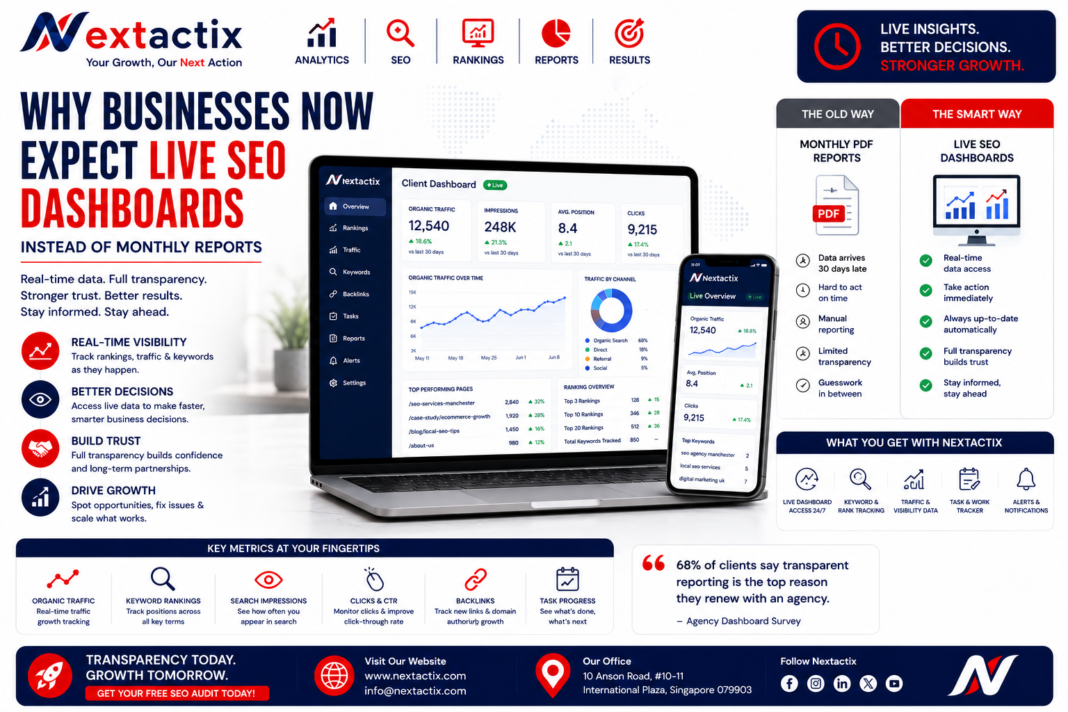
At some point in the last few years, a quiet shift happened in how businesses relate to the agencies working on their digital marketing. It did not happen because agencies got worse at writing reports. It happened because the experience of waiting — for information you knew existed but could not access — became increasingly difficult to justify.
The monthly PDF became a specific kind of frustration. You would sign with an agency in week one. Work would begin. Weeks would pass. And then, thirty days later, a document would arrive summarising what had happened. By the time you read it, another week had gone. And if something had gone wrong three weeks earlier, you were finding out about it now.
This gap between when something happens and when a client learns about it is the core problem that live SEO dashboards solve. And as businesses have become more data-literate, more comfortable with digital tools, and more aware that real-time information exists somewhere — they have started expecting access to it.
What Monthly Reports Actually Show
A well-constructed monthly SEO report is not without value. It provides a curated narrative — explaining what changed, why it changed, and what the agency plans to do next. It gives context to data that raw numbers cannot convey on their own. An experienced SEO manager writing a monthly report is doing interpretive work that a live dashboard cannot replicate automatically.
But that value comes with a significant limitation: the report is a snapshot of a period that has ended. It describes last month. It cannot tell you what is happening now. And for a business that is actively managing marketing spend, making decisions about which campaigns to run, or trying to understand why enquiries dropped in the last ten days, ‘last month’ is not especially useful.
Research consistently shows that unclear and untimely reporting is one of the main reasons clients end relationships with digital marketing agencies. A Forbes Agency Council roundup cited lack of transparency and poor reporting as the most common complaints clients had about past agency partners. And the most pointed version of this complaint is not ‘your reports are badly written.’ It is ‘I didn’t know what was happening with my account.’
Most agencies lose clients not because results are poor, but because clients can’t see the results clearly. A live dashboard changes the relationship from reporting to partnership.
The Live Dashboard Does Something Different
A live SEO dashboard is not a replacement for a monthly report. It is a different tool that serves a different need. Where a monthly report provides narrative and interpretation, a live dashboard provides access — the ability to check in at any moment and see current data.
For the client, this changes something psychological about the agency relationship. When you can see your organic traffic trend, your keyword positions, and your search impressions at any time without asking, you do not spend the month in a state of informational anxiety. You are not constructing narratives about what might be happening based on indirect signals like phone enquiries or website form completions. You have the data, and you can make sense of it yourself.
Agencies that have made the shift to live dashboard access alongside monthly reporting consistently report two downstream effects: fewer ‘what’s happening with my account?’ calls between scheduled check-ins, and higher contract renewal rates at review time. Both make sense. Clients who understand what is happening do not panic. And clients who do not panic are considerably less likely to cancel.
What a Useful Dashboard Actually Shows
Not all dashboards are built equally, and the version that creates the most client value is not the one with the most data. Executives and business owners reading their own dashboards — without an SEO manager present to interpret for them — need information that is immediately legible, not technically impressive.
The data that matters most at a glance: organic traffic trend over the last 30 days compared to the same period in the previous month, keyword position changes for the terms the business specifically cares about, impressions from Google Search Console showing search visibility even before clicks, and any significant changes flagged — a traffic drop, a new top-performing page, a keyword that broke into the top three.
What does not belong in a client-facing dashboard is internal audit data, crawl logs, or the kind of granular technical information that makes sense to an SEO professional but creates confusion for a business owner trying to understand whether their investment is working. There is a useful distinction between the full internal view that an agency’s team uses to do its work, and the curated client view that gives the client what they need to feel informed and confident.
The Reporting Shift Is a Trust Signal
The transition from monthly PDFs to live dashboard access is not purely operational. It signals something about how an agency thinks about its relationship with clients.
An agency that gives clients live access to their own data is making an implicit statement: the results are good enough that they are comfortable with clients seeing them at any time, not only when the agency has had the opportunity to frame them. That confidence is itself a reason to stay. An agency that tightly controls when and how data reaches the client, releasing it in a monthly document with framing provided, creates a different impression — even if no individual number is being misrepresented.
68% of clients, in survey data from Agency Dashboard, cited transparent reporting as the primary reason they renewed their contract. That figure is higher than any satisfaction metric about rankings or traffic. The feeling of being informed outweighs the actual performance numbers in client retention decisions, which suggests that agencies underinvest in reporting transparency relative to its commercial importance.
How to Use Live Data Without Creating Anxiety
There is one nuance worth addressing. Some clients, given access to live data, will check it every day. Organic traffic fluctuates naturally — daily volatility is normal and does not necessarily signal anything meaningful. An agency that provides live access without setting clear expectations about how to interpret daily movement can inadvertently create the anxiety it was trying to eliminate.
The best implementations pair live dashboard access with clear guidance on what to watch and at what frequency. Organic traffic is best evaluated on a weekly trend, not a daily fluctuation. Keyword positions move gradually, and a one or two position drop on a given day is rarely cause for concern. The monthly report remains valuable specifically for this interpretive function — not because it is the only way to access data, but because it provides the expert narrative that raw data on a dashboard cannot supply on its own.
Live access and expert interpretation are complementary. The agencies that provide both — always-on data visibility combined with a monthly expert view of what the data means — are describing the arrangement that produces the most confident, longest-retaining clients. Neither replaces the other. Together, they address both what clients need informationally and what they need relationally.
NextActix clients have live access to their campaign data through the NextActix Client Dashboard from day one of their engagement — alongside monthly reporting that provides context and strategic direction. If you want to see what transparent SEO reporting looks like in practice, ask us to walk you through it.