

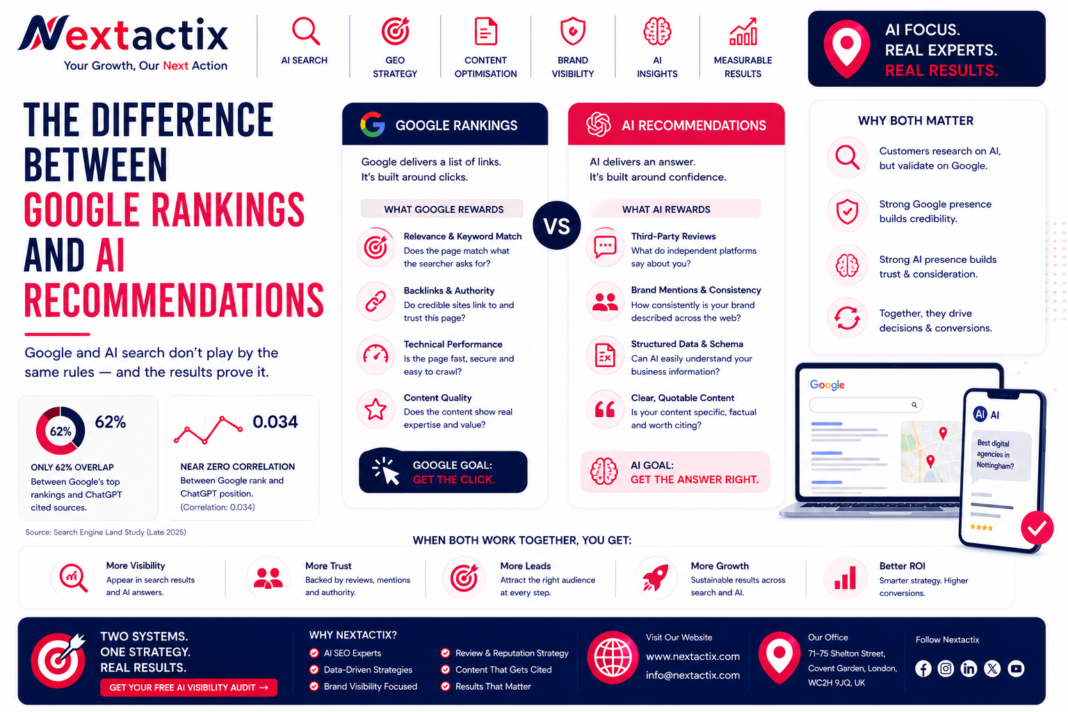
A study published by Search Engine Land in late 2025 measured the overlap between Google’s top-ranking pages and the sources that ChatGPT cites in its answers. The overlap was 62%.
Read that again. Brands ranking on Google’s first page were mentioned by ChatGPT just 62% of the time. In other words, more than a third of the businesses with the best Google rankings were invisible in ChatGPT’s recommendations for the same topics.
And the correlation between Google rank and ChatGPT position — for the brands that appeared in both — was 0.034. Near zero. Ranking number one on Google tells you almost nothing about where you will appear in a ChatGPT answer.
This is the fact that most coverage of AI search glosses over. The two systems are not the same system. They are not slightly different versions of the same ranking signal. They are genuinely different mechanisms, selecting sources based on genuinely different criteria, producing meaningfully different outcomes. Understanding how they differ is the only way to make good decisions about which one to invest in — and when you might need both.
How Google Rankings Work
Google’s ranking system is built around what can be measured across billions of web pages: relevance signals (does the page contain what the query asks for), authority signals (do credible external sources link to and cite this page), technical signals (is the page fast, crawlable, structured correctly), and increasingly, quality signals (does the content demonstrate genuine expertise that only someone with real experience could produce).
Google produces a list. Position one, position two, position three, down to position ten, and then a second page that very few people visit. The searcher clicks. Traffic goes to the website. The website needs to convert that traffic into an enquiry or a sale.
The entire architecture of Google search is built around the click. Google’s revenue depends on users clicking through to websites. The product is the list of results. The result is the visit.
How AI Recommendations Work
ChatGPT, Perplexity, Google’s AI Overviews, and similar systems are not producing a list. They are producing an answer. The user asked a question and received a synthesised response, often with two or three names embedded in it — and sometimes with no external links at all.
The selection logic is different from Google’s ranking logic in a specific way. AI systems are asking, in effect: how confident am I that this brand is a credible, established, trustworthy option in this category? That confidence is built from the consistency and volume of what exists about the brand across independent sources — not primarily from the quality of the brand’s own website.
Google evaluates what your website says and how the web responds to it. AI evaluates what the web says about you independent of your website. Those are different questions.
This is why the data shows such low overlap. A business that has invested heavily in on-page SEO, technical website optimisation, and link-building can rank very well on Google while remaining virtually unknown to AI systems — because AI systems are drawing primarily from third-party mentions, review platforms, social content, and the consistency of brand presence across multiple independent sources.
What Each System Actually Rewards
For Google rankings, the highest-leverage investments are: well-structured pages that clearly match search intent, a strong backlink profile from credible and relevant websites, fast and technically sound website performance, and content that demonstrates genuine expertise through specific claims and real experience.
For AI recommendations, the highest-leverage investments are different in important ways. Third-party review platform presence — Trustpilot, Clutch, GoodFirms, Google Reviews — carries far more weight than it does in traditional SEO. Consistent brand mentions across independent sources, including social platforms, industry publications, and community discussions, teach AI systems what category your brand belongs to and how reliably it is described. Schema markup and structured data help AI crawlers extract specific, accurate information about your business. And clear, quotable content — specific claims, direct answers, named outcomes — gives AI systems something to actually cite.
Research from Princeton, Georgia Tech, and the Allen Institute found that adding specific citations and statistics to content can boost AI visibility by up to 40% for lower-ranked content. Fact density matters to AI systems. Vague, general descriptions — the kind that could apply to any business in your category — do not.
When You Need Both
The vast majority of businesses should be investing in both, not because every business needs to dominate AI recommendations immediately, but because the customer journey now spans both systems in a way that was not true two years ago.
A prospective client researching digital agencies might start by asking ChatGPT for recommendations. They see three names, of which NextActix is one. They then Google ‘NextActix reviews’ and ‘NextActix case studies.’ Those Google searches produce results. Those results need to be strong — the website, the Trustpilot profile, the Clutch listing — or the AI recommendation does not convert into an enquiry.
The reverse is also true. A prospective client might find NextActix through Google first, read the website, and then ask Perplexity whether they are a well-regarded agency. If Perplexity says it does not have enough information, or describes the agency in vague, uncertain terms, that erodes trust built through the website visit.
The two systems check each other. A strong Google presence validates what AI says about you. A strong AI presence validates what people find when they Google you. Investing in one without the other leaves the whole journey vulnerable to a gap at the moment someone is making their decision.
The Practical Starting Point
If you want to understand where you stand on both dimensions, the test is straightforward. Google your primary service category and your location, and evaluate where you appear in the organic results and the map pack. Then ask ChatGPT and Perplexity the question your target customer would ask — ‘best [your service] in [your city]’ — and see whether you appear, how you are described, and who is appearing instead of you.
The gap between those two pictures is the gap in your current digital strategy. Most businesses find a bigger discrepancy than they expected.
NextActix’s free AI visibility audit maps both dimensions — your current Google search rankings and your AI recommendation presence — and gives you a specific picture of what is working and what is not. Get your audit here.