


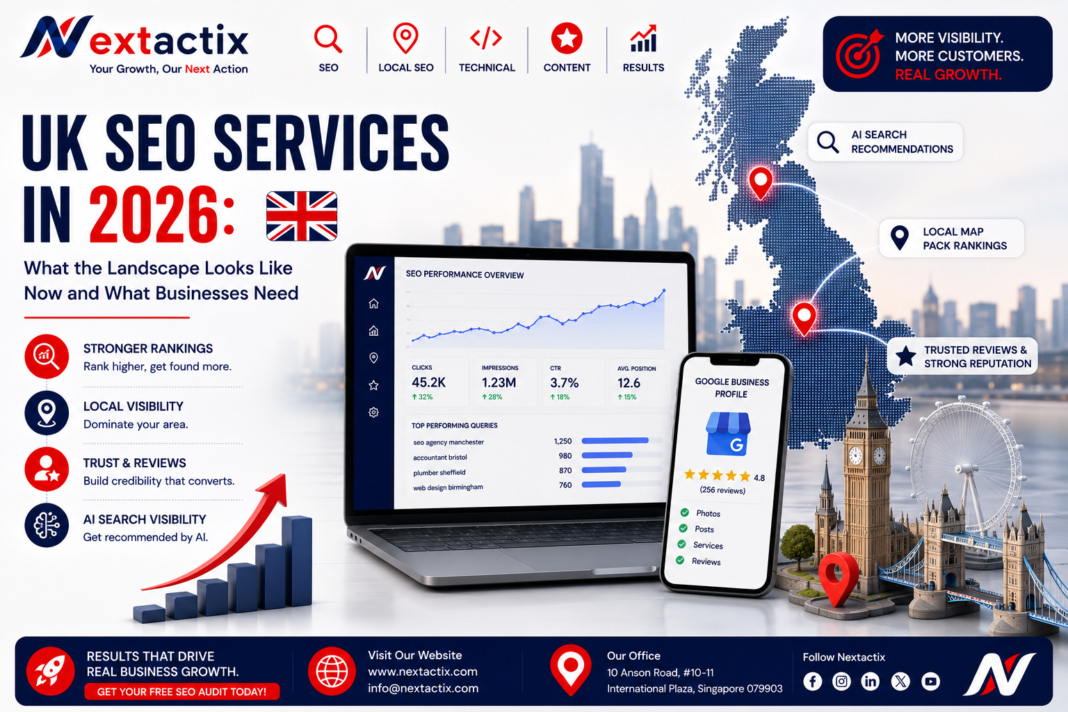
A plumber in Manchester, a solicitor in Bristol, an e-commerce brand shipping from Birmingham — what these businesses need from SEO in 2026 is not entirely different from what they needed in 2022. The fundamentals have not been discarded. But the context around them has shifted enough that treating SEO as a static discipline is increasingly expensive.
One data point that illustrates the shift well: AI now drives 45% of local business recommendations in the UK, up from just 6% the year before. That is not a gradual change. For local businesses especially, it means a meaningful share of the customer journey now runs through AI-generated answers before it ever reaches a website or a map listing.
Understanding what this requires — and what it does not require — is the starting point for UK businesses making decisions about SEO investment in 2026.
What Traditional SEO Covers and Why It Still Matters
The core disciplines of UK SEO have not changed. Keyword research identifies what your potential customers are searching for. On-page optimisation ensures your website pages are structured clearly enough for Google to understand and rank them. Technical health — site speed, mobile performance, correct indexing, clean URL structures — determines whether Google can access your content in the first place. And link building, through genuine editorial coverage and relevant directory presence, tells Google that other credible sources consider your site worth pointing to.
None of this has stopped working. For most UK businesses, organic search still drives the majority of website traffic from new customers who did not already know the business by name. Google’s local map pack — the three businesses shown at the top of location-based searches — is still the most valuable placement for local service businesses and still accounts for the majority of clicks in those searches.
What has changed is the context around these results. Google AI Overviews now appear above traditional organic results for a growing proportion of UK searches. These AI-generated summaries sometimes answer a user’s question completely, reducing the incentive to click through to any of the listed sources. For businesses cited within those summaries, there is a different kind of visibility — not a click, but a recommendation from Google itself, appearing to every user who runs that search.
The Google Business Profile Has Become More Important, Not Less
If there is one asset UK businesses consistently undervalue, it is the Google Business Profile. The profile controls what appears when someone searches your business name, and it determines whether you appear in the local map pack for searches like ‘accountant near me’ or ’emergency plumber Sheffield.’
In 2026, the profile feeds directly into AI Overviews for local searches. When Google’s AI generates a summary that includes local business recommendations, it draws heavily from Business Profile data — categories, services listed, review volume and content, photo recency, and posting activity. A profile set up once and never updated is providing Google with stale information and quiet signals of low activity.
The most effective UK businesses treating SEO seriously in 2026 are managing their Business Profile the way they manage a live channel — updating opening hours seasonally, posting regularly, adding photos from real jobs, listing specific services with accurate descriptions, and maintaining a consistent flow of genuine reviews. The reviews themselves have become a more complex signal: AI systems read review content for mentions of specific services and locations, not just star ratings. A review that says ‘great experience with our house rewire in Sheffield’ is more useful to the AI than a generic five-star.
Technical SEO in 2026: The Thresholds Are Stricter
Google’s Core Web Vitals thresholds tightened in March 2026. The LCP threshold for a ‘Good’ score — measuring how quickly the main content loads — moved from 2.5 seconds to 2.0 seconds. Sites that were previously passing are now in the ‘Needs Improvement’ zone if they have not been updated. For mobile, where over 60% of UK searches now originate, slow loading is not a nuisance. It is a ranking penalty.
For UK businesses with websites built three or more years ago, a technical audit in 2026 will often find issues that did not exist or did not matter when the site was built. Schema markup that was never implemented. Image files that have never been compressed. A robots.txt file that has not been checked in years. Redirect chains that have accumulated as the site was updated piecemeal. These are not glamorous problems. They are the kind of silent drag on performance that a proper technical SEO audit surfaces and prioritises.
One specific technical issue that has emerged in the last eighteen months is AI crawler accessibility. GPTBot, Google-Extended, and PerplexityBot need to crawl websites to include their content in AI-generated answers. Some UK websites have these bots blocked — sometimes deliberately, more often accidentally through a broad robots.txt rule or an overzealous security setting. If AI crawlers cannot access your content, you are not in the running for AI-generated recommendations, regardless of how well your traditional SEO is performing.
Content for UK Audiences: What Performs Now
The most durable content on UK business websites in 2026 shares specific characteristics. It is written for a specific audience in a specific location, with enough local and sector-specific detail that it could only have been written by someone who genuinely knows that market. It answers real questions — the ones customers actually ask before making a decision — with enough specificity to be useful rather than merely reassuring.
Generic service descriptions, thin location pages that swap a city name into a template, and blog posts that cover topics at a surface level have all been affected by Google’s 2024 and 2026 quality updates. These updates were specifically designed to identify and demote content that exists to rank rather than to genuinely inform. UK businesses that built their online presence around high-volume, low-quality content have seen meaningful traffic losses as a result.
The practical rewrite is not to produce more content but to produce content that is genuinely better than what competitors have published on the same topics. A solicitor’s firm that publishes a detailed, specific guide to residential conveyancing in their area — covering local market conditions, realistic timescales, common complications, and honest pricing ranges — is producing content that earns both traditional rankings and AI citations. A thin 400-word page with the same title earns neither.
Multi-Platform Presence: The New Baseline
Local SEO for UK businesses now means being findable and accurately represented across a wider set of platforms than it did three years ago. The map pack, the Business Profile, and the website remain central. But AI systems draw from a broader information ecosystem when generating answers about local businesses.
Review platforms relevant to the business’s sector — Trustpilot, Checkatrade for trades, industry-specific directories — contribute to how AI systems understand and represent the business. LinkedIn company pages, which Semrush has identified as one of the most-cited domains across ChatGPT Search, Google AI Mode, and Perplexity, are now part of the local SEO picture for professional service businesses. Consistent NAP data across all online listings — name, address, phone number in identical formats everywhere — reduces the ambiguity that suppresses both traditional local rankings and AI confidence.
The UK businesses growing organic visibility most consistently in 2026 are treating all of this as a connected system rather than a series of separate tasks. The website, the Business Profile, the review platforms, and the content strategy work together or they underperform independently.
NextActix’s UK SEO services cover the full picture — traditional rankings, Google Business Profile optimisation, technical health, and AI search visibility — as a single connected programme. Read about the approach on our UK SEO services page, or start with a free audit.