

There is an old principle in public relations — one that predates the internet entirely — that says a third party saying something about you is worth ten times more than you saying it about yourself. That principle has always been true in marketing.
In AI search, it turns out to be structurally, mathematically true in a way that finally gives it teeth.
Why AI Systems Weight Third-Party Sources So Heavily
When ChatGPT, Perplexity, or Google’s AI generates a response and names a business, it is not just repeating back whatever that business has said about itself. It is synthesising information from across the web and arriving at a level of confidence about who that business is, what it does, and whether it is worth recommending.
Confidence requires corroboration. If only your own content describes you, the AI is working from a single, self-interested source. That is roughly as useful as a reference letter you wrote for yourself. The model wants to see that other sources — sources it has no reason to distrust — are saying consistent things about you.
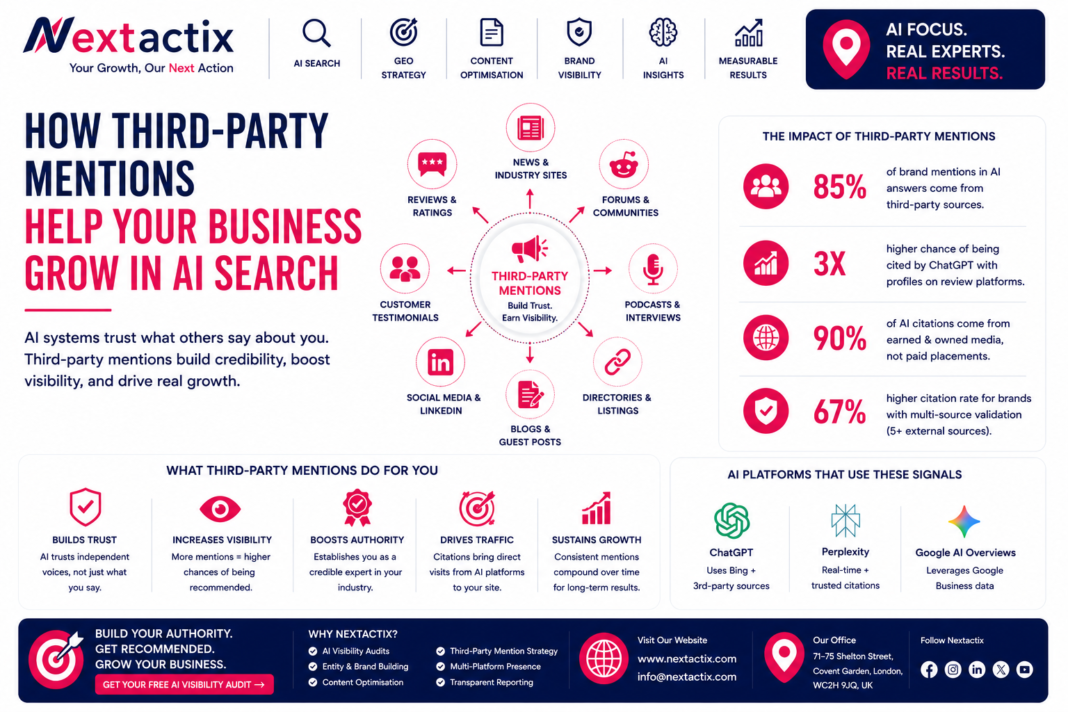
Similarweb’s research found that 90% of AI citations driving brand visibility originate from earned and owned media rather than paid placements. AirOps data across billions of AI citations showed that 85% of brand mentions in AI answers come from third-party pages, not brand-owned content. The implication is straightforward: the work of getting other people to write about you is no longer optional if you want AI visibility.
The pattern is straightforward: getting mentioned consistently across third-party sources teaches the model to associate your brand with a category. That association opens the door to citations.
The Difference Between a Mention and a Citation
These two things look similar from the outside but work differently. It is worth being precise about them.
A mention is when an AI-generated answer includes your brand name — ‘NextActix offers AI SEO services for businesses in the UK.’ You are referenced, you are named, but there may or may not be a link.
A citation is when the AI explicitly links to your content as the source it is drawing from. Citations drive direct traffic back to your site. Mentions build brand awareness and entity recognition without necessarily creating a click.
Both matter, and they build on each other. Mentions accumulate first — they train the model to recognise your brand as a known entity in your category. Citations follow as the model becomes confident enough to point to your content as a source. Brands that focus only on citations without building the mention foundation often struggle to gain consistent visibility, because citations tend to go to brands the model already has some familiarity with.
What Counts as a Third-Party Mention
This is the part that surprises people who have been focused on backlinks. In AI search, a mention does not need to be a linked citation to carry weight. The model processes language, not just URLs.
The types of third-party content that consistently drive AI citation visibility:
- Industry publications and news sites: getting featured in, quoted in, or written about on any respected publication in your sector. The bar is quality and relevance, not just domain authority.
- Review platforms: Trustpilot, Google Reviews, Clutch, G2, Capterra. Research from Averi found that domains with profiles on these platforms have 3x higher chances of being cited by ChatGPT compared to businesses without them. Reviews need to be detailed and specific — generic five-star reviews carry far less weight than ones that mention the service used, the problem solved, and the outcome achieved.
- Reddit and community forums: Profound’s analysis of over 4 billion AI citations found that AI engines lean heavily on human conversations, particularly Reddit, when building trust signals. A recommendation thread mentioning your business in a relevant subreddit carries meaningful weight with AI systems.
- LinkedIn: Semrush’s analysis of 89,000 LinkedIn URLs found it was one of the most-cited domains across ChatGPT Search, Google AI Mode, and Perplexity. A company page with consistent posting is not just social media — it is AI training data.
- Podcast appearances: Audio transcripts and show notes mentioning your business name and expertise in context contribute to the language patterns the model associates with you.
- Guest articles: Writing for an industry publication gives you a mention on a trusted domain that the model already recognises. The article does not need to link to you prominently to carry value — your name and your claimed expertise appearing on that domain is itself a signal.
Mentions Teach AI What Category You Belong To
This is the mechanism that makes third-party mentions so specifically powerful in AI search, as opposed to traditional search.
Google’s ranking algorithm is built around links and on-page signals. ChatGPT’s recommendation behaviour is built around co-occurrence — the frequency with which your brand name appears alongside certain concepts, categories, and audience descriptors across a large body of text.
If your business name appears regularly alongside phrases like ‘AI SEO services,’ ‘Nottingham digital marketing,’ and ‘e-commerce website development’ across independent sources, the model develops a strong association between your brand and those concepts. When someone asks a question that touches on those concepts, your brand surfaces.
If your brand name only appears in those contexts on your own website, the association is weak. You are telling the model what category you belong to. The model wants other sources to confirm it.
Multi-Source Validation and Why It Compounds
Research published in the GEO paper from Princeton, Georgia Tech, IIT Delhi, and the Allen Institute found that adding citations to external sources improved AI visibility by 115% for lower-ranked content. A separate finding: brands with ‘multi-source validation’ — their claims and identity appearing across five or more external domains — see citation rates improve by 67% in AI overviews.
The compounding effect is real and worth understanding. Each new credible mention adds to the model’s confidence in you. At some threshold — it is not a specific number, but rather a sufficient density — the model shifts from uncertain about you to reliably including you. Once you cross that threshold, the citations themselves become additional evidence, and the cycle becomes self-reinforcing.
This is why the businesses that started building third-party presence in 2023 and 2024 have a structural advantage today that is genuinely difficult for a competitor starting in mid-2026 to close quickly. The mentions have accumulated. The associations have been set. You are competing with their history, not just their current marketing.
Where Most Businesses Are Getting This Wrong
The mistake is not ignoring third-party mentions entirely — most businesses have some. The mistake is passivity. Mentions that happen organically over years are not the same as a deliberate, sustained programme of building third-party presence with the specific goal of AI visibility.
The practical shift is treating every guest post, every review request, every podcast appearance, every industry directory listing as an investment in how AI systems understand your business — not just as SEO link-building or general reputation management. The goal and the output are different when you think about it this way, even if some of the activities overlap.
Specifically: when you ask a client for a review, the review that helps most in AI search is not ‘Great company, highly recommend.’ It is one that says: ‘We used NextActix for AI SEO optimisation for our Nottingham-based retail business. Within four months, we were appearing in Google AI Overviews for three of our target terms and our organic enquiries increased significantly.’ That review names the service, names the location, describes the outcome. It is the kind of language that teaches an AI model exactly what category your business belongs to.
How to Start Building This Systematically
You do not need to do everything at once. The most effective starting point is a gap analysis — understanding where you currently exist across the web and where you do not.
Run your business name through Google with operator searches that exclude your own site. See what comes up. Check how you appear on Trustpilot, Clutch, Google Business Profile, LinkedIn. Run your category in ChatGPT and Perplexity and see whose names come up and what sources they are drawing from.
That picture tells you where the gaps are. The priority is almost always the same: consistent NAP data everywhere, detailed reviews on trusted platforms, and two or three meaningful mentions per month on external sites — starting with the easiest wins and building from there.
NextActix’s AI SEO audit includes a full third-party mention gap analysis — showing you exactly where your competitors are being mentioned that you are not, and which sources carry the most weight for AI visibility in your category.