


There is a conversation that happens regularly at the start of a new client relationship. The business owner has a website — often a reasonably good one — and they want to know why they are not getting more enquiries from it. The website is clean, it loads quickly, the contact form works. And yet the phone is quieter than it should be.
The answer, almost every time, is the same: the website is doing its job. The rest of the infrastructure is not there to back it up.
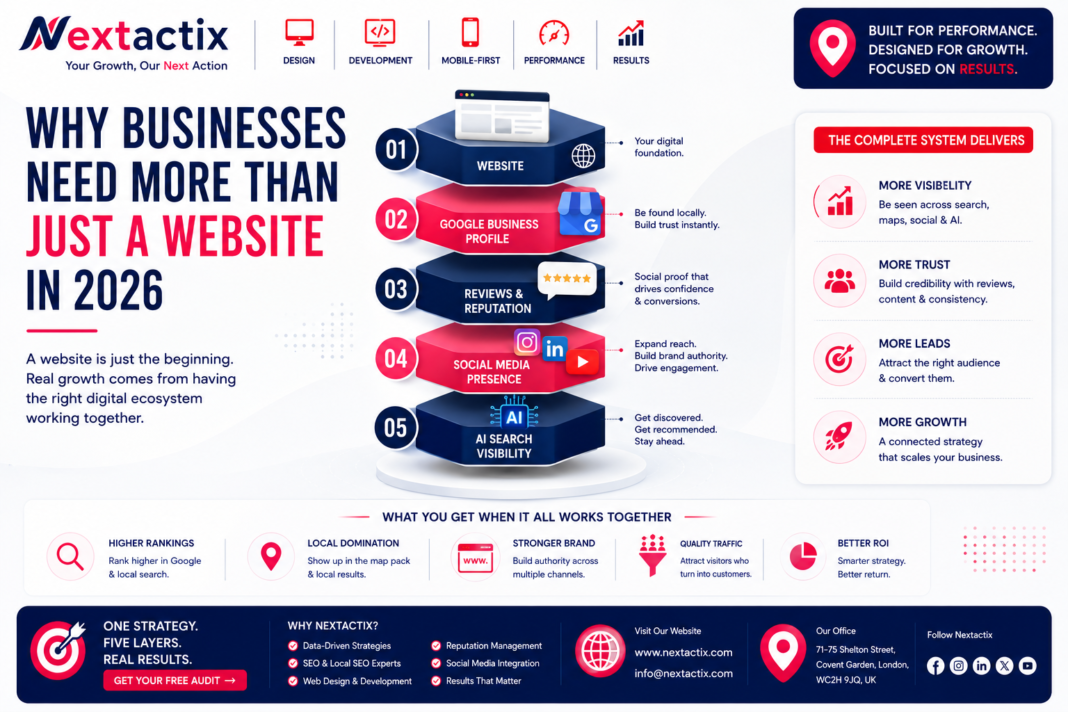
A website in 2026 is not a standalone asset that generates customers on its own. It is one layer in a connected system, and it only produces results when the other layers are in place and working. Here is what those layers are and why each one matters.
Layer One: The Website Itself
The foundation is still the website — but what ‘good website’ means has shifted. Speed and mobile performance are now entry-level requirements, not differentiators. Google measures Core Web Vitals for every website, and pages that fail the LCP threshold of 2.0 seconds are actively suppressed in rankings.
Beyond performance, a website needs to do one thing clearly: answer the question ‘what do you do, for whom, and why should I trust you?’ within the first few seconds of a visit. Most business websites are designed to look good. Fewer are designed to answer that question immediately and convincingly for a new visitor who knows nothing about the company and is deciding in ten seconds whether to stay or leave.
The website also needs to be structured for search — clean URL architecture, proper heading hierarchies, schema markup that helps Google understand what each page is about — and increasingly, structured for AI readability, which means clear, specific, quotable content that an AI system can extract and cite in a generated answer.
Layer Two: Google Business Profile
The vast majority of searches with local intent still result in someone looking at the Google map pack before they ever visit a website. For a business that serves customers in a specific area, the Google Business Profile is often the first impression — and the most influential one.
A profile that is incomplete, has outdated hours, or has not been updated in six months signals something to a potential customer before they have read a single word about what you do. An actively managed profile — with accurate service areas, recent photos, and a consistent flow of new reviews — signals the opposite.
Google Business Profile also feeds directly into AI-generated local summaries. When a user asks Google AI Mode or ChatGPT for a service recommendation in a specific city, the businesses that appear most often are the ones with complete, consistent, well-reviewed profiles across Google. The website is secondary. The profile is primary.
Layer Three: Reviews Across Multiple Platforms
We have written separately about how customer reviews now influence search rankings, AI visibility, and buyer trust simultaneously. The short version for this context: a website with no reviews pointing to it from external platforms — Google, Trustpilot, Clutch, GoodFirms, or industry-specific directories — is a business that exists in isolation on the web.
AI systems specifically look for corroboration. If only your own website describes your business in positive terms, the AI has limited evidence to draw on. When independent platforms independently describe your business in consistent terms, the AI has cross-referenced evidence. That is what makes it confident recommending you over a competitor.
A website without reviews is a one-source claim. A business with consistent reviews across several platforms is a verified fact.
Layer Four: Social Media Presence
Social media’s role has changed in a specific and important way since 2025. Google now indexes Instagram, YouTube, TikTok, and X content in its search results — and from July 2026, you can track exactly how that content performs in Google Search through the new platform properties feature in Search Console.
This means social content is no longer just a platform-specific activity. A YouTube tutorial, an Instagram case study post, or a LinkedIn thought leadership piece can generate Google Search impressions for topics your website is not ranking for. Your social presence has become part of your search presence, whether you optimised it for that purpose or not.
For small businesses, this does not require a daily posting schedule across five platforms. It requires a consistent, considered presence on one or two platforms that are relevant to your audience — and content that is specific and genuinely useful, rather than generic updates that serve no purpose beyond filling the calendar.
Layer Five: AI Search Visibility
This is the newest layer, and the one most businesses have not yet addressed. Approximately 21 million UK adults use AI tools monthly as of late 2025. Google AI Mode has crossed a billion monthly users. Perplexity, ChatGPT, and Claude with web search enabled are answering questions about which businesses to use — and the answers they give are not determined by who has the best website. They are determined by who has the most consistent, credible, verifiable presence across all the layers described above.
A business that has a good website but no Google Business Profile, no reviews on third-party platforms, and no social presence beyond a dormant Facebook page is essentially invisible to AI systems. There is simply not enough independent evidence for the AI to form a confident recommendation.
Getting this layer right is not a separate project from the other layers. It is the result of doing the other layers well. A business with an optimised website, an active Google Business Profile, consistent reviews on Trustpilot and Clutch, and relevant social content that appears in Google Search is a business that AI systems can confidently recommend — because the evidence is there across multiple independent sources.
Putting It Together
Most businesses in the UK, UAE, and internationally have one or two of these layers in reasonable shape. Very few have all five working together as a connected system. The ones that do — the businesses that appear in the map pack, rank in organic search, get cited in AI answers, and have reviews that validate what their website claims — are not necessarily bigger or better funded. They are more deliberately built.
The gap between where most businesses are and where the best-performing ones are is not a budget gap. It is a coordination gap. The five layers are not expensive individually. What is rare is a strategy that connects them intentionally, measures them together, and treats the whole picture — not just the website — as the unit of online presence.
NextActix builds and manages all five of these layers for businesses across the UK, UAE, and Singapore. If you want to understand which layers you currently have in place and what building the others would involve, start with a free audit.