


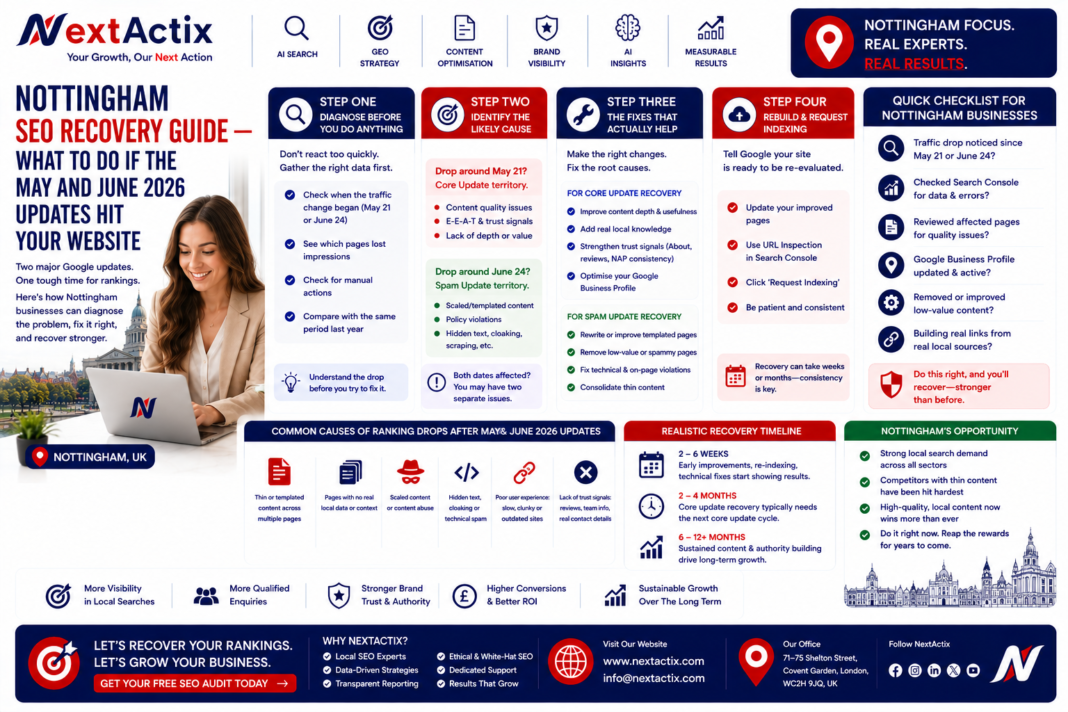
If your Nottingham business has seen a drop in organic traffic, Google impressions, or enquiries since late May 2026, you are dealing with the aftermath of two of the most significant Google updates in the past two years — and possibly both at once.
Google released the May 2026 core update on May 21, and it kept rolling out until June 2 — nearly two weeks of shifting rankings. Then, three weeks later on June 24, the June 2026 spam update launched. It completed in under two days, but the ranking movements it caused layered on top of whatever the core update had already changed.
As Search Engine Journal reported on the June spam update rollout, the back-to-back timing of these two updates has made it unusually difficult for businesses and their SEO agencies to identify which change caused which effect. This guide is designed to help Nottingham business owners diagnose what is actually happening and take the right steps — in the right order.
Step One — Diagnose Before You Do Anything
The most common mistake after a Google update is reacting too quickly. Changing title tags, deleting pages, or rebuilding your site during or immediately after an update often makes things worse, not better. Before you change anything:
- Open Google Search Console and note exactly when your impressions or click data changed. If it changed around May 21 — core update. If it changed around June 24 — spam update. If it changed at both points — you may be dealing with two separate issues.
- Check the Manual Actions report in Search Console. If Google has issued a manual penalty against your site, it will appear here. Manual actions are different from algorithmic updates and require different responses.
- Look at which pages specifically lost impressions. Was it your main service pages? Your city landing pages? Your blog? The pattern tells you a lot about what the update was targeting on your site.
- Compare your traffic to the same period last year, not just the last few weeks. Some drops in mid-summer reflect genuine seasonal patterns rather than update impact.
Before you change anything on your website, confirm in Search Console:
1. Exactly when the traffic change began (May 21 or June 24 are the key dates)
2. Which specific pages lost impressions — not just the homepage
3. Whether any manual actions have been issued
4. Whether the drop affects all keywords or specific keyword groups
Step Two — Identify the Likely Cause
If the drop started around May 21 — core update territory
The May 2026 core update assessed content quality broadly. The questions to ask about your affected pages are: does this page contain genuinely useful, specific information, or is it generic content that could apply to any business in any city? Does it demonstrate real expertise and real local knowledge? Would someone searching for this topic in Nottingham find it meaningfully more useful than your competitors’ equivalent pages?
Pages that answer yes to these questions tend to be the ones that survived or benefited from the May core update. Pages that answer no are the ones most likely to have dropped.
If the drop started around June 24 — spam update territory
The June 2026 spam update worked through SpamBrain, Google’s AI-based spam detection system. It targeted scaled content abuse, cloaking, scraping, hidden text, and similar policy violations. According to Search Engine Roundtable’s coverage of the rollout, this update excluded link spam — so the likely causes of a June 24 drop are on-page content issues rather than backlink profile problems.
Ask yourself: are any of your pages clearly templated — the same structure with different keyword phrases? Does any of your content appear to have been generated at scale without genuine human editing? Are there pages on your site that serve no real user purpose and exist primarily to target keyword phrases?
If both dates show drops — you are dealing with two separate issues
This is the most common and most frustrating scenario. The May core update may have flagged content quality issues, and the June spam update may have additionally flagged specific policy violations. These require different fixes, addressed separately. Trying to fix both simultaneously makes it very difficult to assess what is working.
Step Three — The Fixes That Actually Help
Based on what Google has confirmed about both updates, and what recovery from previous comparable updates has shown, here is what actually moves the needle:
For core update recovery
Improve the quality of affected pages, do not just delete them: Pages that have dropped in a core update have been assessed as lower quality than competing pages, not as violations. Deleting them often makes things worse. Instead, significantly improve them — add genuine depth, local specificity, real examples, and useful information that was not there before.
Fix trust signals sitewide: The May core update paid attention to E-E-A-T signals. Check that your About page is complete and genuine, your contact details are consistent, your reviews are visible and real, and your website presents a credible professional business.
Improve your Google Business Profile: The core update period saw local pack results shift more than traditional organic results for many searches. A well-managed Google Business Profile with regular posts, photos, and review responses can partially compensate for drops in traditional rankings.
For spam update recovery
Review your content for policy violations: Scaled, templated content is the primary target. If you have multiple city pages or service pages that are structurally identical with only a few words changed, these need to be genuinely rewritten — not superficially edited.
Remove or redirect pages that serve no user purpose: Thin pages that exist only to target keyword phrases and offer nothing useful to a real visitor should be consolidated into better pages or removed, with 301 redirects pointing to the most relevant surviving page.
Check for any technical spam signals: Hidden text, cloaking, or sneaky redirects — while less common on genuine business websites — should be audited and eliminated.
Step Four — Rebuild and Request Indexing
Once you have made genuine improvements to affected pages, the next step is telling Google to come and re-evaluate them. Do not wait for Google to recrawl your site naturally — it can take weeks.
In Google Search Console, use URL Inspection for each page you have updated, and click Request Indexing. This tells Google’s crawlers to prioritise visiting that page. For a page you have made significant improvements to, this can accelerate the reassessment process by days or even weeks.
Be realistic about timelines. Google has stated that recovery from spam policy violations can take months, as their systems need to learn over time that a site is now complying. Core update recovery typically requires waiting for the next core update — which may be three to four months away — to see significant position improvements.
What This Means for Nottingham Businesses Going Forward
Nottingham is a city with real, growing search demand. The Nottingham economy — its two universities, its science and tech corridor, its creative industries in Hockley and the Lace Market, its retail and professional services sectors — generates consistent, valuable search volume that is not going anywhere.
The May and June 2026 updates did not reduce that opportunity. They narrowed the path to it. Businesses with genuinely useful, locally specific, well-maintained websites are better positioned now than they were before the updates, because their competition — the thin, templated pages — have been demoted. The gap has widened in favour of doing things properly.
If you are a Nottingham business that has taken a hit from these updates and needs expert help assessing and recovering your position, our team at NextActix can help. We have been through multiple update cycles and our approach — genuine local content, ethical link building, real technical health — is aligned with where Google’s algorithm has been consistently heading.