


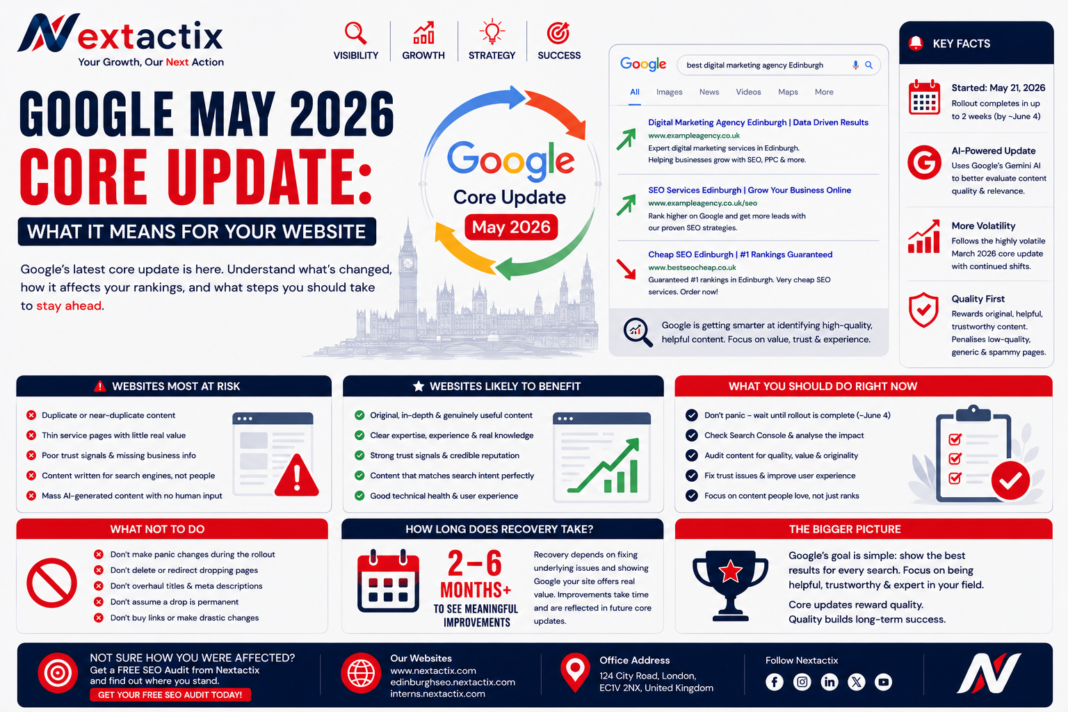
On May 21, 2026, Google released its latest core update — and it is already making waves across the SEO world. If you have noticed your website’s traffic or rankings shifting over the past few days, this update is almost certainly the reason.
But before you start making panic changes to your website, read this first. This article explains exactly what the May 2026 core update is, what Google is trying to achieve with it, which types of websites are most affected, and — most importantly — what you should actually do right now.
We have written this in plain English for business owners and website managers, not just SEO specialists. Whether you run an e-commerce store, a local service business, a blog, a professional services firm, or anything in between — this applies to you.
What Is a Google Core Update?
Google releases core updates several times a year. Unlike smaller, targeted updates that might focus on one specific thing — like spam or product reviews — a core update is a broad, significant change to the way Google’s main ranking algorithm evaluates and ranks websites.
Think of it this way. Google’s job is to show people the most useful, relevant, and trustworthy results for every search. Over time, Google gets better and better at doing this job. A core update is Google essentially saying: we have improved our ability to judge what makes a great search result — and we are updating our rankings to reflect that.
For some websites, this means rankings improve significantly. For others, it means a drop. And for many, the change is small or barely noticeable. The key is understanding which camp you are likely to fall into — and why.
Key fact: The May 2026 core update started on May 21 and will take up to two weeks to
fully roll out. Google says to wait until around June 4 before drawing firm conclusions
about how your website has been affected.
What Is Different About the May 2026 Core Update?
Every core update has its own character. Here is what makes this particular one significant:
It Is Powered by Gemini AI Quality Models
This update uses Google’s most advanced AI systems — based on its Gemini technology — to evaluate content quality. This means Google is now significantly better at understanding what a page is actually about, whether the information is genuinely useful, and whether it was written to help people or just to rank on Google.
In practical terms, this makes it much harder to fool Google with surface-level optimisation. A page that looks SEO-friendly on the outside but is actually thin, generic, or unhelpful is much more likely to be identified and demoted under this update than under previous ones.
It Follows a Very Volatile March 2026 Update
The March 2026 core update was one of the most disruptive in recent years — nearly 80% of top search results shifted positions during that rollout. The May update builds on that momentum. Google is continuing to raise the bar for what a quality search result looks like, and the websites that survived March in good shape are better positioned for May.
Google Is Pushing Hard Against Generic, Commodity Content
In the lead-up to this update, Google’s own team repeatedly used the phrase ‘non-commodity content’ — meaning content that offers something original and genuinely useful, rather than just the same information that already exists on dozens of other websites. This update specifically targets pages that say nothing new, add nothing unique, and exist primarily to rank rather than to genuinely help readers.
Which Websites Are Most at Risk?
Not every website will feel this update equally. Based on what we know about this update and the patterns from previous core updates, these are the types of pages and sites most likely to see negative movement:
- Pages with duplicate or near-duplicate content: If you have multiple pages on your website that are essentially the same content with small changes — like location pages that say the same thing with just a different city name — this update is very likely to affect you. Google’s improved AI can now spot this pattern much more reliably.
- Thin service pages with no real substance: A page that lists your services in bullet points without genuinely explaining anything, providing real value, or demonstrating expertise is exactly what this update is designed to deprioritise.
- Sites with trust and credibility issues: Inconsistent business information, missing contact details, no team or about page, no reviews or social proof — these are all signals that reduce Google’s confidence in a website. This update pays closer attention to these trust factors.
- Content clearly written for Google rather than for people: Pages stuffed with keywords, awkward repetitive phrasing, and information that reads like it was written to tick SEO boxes rather than help a real reader are at elevated risk.
- Websites that rely heavily on AI-generated content without human editing: Google is getting better at identifying content that was mass-produced without genuine human expertise or editorial input. Volume alone is not an advantage if the quality is low.
Which Websites Are Likely to Benefit?
The flip side of every core update is that some websites benefit significantly. The May 2026 update is expected to reward:
- Pages with genuinely original, well-researched content that goes beyond surface-level information
- Websites that demonstrate clear expertise in their subject area — through specific knowledge, real examples, and genuine depth
- Sites with strong trust signals — accurate business information, reviews, team details, and consistent brand presence
- Pages that match what the searcher actually wants, not just what the keyword suggests
- Websites with good technical health — fast loading on mobile, no crawl errors, clean structure
- Content that is updated regularly and kept accurate and relevant over time
What Should You Do Right Now?
This is the question everyone is asking. Here is the honest, practical answer:
Step 1 — Do Not Make Panic Changes During the Rollout
This is the most important piece of advice. The update is still rolling out until around June 4. Rankings will move up and down unpredictably during this period. Making major changes to your website based on mid-rollout data is like steering a car based on what you saw in the rear-view mirror two seconds ago. Wait until the rollout is complete before assessing your position and deciding what to change.
Step 2 — Check Your Search Console After June 4
Once the update has finished rolling out, open Google Search Console and compare your impressions, clicks, and average position to where they were before May 21. Look specifically at which pages have gained or lost the most. This tells you exactly where Google’s new quality assessment has changed its view of your content.
Step 3 — Audit Your Content for Genuine Quality
Go through your most important pages and ask these questions honestly: Does this page actually help the person reading it? Does it say something specific and useful, or is it mostly generic? Is the information accurate and up to date? Does it demonstrate that the person or business behind it genuinely knows their subject?
Pages that fail these questions are your priority for improvement — not because of this specific update, but because improving them is the right long-term strategy regardless of any particular algorithm change.
Step 4 — Fix Trust Signal Issues
If your website has basic credibility issues — an incomplete About page, inconsistent contact information, no customer reviews, broken links, or a design that feels unfinished — address these. They affect how both visitors and Google evaluate your website, and this update pays closer attention to them.
Step 5 — Focus on Content That Cannot Be Commoditised
Going forward, the safest and most sustainable SEO strategy is to create content that is uniquely yours. Content built on your own expertise, your own customer insights, your own research, and your own experience cannot be replicated by a hundred other websites. This is what Google’s algorithm is increasingly designed to find and reward.
What NOT to do during a core update rollout:
✗ Do not delete or redirect pages that have dropped — wait and assess first
✗ Do not start changing title tags and meta descriptions across your whole site
✗ Do not assume a drop means your page is bad — it may recover as the rollout settles
✗ Do not buy backlinks or make drastic structural changes while rankings are in flux
How Long Does Recovery Take If You Are Hit?
If this update has negatively affected your website, recovery is possible — but it takes time. Google’s own guidance is clear: there are no specific actions that reverse a core update impact. Recovery happens when your website genuinely improves in the areas the update is evaluating.
The most realistic recovery path is to identify the specific content and trust issues that are causing Google to evaluate your site less favourably, make genuine improvements over the following weeks and months, and then wait for the next core update — which typically arrives a few months later — to see significant recovery movement.
This is not a quick fix process. But businesses that respond to core updates by genuinely improving their websites rather than looking for shortcuts consistently come out stronger after the next update.
The Bigger Picture — Where Google Is Heading
The May 2026 core update is not an isolated event. It is the latest step in a long-term direction that Google has been moving in consistently for several years. The pattern is clear: with every update cycle, Google gets better at identifying and rewarding content that is genuinely useful to real people — and better at identifying and deprioritising content that exists primarily to rank.
This means the businesses that will win on Google over the next few years are not the ones that find the cleverest technical tricks. They are the ones that genuinely invest in being useful, trustworthy, and expert in their field — and express that through their websites.
If your SEO strategy is built on that foundation, core updates are not threats. They are opportunities.
Need Help Assessing Your Website After This Update?
If you are not sure how the May 2026 core update has affected your website — or if you know your rankings have dropped and you want expert guidance on what to do next — NextActix can help.
We offer a free website SEO audit that covers your content quality, your technical health, your trust signals, and your overall position relative to your competitors. We will give you an honest assessment of where you stand and a clear, practical plan for moving forward.
Get in touch with the NextActix team today and let us help you turn this update into an opportunity for your business.