


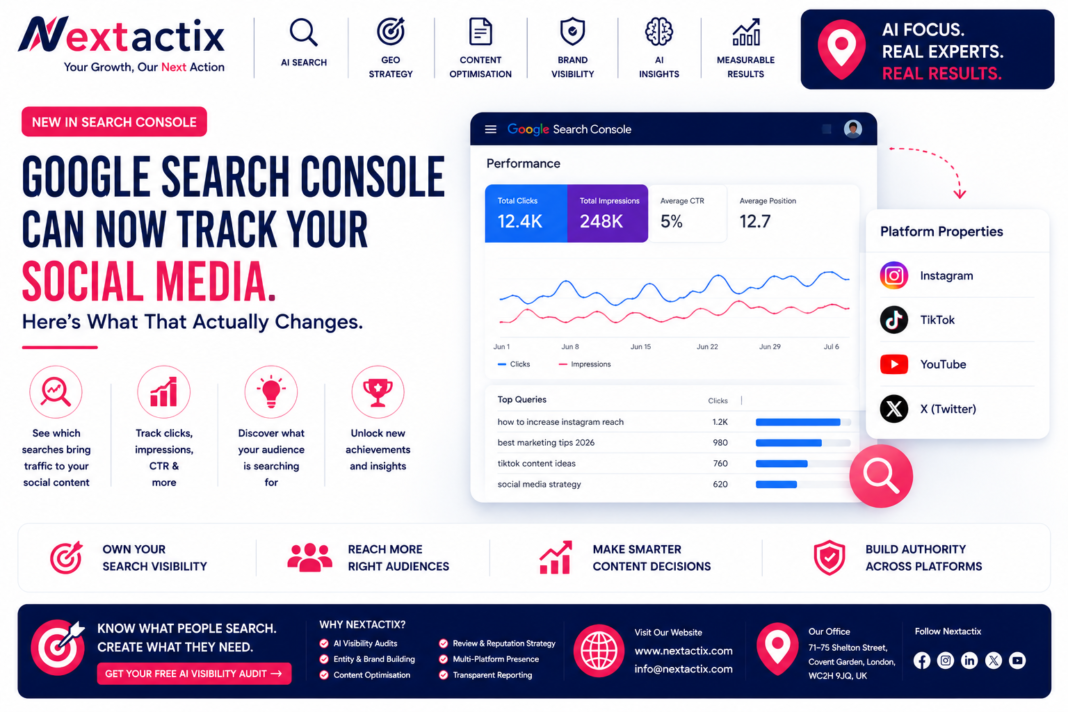
On 7 July 2026, Google published an announcement on its Search Central Blog that most people in marketing would have considered unlikely three years ago: Search Console can now track how your Instagram posts, TikTok videos, YouTube content, and posts on X perform in Google Search.
The feature is called platform properties. It is not a minor update to an existing report. It is an entirely new property type — the same way a website is a property in Search Console, your Instagram account is now a property in Search Console. And the implications, if you spend any time thinking about them properly, run considerably deeper than a new dashboard to check on Monday morning.
What Was the Problem Before
For years, Google Search Console had a blind spot that anyone running social media alongside a website knew well. If someone found your brand by Googling a topic and your YouTube video appeared in the results, you had no clean way to see that inside Search Console. You could see how your website pages performed. You could not see how your YouTube channel performed. The two were measured in completely separate places, with no easy way to connect them.
The same was true for Instagram Reels appearing in Google’s visual results, TikTok videos showing up when people searched for how-to content, and posts on X surfacing for real-time news or commentary queries. All of that search performance was effectively invisible in the tool that most SEO and marketing teams use as their primary measurement home.
Google made a small attempt to address this in December 2025, when it quietly added ‘social channels’ to the Insights report for a limited set of websites. It auto-detected channels associated with a site and pulled in some data. It was useful but limited — it was tied to your website property, not something you set up independently, and it covered the Insights view only, not the full Performance report.
What launched on 7 July is a different thing. It is a distinct, independently verified property type. You set it up yourself, you verify it by signing in to the platform, and it feeds a full suite of reports: Performance, Insights, and Achievements. And critically, it does not require you to have a website at all.
A creator who has built an audience entirely on YouTube and TikTok, and has never set up a website, can now open Search Console and see exactly which searches are sending people to their content. That is a genuine change in who this tool is for.
What Platform Properties Actually Shows You
The Performance report for a platform property works the same way as the Performance report for a website — because it is the same report, just pointed at a different type of content. You see total clicks, total impressions, average click-through rate, and average position. You can filter by query, by post, by date range. You can export the data.
The Queries tab is where most of the value sits. That list shows you the actual search terms people typed into Google before clicking through to your Instagram post or YouTube video. This is information most social media managers have never had access to before in any clean form. You can see, in your customers’ own words, what they were looking for when your content showed up.
The Insights report gives you the high-level picture — recent traffic trends, your top-performing posts in Search, and how people are discovering your account on Google. It is less granular than the Performance report but easier to read at a glance. The Achievements section tracks milestones — when you cross a new personal high for clicks or impressions in the last 28 days. That might sound cosmetic, but it is actually a useful signal: if a post is breaking your records while it is still fresh, that is the moment to create more content on the same topic or expand it into something longer.
One important clarification from Google’s own documentation: platform properties only show how your content performs on Google Search, including News and Discover. They do not show how your content performs inside Instagram, TikTok, X, or YouTube themselves. The native platform analytics — views, likes, saves, follower growth — are still only available inside each platform. This tool is specifically about how your social content shows up when people search on Google.
How the Setup Works
Google’s own help documentation describes this as a minutes-long process, and that appears to be accurate. There are no DNS records to update, no HTML tags to add to a website, no code involved.
You open Search Console, click the property selector dropdown in the sidebar, and choose Add property. The supported platforms appear as options alongside the usual website property type. You select your platform — Instagram, TikTok, X, or YouTube — and follow the on-screen steps to authorise the connection. Verification happens by signing in to the relevant platform account, which Google uses to confirm you control it.
If you have accounts on multiple platforms, you add each one as a separate property. If you manage more than one Instagram account, each becomes its own property. The data starts accumulating from the point of connection — there is no historical data imported, which is the same as how website properties work. The earlier you set it up, the more history you build.
One practical note from Google’s documentation: verification is periodically rechecked. If the connection between Search Console and your platform account lapses — because an external login expired, for example — reporting pauses until you re-verify. When you do re-verify, your previous data is still there; you do not lose history or have to wait for data to rebuild.
The rollout is gradual. Google confirmed the feature is being introduced over several weeks, so if you open Search Console today and the platform options are not showing yet, that is expected. It is not an account issue or a setup error. Check again in a week or two.
Why This Matters More Than It Might Initially Seem
The practical use case that most guides are describing is the obvious one: you can now see which of your social posts are getting found on Google. That is valuable. But there are several implications that go further.
Social content is already part of how Google generates AI answers
Google has been pulling social and video content — particularly YouTube and increasingly Instagram Reels and TikTok — into its AI Overviews and Discover feed for some time. The September 2025 integration of Instagram, X, and YouTube Shorts into the Discover feed is the structural reason that platform properties now exist as a data product: Google needed a way to surface that performance data back to creators.
If you are thinking about AI search visibility — how your brand appears in Google’s AI Overviews, not just the blue link results — your social content is now part of that picture. A YouTube video or an Instagram post can appear in an AI Overview in a way that a blog article cannot. Platform properties is the tool that lets you measure whether that is happening for your content.
The data bridges a gap that has caused real strategic confusion
For years, SEO teams and social media teams inside the same organisation operated with different data, different goals, and often different definitions of success. The SEO team watched Search Console for website performance. The social team watched native platform analytics for engagement. Neither had a clean view of how the other’s work was performing on Google.
Platform properties creates a shared dataset. When a 60-second TikTok is generating 4,000 impressions per month for a high-intent search query, that information is now visible in the same tool your SEO team is already using. It creates a direct, data-backed reason for SEO and social teams to talk to each other about content strategy — and for social content to be planned with Google search intent in mind, not just platform algorithm performance.
The query data is an underrated strategic asset
The most underused thing in most Search Console accounts, for website properties too, is the Queries tab. People look at overall impressions and clicks, maybe check their top pages, and close the tab. But the query data — the list of actual search terms that people typed before finding your content — is the most direct available read on what your audience wants to know.
For social content, this data has never been available in any clean form before now. Knowing that your Instagram post about skincare ingredients is generating search traffic from queries like ‘what does niacinamide actually do’ and ‘is retinol safe to use every day’ tells you something specific: those topics have search demand beyond your existing follower base. That information should directly influence what you create next. It is keyword research, but drawn from what is actually working rather than what a tool predicts might work.
What This Does Not Do
A few things worth being clear about, because the coverage of this feature has not always been precise.
Platform properties do not show you how your content performs inside the social platforms themselves. If you want to know your TikTok view count, your Instagram reach, or your YouTube watch time, those numbers live inside each platform’s native analytics. That is not changing.
Platform properties also do not currently have Search Console API support. The data is available in the interface but not yet exportable through the API, which matters for teams that pull Search Console data into their own dashboards or reporting tools. Whether Google extends API access is not addressed in the launch announcement.
And the four platforms supported at launch — Instagram, TikTok, X, and YouTube — are the only four. Facebook, LinkedIn, Pinterest, Threads, and other platforms are not included yet. Google’s documentation notes that additional platforms may be added over time, but makes no specific commitment.
What to Actually Do With This
Set it up now, even if the data that comes back in the first few weeks is thin. The sooner you connect your accounts, the sooner data starts accumulating. Like website Search Console properties, the value grows over time as you build a longer history to compare against.
Once you have a month of data, the most useful starting point is the Queries tab in the Performance report. Look for search terms you were not intentionally targeting but that your content is showing up for anyway. Those are the accidental rankings — topics where you have demonstrated enough relevance that Google is already surfacing you, without you having specifically optimised for it. Those are the highest-confidence signals for what to create more of deliberately.
Look also at the gap between impressions and clicks. A post with high impressions and a very low click-through rate is appearing in search results but not compelling people to tap through. That is a thumbnail, headline, or context problem — the content is discoverable, but something about how it is presented in search results is not working. That is a fixable problem once you can see it.
For businesses thinking about the broader question of AI search visibility — how your brand appears in Google AI Overviews, in Perplexity, in ChatGPT — your social presence is now formally part of that picture. A YouTube channel that consistently generates search traffic from high-intent queries is building the same kind of entity authority that traditional website SEO builds. Platform properties is the tool that finally makes that visible.
Search Console started as a tool for website owners. It is now a tool for anyone who creates content that appears in Google Search — whether or not they own a website.
The Bigger Picture
There is a thread running through almost everything Google has done to Search Console in the last eighteen months — custom annotations in November 2025, the Search Console Insights integration in June 2025, AI query grouping in October 2025, and now platform properties. The tool is being expanded to reflect the reality that Google Search is drawing from a much wider range of content sources than a list of websites, and that the people who need measurement data to make decisions have broadened well beyond traditional webmasters.
Platform properties is the clearest signal yet that in Google’s model of search, your brand’s online presence is not just your website. It is everything that appears when someone searches for your name, your products, your topics, or your category — including the content you publish on platforms you do not own.
For businesses that have been treating social media and SEO as separate budgets with separate goals and separate measurement frameworks, this is a nudge from Google itself that the separation is an accounting fiction. The search performance is already unified. The measurement is catching up.
If you want help understanding how your Google presence — website and social combined — looks right now, and what the data is actually telling you, NextActix offers a free search and AI visibility audit that covers both.