


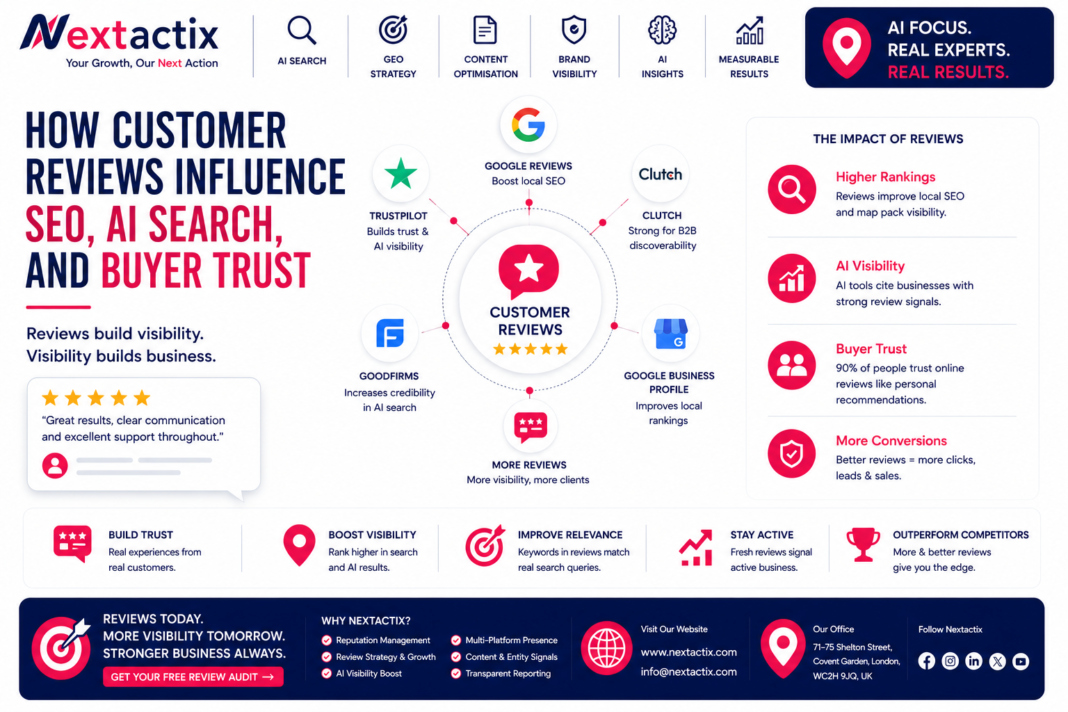
In 2024, reviews helped convert visitors who already found you. In 2026, reviews determine whether visitors find you at all.
That shift — from conversion tool to discovery signal — is what makes customer reviews one of the most underestimated assets in a business’s online strategy right now. Most businesses treat reviews as reputation management: something you monitor, respond to occasionally, and hope stays positive. That mindset is about two years behind where reviews actually sit in the search ecosystem.
Let’s work through exactly how they function — across traditional search, AI-driven discovery, and the buyer psychology that connects both.
What Google Actually Does With Your Reviews
Google has publicly confirmed that reviews are a component of its local ranking algorithm. More specifically, they affect what Google calls ‘prominence’ — one of the three factors (alongside relevance and distance) that determine where your business appears in local search results, including the map pack.
But the mechanism is more nuanced than ‘more reviews equals higher ranking.’ Google’s local algorithm evaluates review volume, average star rating, recency, and the keywords that naturally appear inside the review text. That last one surprises most business owners. When a customer writes ‘best physiotherapist in Nottingham for sports injuries,’ those words become searchable signals. The business becomes findable for a phrase that never appeared on its website, because customers used it to describe what they experienced.
This is what researchers call review-as-content. It is user-generated text that contributes to how Google understands and categorises your business — and it is completely outside your control to create, which is precisely why Google weights it as a trust signal.
Review velocity matters as much as review volume. A business with 200 old reviews and no recent ones looks stagnant to Google. A business with 40 reviews, 15 of them from the last 90 days, looks active and relevant.
74% of consumers only trust reviews from the last three months. Google’s algorithm reflects a similar preference. A steady stream of five to ten new reviews per month consistently outperforms a historical accumulation that stopped growing.
The Platform Question: Which Reviews Actually Matter
The honest answer is that it depends on what you’re trying to achieve — and who your buyer is.
Google Reviews carry the most direct local SEO weight. They feed directly into your Google Business Profile, which powers the local map pack. For any business that serves customers in a specific area — a clinic in Leeds, a law firm in Birmingham, a digital agency serving Nottingham businesses — Google Reviews are the first priority.
Trustpilot matters significantly for consumer-facing businesses and for AI search visibility. ChatGPT, Perplexity, and Google’s AI Overviews treat Trustpilot as a credible, structured source and pull from it regularly when generating brand descriptions. A business with a strong Trustpilot profile is more likely to be described accurately and positively in AI-generated answers than one that exists only on Google.
For B2B service businesses — digital agencies, software companies, consultancies — Clutch and GoodFirms carry disproportionate weight. AI systems have been observed pulling from these platforms specifically when answering questions about professional service providers. A NextActix client comparing digital agencies, for example, is more likely to encounter Clutch summaries in ChatGPT responses than Google Reviews.
The multi-platform picture is not optional. Research from Trustmary found that brands with reviews spread consistently across multiple platforms see AI citation rates three to five times higher than those concentrated on a single review source. AI cross-references what it finds. Consistent signals from several platforms add up to genuine authority. A single platform, however strong, is easier for the model to dismiss as limited evidence.
How AI Systems Actually Read Your Reviews
Traditional search engines processed reviews mainly for sentiment and star ratings. AI systems go considerably deeper. Large language models perform natural language processing across your entire review history to build what researchers describe as an entity profile — the model’s internal understanding of what your business is known for, who it serves well, and what it consistently delivers.
If 30 of your reviews mention ‘clear communication’ and 5 mention ‘slow response times,’ the AI does not average those observations. It learns both associations and surfaces your business as one that communicates well — while registering the support issue separately. The dominant, recent pattern wins. This is why a strategic approach to review collection — not manufactured reviews, but actively encouraging satisfied clients to be specific — pays dividends beyond just the star rating.
A review that says ‘five stars, great service’ teaches the AI almost nothing about what kind of service it was, who it was for, or what problem it solved. A review that says ‘NextActix helped us recover from a Google spam update penalty in four months — our Nottingham SEO traffic is now higher than before the drop’ is searchable, citable, specific, and instructive to both Google and AI about exactly what this agency does and for whom.
The Buyer Trust Layer
All of this would matter less if reviews didn’t also directly influence whether someone actually contacts you after they find you. Around nine in ten people make purchasing decisions based on online reviews — and that figure has been consistent across multiple surveys over several years, which suggests it reflects something real about how people process decisions rather than a trend.
What buyers are actually doing when they read reviews is running a risk assessment. A transaction with a new business always carries uncertainty. Reviews reduce that uncertainty by providing third-party evidence from people who took the risk before them. The more specific those reviews are — real names, specific outcomes, honest descriptions of what the process was like — the more effectively they reduce perceived risk.
Star ratings influence click-through rates in search results. When Google shows two similar businesses in the local pack and one has 4.8 stars with 60 reviews versus the other’s 4.1 stars with 15 reviews, the first business wins the click without the searcher even visiting either website. That effect compounds with rankings: more clicks validate the ranking, which reinforces it over time.
How to Build a Review Strategy That Serves All Three Goals
The businesses with the strongest review profiles in 2026 are not the ones who got lucky with enthusiastic customers. They built a consistent practice around three things: asking, timing, and specificity.
Asking is the part most businesses skip. Most satisfied customers do not leave reviews unless prompted, because leaving a review requires effort and there is no immediate reward for doing it. Asking directly — ideally at the moment the positive experience is freshest, whether that is immediately after a project delivery, a service completion, or a successful outcome — is what separates a business with 8 reviews from one with 80.
Timing matters because review recency is a ranking signal. A review request sent three weeks after the work is done is less likely to produce a detailed, specific response than one sent the same day the client says they are happy. The emotion is fresher. The details are clearer. The motivation to help is higher.
Specificity comes from how you frame the request. Asking ‘can you leave us a Google review?’ gets you a star rating and three words. Asking ‘could you mention in the review what service you used, where your business is based, and what changed as a result?’ gets you the kind of review that functions as both trust signal and SEO content.
Respond to every review — including the critical ones. Google has confirmed that response rate is a local ranking signal. Beyond rankings, a thoughtful response to a negative review often does more trust-building than another five-star rating, because it shows prospective customers how you handle problems. Buyers are not expecting perfection. They are evaluating how you behave when things go wrong.
At NextActix, reviews from clients on Trustpilot, Google, Clutch, and GoodFirms feed into how we appear in AI search and how prospective clients assess us before they make contact. If you want to know how your current review profile is affecting your visibility in Google and AI search, our free audit covers both.