


When you are considering hiring a digital marketing agency, you will read the word ‘transparent’ on almost every website you visit. It appears in value statements, in service descriptions, in client testimonials. It is used so often, and defined so rarely, that it has become nearly meaningless as a claim.
So here is a more useful question: what does transparency actually look like when it is real? Not as a brand value, but as a practice — something you can check for, ask about, and hold an agency accountable to once you start working with them.
The Reporting Problem
The most common way agencies fail on transparency is not through dishonesty. It is through vagueness. Monthly reports that show traffic trends without connecting them to business outcomes. Ranking reports that list positions without explaining whether those positions are driving enquiries. Campaign summaries that describe activities completed without giving you any way to evaluate whether the activities were the right ones.
According to the SoDA Report, agencies with live client dashboards — where clients can check their own data at any point without waiting for a scheduled report — retain clients 34% longer than those delivering static monthly reports. The reason is fairly intuitive: when you can see what is happening at any time, you are less anxious between calls. When you have to wait for a monthly PDF, every quiet week feels like evidence that something is being hidden.
A genuinely transparent agency gives you access to the data, not just a summary of it. You should be able to see your keyword rankings, your organic traffic trends, your Google Search Console data, and your campaign performance without asking. The report should interpret that data and explain what it means — but the underlying data should always be available to you directly.
The difference between a transparent report and a standard agency report is simple: a transparent report tells you what changed, why it changed, and what comes next. A standard report tells you what happened.
What the NextActix Client Dashboard Does Differently
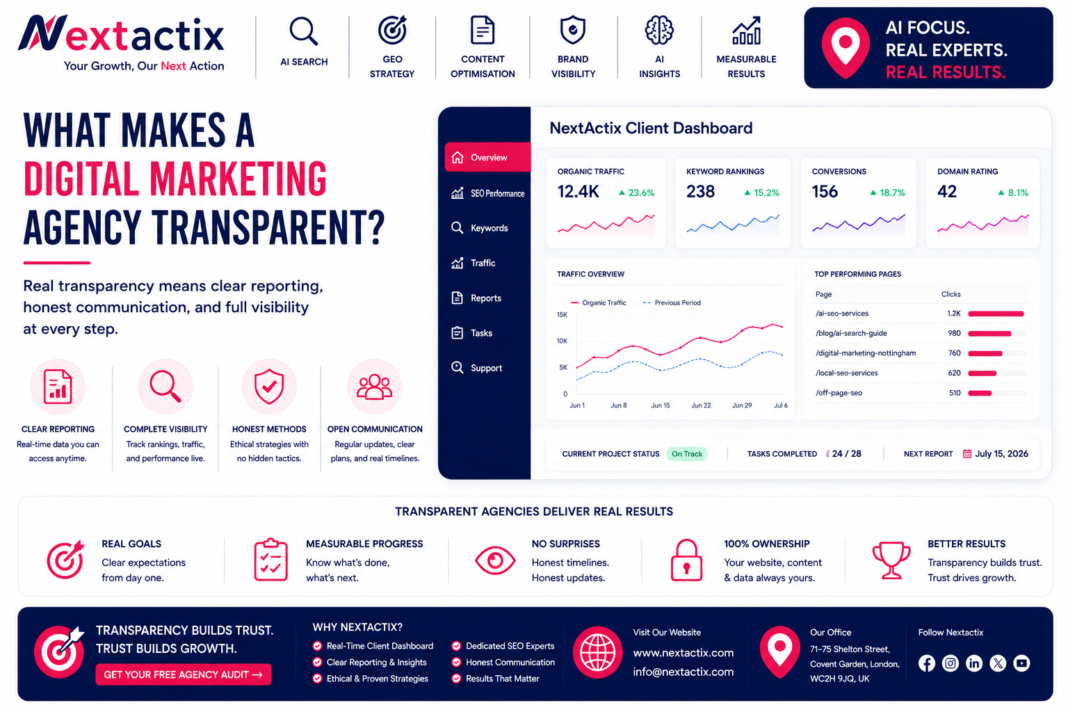
We built the NextActix Client Dashboard because we found that monthly reports, however well written, were creating anxiety rather than reducing it. Clients who had to wait four weeks between updates had no way to know whether their campaign was on track or whether a dip in the previous week was something to be worried about.
The dashboard gives every active NextActix client real-time access to their project status, monthly deliverables, SEO performance data, and campaign reports in one place. Not a PDF. Not a static screenshot. Live data, updated continuously, accessible whenever you want to check it.
What that changes in practice is the nature of our client conversations. Instead of spending the first ten minutes of a call establishing what happened last month, we start from a shared understanding of what the data shows — and spend the time on decisions about what to do next. That is a better use of everyone’s time, and it is only possible when the client has access to the same information the agency team has.
Transparency About Methods
Reporting is one dimension. What an agency actually does with your website and your marketing budget is another, and it is where transparency gets harder to evaluate.
A transparent agency can explain, in plain English, exactly what work will be done each month — not in vague categories like ‘link building‘ or ‘content marketing,’ but specifically: what kinds of links, on what kinds of sites, built through what methods. What content, on what topics, targeting which keywords, for what purpose.
Ask any agency you are considering to describe their link-building approach in detail. If the answer is evasive, or involves terms like ‘proprietary techniques’ or ‘our network of publishers,’ be careful. Ethical link building is not a trade secret. It is guest posts on real publications, digital PR, directory listings, and relationship-based placements. Any agency doing this work should be able to show you examples of the actual links built for previous clients.
The same applies to content. ‘We create SEO content for your website’ is not a description of a method. Which topics, based on what keyword research, written to what brief, reviewed by whom, published how frequently? These are questions a transparent agency answers without hesitation because they have clear answers ready.
Transparency About Timelines and What’s Realistic
One of the clearest signals of an agency’s honesty is what they say about timelines when you first enquire. Any agency that tells you they can get you to page one of Google in 30 days, or that their approach will produce results within a month, is not being straight with you.
SEO in competitive markets takes time. The honest answer — which is the only honest answer — is that meaningful ranking movements typically take three to six months of consistent work, and significant competitive gains take longer. An agency that tells you this upfront, explains why, and sets expectations accordingly is one you can trust when the first monthly report arrives without dramatic results.
At NextActix, we tell every prospective client the realistic timeline for their specific situation before they sign anything. That conversation sometimes loses us business from clients who want faster promises. We would rather lose that business than create an expectation we cannot meet.
What to Ask Before You Hire
The transparency of an agency is easiest to evaluate before you sign, not after. These are the questions worth asking during your first conversation:
- Can I see an example of a monthly report you produce for a client, and can you walk me through it?
- What access will I have to my own data — can I log in and check it independently?
- What specific link-building methods do you use, and can you show me examples of links built for previous clients?
- What is the realistic timeline for my specific market and what would meaningful progress look like at month three versus month six?
- What happens to my website, content, and links if I decide to leave?
That last question matters more than most people think. A transparent agency will tell you that everything belongs to you — the website code, the content, the links — and that you can take it all if you leave. An agency that hedges on this, or builds your campaigns in proprietary platforms that you cannot export, is structuring the relationship to be difficult to exit. That is not transparency. That is dependency.
If you want to see what a transparent client reporting relationship looks like in practice, NextActix’s Client Dashboard is available to all active clients from day one. Ask us to show it to you during your first conversation.