


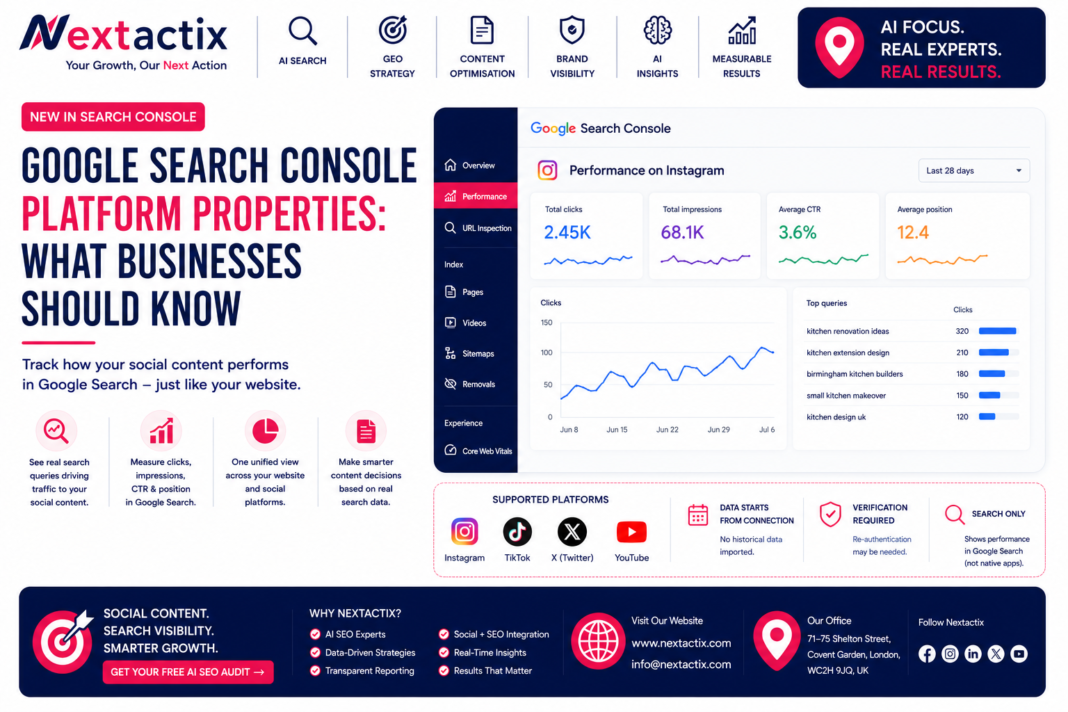
If you opened Google Search Console recently and noticed new options for connecting Instagram, TikTok, YouTube, or X, you were seeing something that did not exist six months ago. Google officially launched platform properties on 7 July 2026 — a new property type that lets you track how your social media content performs in Google Search, the same way you have always tracked how your website performs.
The rollout is gradual. Not every Search Console account has it yet, and Google has been transparent that it is being introduced in stages over several weeks. If it has not appeared in your account, that is expected — not a problem with your setup.
Here is what the feature actually does, who it is most useful for, and what the data means once you have it.
What Changed and Why It Matters
Until now, Search Console was a tool for website owners. If your YouTube channel appeared in Google Search results — which YouTube content regularly does — you had no clean way to see that performance in Search Console. You could see it in YouTube Studio’s own analytics, but that showed performance inside YouTube, not performance in Google Search.
Platform properties closes that gap. You connect your social account as a property, Google verifies that you control it, and you start receiving the same Performance report data for that account that you get for your website: total clicks from Google Search, total impressions, average click-through rate, and average position.
The Queries tab is where most of the practical value is. It shows the actual search terms people typed into Google before clicking through to your Instagram post, TikTok video, or YouTube content. For most businesses and creators, this is genuinely new information — search keyword data for social content that previously existed nowhere in a clean, accessible form.
One Clarification Worth Making Early
Platform properties only show how your content performs on Google Search. They do not show performance inside the social platforms themselves — view counts, follower growth, likes, shares, or anything else that happens within Instagram, TikTok, YouTube, or X. That data still only lives inside each platform’s native analytics.
This distinction gets blurred in some of the coverage of this feature. The tool is specifically about Google Search performance for social content. It is an SEO tool, not a social media analytics tool.
How the Setup Works
The process is designed to take a few minutes. In Search Console, click the property selector and choose Add property. The supported platforms appear as options — Instagram, TikTok, X, and YouTube — alongside the usual website property type. You select your platform, follow the on-screen steps, and verify by signing into the relevant account. Google uses that login to confirm you control the account.
Each account is added as a separate property. If you manage several social profiles, each one gets its own property. Data begins accumulating from the point of connection — there is no historical import, which is the same as how website properties work. The earlier you set it up, the more data you build over time.
One practical note from Google’s documentation: verification is periodically rechecked. If the connection lapses — an authorisation token expiring, for example — reporting pauses until you re-verify. Your historical data is retained; you do not lose what was collected before.
Who Gets the Most From This
For businesses that publish social content consistently and whose content appears regularly in Google Search results — which is more common than many realise, particularly for YouTube and Instagram Reels — this feature creates a meaningful new measurement capability.
The most immediately useful application is the Queries tab. A business that has been posting Instagram content about kitchen renovations in Birmingham, and suddenly has Search Console data showing that specific searches like ‘kitchen extension ideas Victorian terrace’ are generating clicks to their posts, has learned something valuable: there is organic search demand for that topic, and their content is already meeting some of it. That should directly influence what they create next.
For SEO and marketing teams inside larger organisations, the feature matters because it creates a shared dataset between SEO work (traditionally website-focused) and social media work (traditionally platform-focused). When a YouTube video is generating 3,000 Google Search impressions per month for a keyword the website is not ranking for, that is information both teams need to have — and previously, neither had it in a form they could act on.
A brand’s Google Search visibility now includes its website and its social content. Platform properties is the measurement layer that finally makes both visible in the same place.
What the Limited Rollout Means in Practice
Google confirmed the feature is being introduced gradually. This has two implications worth noting.
First: if you do not see the platform property options in your Search Console account yet, check again in one to two weeks. The absence is not something you need to troubleshoot.
Second: early access is worth using strategically. Every week that passes without setting up the property is a week of data you are not collecting. The day you connect your accounts is the day your data history starts. Businesses that connect in July 2026 will have six months of historical comparison data by January 2027. Those that wait until the feature is widely discussed in late 2026 will be starting from scratch.
What It Does Not Do
For completeness: the four supported platforms at launch are Instagram, TikTok, X, and YouTube. Facebook, LinkedIn, Pinterest, and other platforms are not currently supported. Google’s documentation notes that additional platforms may be added, but gives no specific timeline.
There is also no Search Console API access for platform property data yet. If your team pulls Search Console data into custom dashboards or reporting tools via the API, platform property performance will not be available through that method for now.
If you are thinking about how your social content and your website SEO fit together as part of your Google visibility strategy, NextActix’s AI SEO audit covers both — including how to connect your social and search presence into a single coherent strategy.