


If you spend any time reading about digital marketing right now, you’ll come across a lot of strong opinions about AI and search. Some people say SEO is dead. Others say it’s fine and nothing has changed. The truth, as usual, is somewhere in the middle and considerably more interesting than either extreme.
This post tries to explain, in genuinely plain terms, how AI-powered search actually works — the mechanics of it — and what that means for anyone with a website who cares about being found online. No hype, no panic, just an attempt at clarity.
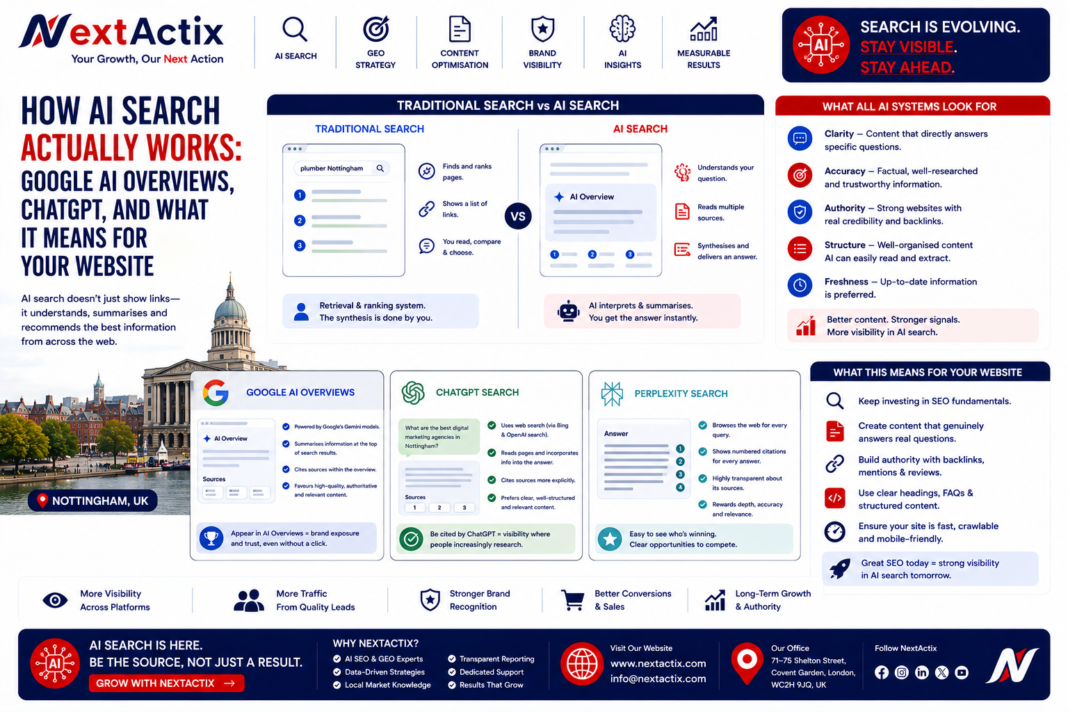
Traditional Search vs AI Search: The Core Difference
To understand what’s changed, you need to understand how traditional search works. When you type a query into Google, its algorithm evaluates billions of web pages and ranks them by estimated relevance and quality. The result is an ordered list of links — ten blue links, in the classic formulation, though Google’s results pages have been much more complex than that for years now.
The key point is that traditional search is a retrieval and ranking system. It finds documents and orders them. It doesn’t interpret or synthesise. The synthesis is done by the human doing the searching.
AI search changes this. When Google’s AI Overviews generate a summary at the top of a results page, or when ChatGPT answers a question, the system is doing something different: it’s reading multiple sources (or drawing on training data that contains those sources), synthesising the relevant information, and presenting a single composed answer. The AI is doing the synthesis, not the user.
How Google AI Overviews Work
Google’s AI Overviews (which replaced the earlier ‘Search Generative Experience’ in 2024) appear at the top of search results for a subset of queries — mostly informational ones where a direct answer is helpful. They’re generated by Google’s Gemini models, which are large language models trained on Google’s index of web content.
When a query triggers an AI Overview, Gemini reads a selection of high-ranking web pages, synthesises the key information relevant to the query, and generates a summary. That summary often links to the sources it drew on, which appear as small cited cards within or alongside the overview.
This is important for website owners: appearing as a cited source in an AI Overview is meaningful brand exposure. The user sees your site name associated with the information they were looking for, even if they don’t click through. And the pages most likely to be cited are those that Google already considers high-quality and trustworthy — which means that, fundamentally, ranking well in traditional search and appearing in AI Overviews require the same underlying work.
How ChatGPT Search Works
ChatGPT’s search capability (via Bing integration and OpenAI’s own search features) works somewhat differently. When you ask ChatGPT a question that requires current information, it performs a web search, retrieves relevant pages, reads them, and incorporates the information into its response. It’s closer to having a research assistant read the internet on your behalf and summarise what it finds.
ChatGPT tends to cite sources more explicitly than Google’s AI Overviews, often providing clickable references. Being cited by ChatGPT requires your content to: be indexable by Bing (since that’s the search engine it uses), be well-structured and clearly written so the AI can parse it accurately, and be relevant enough to the query to be selected from the retrieved set.
How Perplexity Works
Perplexity is probably the most transparent of the major AI search tools about how it works. Every Perplexity answer comes with numbered citations, and clicking through to those sources is a central part of the product experience. Perplexity actively browses the web for each query, pulling from what it considers the most relevant and reliable sources.
For businesses, Perplexity is interesting because its citation behaviour is very visible. You can ask Perplexity about your industry or location and see exactly what sources it’s drawing on. This gives you a direct view into which sites are winning AI-generated visibility — and often reveals opportunities where your content could compete if it were better structured or more comprehensive.
What All These Systems Have in Common
Despite the differences in how they work, Google AI Overviews, ChatGPT search, and Perplexity all share some important characteristics in terms of what content they prefer to cite:
- Clarity. Content that directly answers the question being asked, without burying the answer in preamble or padding, is easier for AI systems to extract and use.
- Accuracy. AI systems are increasingly good at cross-referencing claims against other sources. Content that contains factual errors is less likely to be trusted.
- Authority. Well-established websites with strong backlink profiles and a track record of ranking well in traditional search are disproportionately likely to appear in AI-generated responses.
- Structure. Clear headings, well-organised sections, and — where appropriate — FAQ-format content are all easier for AI models to parse than dense, undifferentiated prose.
- Current information. All these systems prefer up-to-date content. Outdated information that contradicts more recent sources is less likely to be cited.
What This Means for Your Website
If you’ve read this far, you probably want to know what to actually do. Here’s the practical answer:
Continue investing in SEO. The signals that drive strong organic rankings — quality content, authoritative backlinks, technical performance, structured data — are the same signals that drive AI citation. They’re not separate things.
Write content that genuinely answers questions. Not content written to hit a keyword count, but content that a reader (or an AI) could extract a real answer from. Ask yourself: if an AI summarised this page, would the summary be accurate and useful?
Make sure your technical foundations are solid. If your pages can’t be crawled, indexed, and rendered properly by search engines, AI systems can’t use them as sources either.
Don’t panic about zero-click searches. The traffic that matters most — people ready to contact or buy from a business — still clicks. The informational searches that are increasingly answered by AI are, for most businesses, a smaller portion of valuable traffic than the commercial searches that still produce traditional results.
AI search is changing things. It’s not ending SEO. The businesses that invest in genuine quality now will be the ones best positioned for whatever the search landscape looks like in five years — regardless of which particular AI tools dominate by then.