


A small accountancy practice in Bristol spent several months improving its website content. Better service pages, a regularly updated blog, proper keyword research. By most measures it looked like a solid SEO effort. Rankings improved slightly but never reached the first page on the terms that actually mattered.
A competitor with fewer blog posts and a simpler website was sitting comfortably above them. When the accountancy practice looked more carefully at the difference, it was not the content that set the two apart. It was the signals surrounding the content — the reviews, the third-party mentions, the consistency of the business information, the visible credentials of the people behind the site. The content was largely comparable. The trust environment was not.
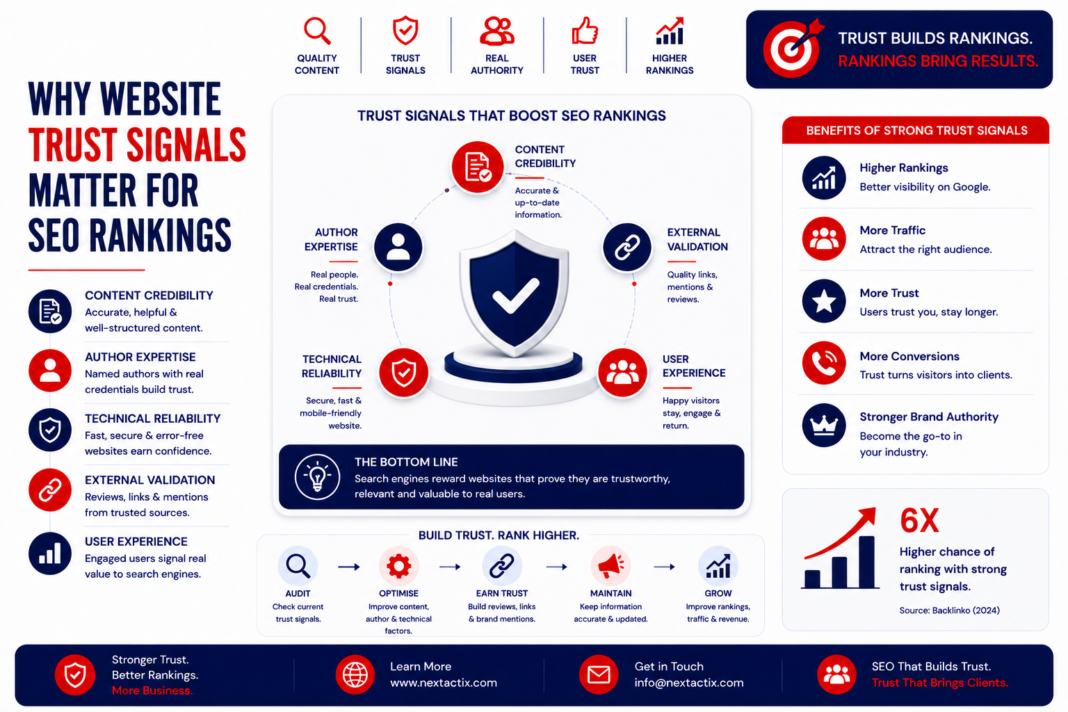
This is the gap that trust signals describe. They are not a single ranking factor but a collection of signals across your website and around it that tell search engines, collectively, whether your site is a reliable place to send a user. Understanding what they are, why they matter, and where businesses most often fall short is worth more to most websites than any individual content tweak.
What Trust Signals Actually Are
The phrase gets used loosely, so it is worth being specific. Trust signals are indicators — some technical, some editorial, some behavioural — that help search engines assess whether a website deserves a prominent, stable ranking for relevant queries.
They are not separate from SEO. They are SEO, but a dimension of it that many businesses underinvest in because the signals are less visible than rankings or traffic numbers.
Google’s quality rater guidelines, which are public documents that describe how human evaluators assess search results, organise these signals around a framework called E-E-A-T: Experience, Expertise, Authoritativeness, and Trustworthiness. This framework applies to both the content on the page and the website behind it. A page about managing type 2 diabetes written anonymously on a domain with no medical credentials will be assessed very differently from an identical piece written by a named NHS-registered dietitian on a recognised health platform, even if the words are similar.
That distinction — not just what you say, but who is saying it and whether anyone independent confirms it — is the essence of what trust signals communicate.
Why Search Engines Need These Signals
Search engines cannot personally verify everything on the web. They have to make probabilistic decisions about which sources are genuinely reliable and which are merely presenting themselves that way. Trust signals exist because they are harder to fake at scale than content alone.
Anyone can write a convincing-sounding article about financial planning. Earning a genuine mention in a recognised financial publication, building a consistent review record over years, having a named author with verifiable credentials, and maintaining accurate contact information across multiple directories — these things take real effort and real credibility to accumulate. Search engines weight them accordingly.
This is also why Google’s helpful content updates and spam policies keep returning to the same theme: rewards for sites that demonstrate genuine usefulness and credibility, and reduced visibility for sites that optimise surface signals without the substance underneath.
The Main Categories of Trust Signal
Content credibility
This covers whether the content on your site reads as genuinely knowledgeable and accurate. It includes obvious things like factual accuracy, but also subtler signals: whether claims are supported by named sources, whether the writing reflects real familiarity with the subject, whether the content is updated when circumstances change.
An outdated piece about GDPR compliance that still describes pre-2023 requirements is not just wrong — it signals to search engines that the site may not be maintained carefully enough to trust. Freshness and accuracy work together here.
Author and entity clarity
Knowing who is behind a website, and being able to verify that independently, matters more than it used to. A site where articles are published under a real name, with a biography that includes verifiable credentials and links to external profiles, performs better in quality assessments than one where content appears under “Admin” or a generic company name.
This is not about adding a fake author bio. Google’s quality raters are specifically trained to look for whether claimed expertise can be verified externally. The author should have a real presence elsewhere on the web — a LinkedIn profile, professional directory listing, published work on other sites — that corroborates what the bio claims.
Technical reliability
A website that loads slowly, breaks on mobile, has pages returning errors, or uses an insecure connection signals unreliability even if the content is excellent. These are not optional maintenance tasks — they are part of the trust profile the site presents.
HTTPS is the baseline. Google confirmed it as a ranking signal years ago, and browsers flag HTTP sites as not secure to users, which reduces engagement. Reduced engagement is itself a negative signal. The technical and behavioural signals feed each other.
External validation
When other credible websites link to, cite, or mention your site, it functions as third-party verification of your relevance and reliability. This is the traditional role of backlinks, but it extends beyond links. Press mentions without links, citations in academic or professional contexts, appearances on recognised directories relevant to your industry — all of these contribute to the external footprint that tells search engines your site is not operating in isolation from the wider world.
Quality matters enormously here. A handful of genuine, relevant mentions from credible sources carries more weight than hundreds of links from unrelated low-quality directories. In fact, the latter can harm trust rather than building it.
User behaviour
Search engines observe what happens after a user clicks your result. Do they stay and read? Do they navigate to other pages? Do they return? Or do they leave within seconds and click a different result instead?
These behavioural signals are not perfectly transparent, and Google has been cautious about how much it officially acknowledges using them. But the direction is clear: a site that users consistently find useful and engaging will perform better over time than one they consistently abandon quickly.
Where Businesses Most Often Go Wrong
The most common trust signal failure is not ignorance of the concept — most business owners have heard of E-E-A-T and reviews and backlinks. It is inconsistency.
A business with a strong review record on Google but a half-empty Trustpilot profile, an outdated LinkedIn page, and contact details that differ between its website and its Google Business Profile is sending mixed signals. Each individual element might be adequate in isolation. Together, they create an inconsistent picture that reduces the confidence a search engine can assign.
Another frequent gap is the anonymous website. Many small and medium business sites list no named individuals anywhere — no author names, no team pages, no professional credentials. This was fine for SEO a decade ago. It is a meaningful disadvantage now, particularly for businesses in categories where the credentials of the people involved directly affect the reliability of the service they offer.
Practical check: Search your own business name in Google. What comes up beyond your own website? Reviews, press mentions, directory listings, named professional profiles — if the answer is very little, that is the trust signal gap to address first.
Trust Signals and AI Search
The conversation about trust signals has taken on additional significance with the growth of AI-powered search. Tools like Google’s AI Overviews, ChatGPT, and Perplexity are making citation decisions that traditional rankings did not require. An AI system deciding whether to recommend your business in an answer to a user’s question is applying a version of the same trust assessment — is this source consistent, verifiable, and credible enough to cite?
The businesses appearing in AI-generated answers are, generally speaking, the ones that have built the kind of external, consistent trust presence described above. This is not a coincidence. The same signals that persuade Google to rank you prominently are the signals that allow an AI system to recommend you confidently.
Building Trust Signals Practically
None of this requires a large budget. Most of the foundational work is about consistency and visibility rather than spending.
Start with the basics that are directly within your control: accurate, consistent business information everywhere it appears online; named, credentialled authors on content that benefits from demonstrated expertise; a Google Business Profile that is complete and maintained; and technical fundamentals — site speed, mobile responsiveness, HTTPS — that are sound.
From there, build the external presence gradually: earn genuine reviews over time rather than chasing volume, look for relevant industry directories and publications where your business should logically appear, and make sure the people behind the business are visible enough online that their credentials can be independently confirmed.
The accountancy practice mentioned at the start eventually addressed most of these. The change in rankings did not happen quickly — this kind of work compounds over months, not weeks. But the gap it closed was the gap that content work alone had not been able to close, because content and trust signals are not the same thing, even though both matter.