


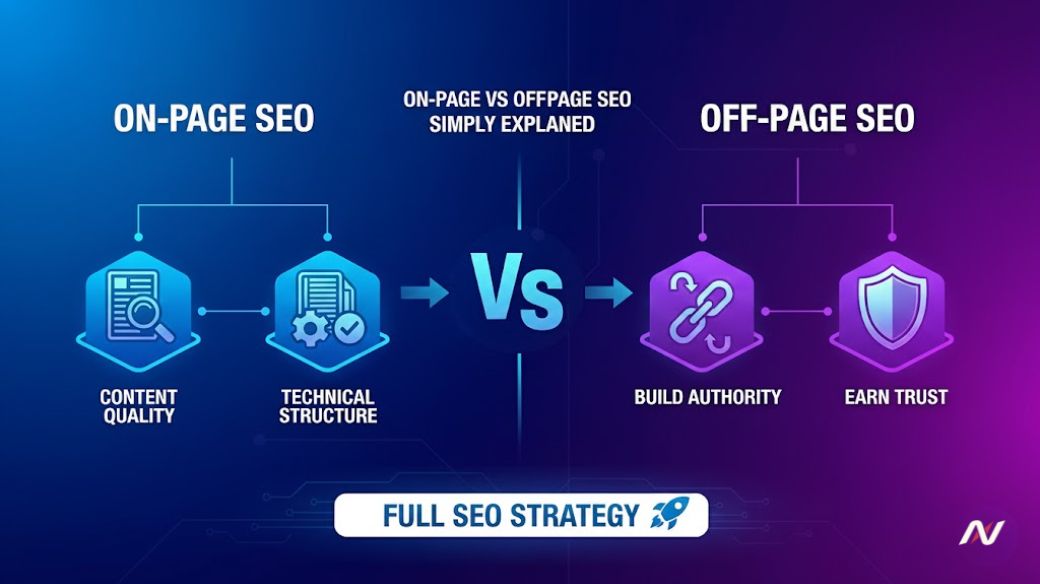
Search engine optimization is built on multiple components, but two of the most important are on-page SEO and off-page SEO. While both aim to improve visibility in search results, they work in very different ways. Understanding how these two areas function helps businesses build balanced strategies that support long-term growth rather than short-lived ranking gains.
Many websites struggle because they focus on only one side of SEO. Real progress happens when both are aligned correctly.
What Is On-Page SEO?
On-page SEO refers to all optimization activities performed within a website. These efforts help search engines understand what a page is about and whether it provides value to users.
Key elements of on-page SEO include content structure, page headings, internal linking, URL clarity, and overall usability. Search engines analyze how well a page answers a user’s query, how readable the content is, and whether the layout supports a good experience.
Well-optimized pages are clear, relevant, and easy to navigate. They avoid keyword stuffing and instead focus on delivering useful information in a logical format. On-page optimization also ensures that content aligns with search intent, which plays a major role in ranking stability.
Why On-Page SEO Matters
Search engines cannot evaluate a page properly without strong on-page signals. Even high-quality backlinks cannot compensate for poorly structured content or confusing layouts. Pages with weak internal structure often fail to rank consistently because search engines struggle to interpret their relevance.
On-page SEO creates the foundation for all other optimization efforts. Without it, off-page activities lose much of their effectiveness.
What Is Off-Page SEO?
Off-page SEO focuses on factors outside the website that influence credibility and authority. These signals help search engines determine how trustworthy a site is within its industry or niche.
The most well-known off-page element is backlinks, but authority is also shaped by brand mentions, citations, and overall digital presence. When other reputable websites reference your content, it indicates recognition and validation.
Off-page optimization is less about direct control and more about reputation. Search engines evaluate how your website is perceived across the web rather than how it is structured internally.
Why Off-Page SEO Matters
Search engines use off-page signals to measure trust. A website with strong content but no external recognition may struggle to compete against established sources. Off-page SEO helps confirm that a site is not only informative but also respected by others.
However, quality matters more than volume. Unnatural or irrelevant references can weaken credibility rather than strengthen it.
Key Differences Between On-Page and Off-Page SEO
On-page SEO improves clarity and relevance, while off-page SEO strengthens authority and trust. One focuses on what users experience directly, and the other reflects how the wider web responds to your content.
On-page optimization can be adjusted immediately, while off-page results take time to develop. Both require consistency and ethical practices to deliver sustainable results.
Why Both Are Needed for Long-Term Rankings
Search engines evaluate websites holistically. Strong on-page SEO ensures content quality and usability, while off-page SEO reinforces legitimacy. When these two areas work together, they create stable rankings that survive algorithm updates.
Focusing on only one side often leads to imbalance. Websites with excellent content but no authority remain invisible, while sites with strong links but weak pages struggle to convert traffic.
Building a Balanced SEO Strategy
A successful SEO approach starts with solid on-page optimization, followed by gradual off-page growth. Content should be refined first, ensuring it meets user expectations, before external promotion begins.
This balance allows search engines to recognize both relevance and trust, which are essential for consistent visibility.
Final Thoughts
On-page SEO and off-page SEO are not competing strategies. They are complementary components of a single system. Websites that invest in both areas thoughtfully are more likely to achieve steady rankings, stronger authority, and long-term organic growth.
Understanding the difference is the first step toward building an SEO strategy that delivers real results rather than temporary spikes.