


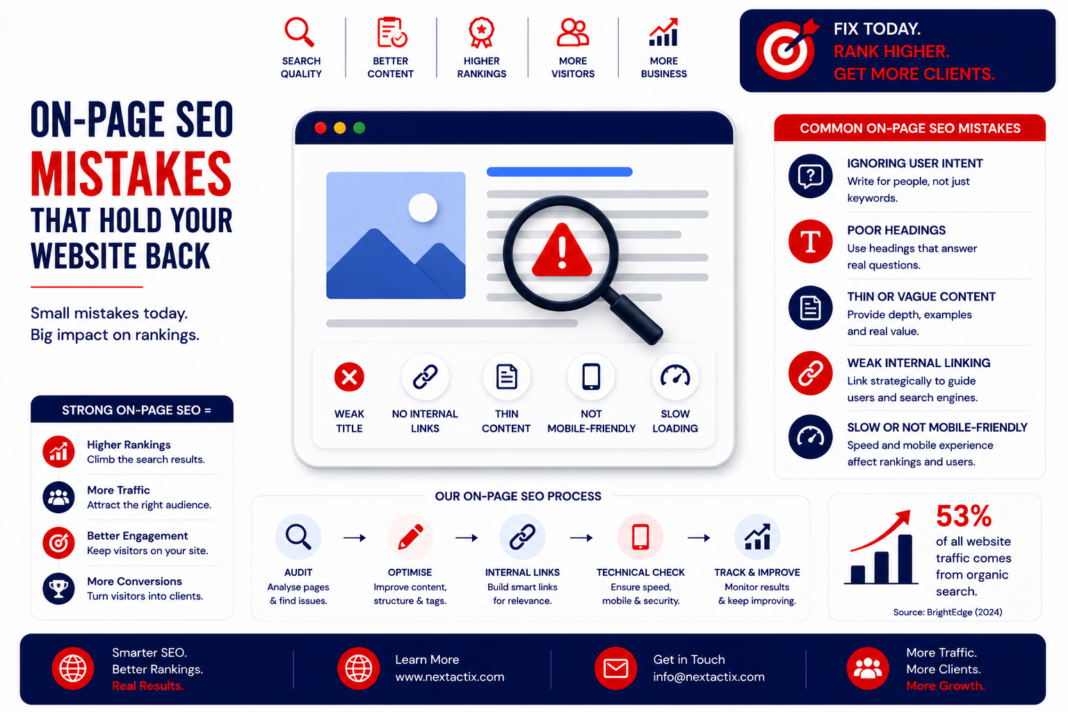
Most businesses that have invested meaningfully in their website have heard the basics of on-page SEO: write good content, use your keywords, fill in your meta titles and descriptions, make it mobile-friendly. The guidance is not wrong. But it leaves a significant gap between knowing what to do and actually doing it in a way that produces consistent results.
The on-page SEO mistakes that most often hold websites back are not usually dramatic. They rarely show up as an obvious technical error. They show up as a page that ranks on page two and never moves, or a piece of content that gets indexed and then disappears from view within a few weeks, or a site that attracts reasonable traffic but converts almost none of it into enquiries.
Understanding what is actually going wrong — and why it goes wrong — is more useful than another list of rules to follow. So this piece works through the most consequential on-page mistakes with the explanation behind each one, not just the label.
Writing for a Keyword Instead of a Question
This is the foundational mistake that underlies many of the others. A page built around “affordable accountants London” as a keyword target is trying to satisfy a ranking signal rather than a person. The person who typed those words into Google has a specific situation — they need an accountant, they are price-conscious, they are in London, and they want to know whether a particular firm might be right for them.
A page that leads with “we are affordable accountants based in London” and then describes the firm’s services in general terms has addressed the keyword without addressing the question. It has given the search engine the phrase it was looking for without giving the user the answer they came for.
Search engines have become considerably better at understanding the intent behind a query rather than just matching its words. A page that answers the real question — what does affordable mean in practice, what should I expect to pay, who is this service right for — will generally outperform a page that simply repeats the target phrase more naturally.
The useful test: Read the first paragraph of your page out loud. Does it directly answer the question someone searching that term would arrive with? Or does it describe your business without addressing what the visitor actually wants to know?
Content That Buries Its Point
Related to the above, but distinct enough to deserve its own discussion. A very common pattern on business websites is content that builds toward its point rather than starting with it. Three paragraphs of context before the actual answer. A service page that explains the history of the industry before explaining what the service does.
This was a natural writing style long before SEO existed. Many people write this way because it feels more complete. But it creates two problems simultaneously: search engines extracting a summary of the page to display in results have to work harder to find the most relevant sentence, and users scanning the page to see if their question is answered are more likely to leave before they find the answer.
The principle worth applying is simple: state the most useful thing first, then explain and support it. This feels backwards if you are used to building to a conclusion, but it reflects how people actually read web pages — not linearly from top to bottom, but scanning for the moment where something answers their specific need.
Headings That Do Not Reflect Real Questions
Headings on a web page serve two audiences: the human reader scanning for the section most relevant to them, and the search engine trying to understand what each part of the page covers. Most business website headings are written for neither.
“Our Services” tells a reader and a search engine almost nothing. “Why choose us?” is a heading that exists on hundreds of thousands of pages and has been drained of almost all meaning through repetition. “How We Deliver Results” sounds purposeful but says nothing specific.
Compare these to headings that reflect the actual questions people ask: “How long does it take to set up a limited company?” or “What’s included in a monthly bookkeeping package?” or “Do you work with businesses outside the UK?” These headings do something. They signal to a scanner that this section answers a specific question. They signal to a search engine that this page addresses a particular topic with specificity.
The headings on your page should be the questions your customers actually ask you, in the language they use when they ask them.
Keyword Density Thinking in Either Direction
Keyword stuffing — repeating the same phrase artificially throughout a page to signal relevance — remains a problem on some websites, particularly those built using older SEO practices or templates. Google’s ability to detect and discount this has improved considerably over the past several years. Pages built this way are not just failing to gain an advantage; they are often being actively filtered down in results.
But the overcorrection is also a real mistake. Some businesses, aware of the stuffing risk, avoid their primary topic language to the point of vagueness. A page about conveyancing solicitors that mentions conveyancing twice in 1,200 words, in an attempt to sound natural, is not being naturally relevant — it is being relevance-free.
The right approach is not counting keywords. It is writing the way a knowledgeable person would write when genuinely trying to explain the topic. That person would use the main term, its natural variations, related concepts, and the questions that surround the topic. They would not count how many times they used a phrase. They would focus on whether the explanation was clear and complete.
Internal Linking Done by Accident Rather Than Design
Most business websites have some internal links, but very few have internal links that were placed with any deliberate strategy. Pages link to other pages when it felt natural to mention them, or when a developer added related content modules automatically, or when an editor remembered to add a link to a relevant service page.
The result is typically a link structure where the homepage has many links pointing to it, a few key service pages have some links, and the long-tail content that might support rankings for specific queries sits in relative isolation with nothing pointing to it from the pages that already carry authority.
A simple way to think about this: every page on your site that you want to rank well should have at least two or three internal links pointing to it from pages that are themselves well-linked and clearly relevant. If you can’t easily create those links because there is no natural place for them, that is a signal that the site’s content structure needs more work.
Meta Titles Written as Formalities
A meta title is the headline that appears in a search result. It is usually the first thing a potential visitor reads about your page. It has a character limit of roughly 60 characters, after which Google typically truncates it.
Despite this, meta titles are routinely written as if they are internal filing labels rather than headlines. “Services | Company Name” conveys no value to someone scanning a page of search results. “About Us | Company Name” is similarly invisible. Even specific service pages often have titles that describe what the page is rather than why someone would want to click it.
A meta title has one job: to make the right person want to click the result rather than the others next to it. It should include the topic clearly, but it should also give a reason — specificity, a relevant qualifier, a direct connection to what the user was looking for. “Conveyancing Solicitors in Leeds | Fixed-Fee Quotes, No Hidden Costs” is a title doing real work. “Conveyancing Services | Smith & Partners” is a title doing almost none.
Pages That Neglect User Experience in Favour of Content Volume
One well-documented pattern in SEO is the assumption that more content always helps. Longer pages, more sections, more detail. Sometimes this is true. Often it is not.
A page with 3,000 words covering every conceivable angle of a topic is not automatically better than a 900-word page that answers the most important question directly and clearly. Google’s helpful content guidance is explicit on this point: content should serve the reader, not fill a word count. Padding — sections that exist to add length rather than value — is increasingly recognised as a quality signal in the wrong direction.
The question worth asking of any page is not “is this long enough?” but “does a person who arrived with this question leave with a clear, useful answer?” If the honest answer is that the page has too much and the core message is buried in it, the fix is subtraction rather than addition.
Neglecting What Happens After the Click
On-page SEO is often discussed as if the page exists in isolation — as if the only question is whether it ranks. But search engines are increasingly able to observe what happens after someone clicks a result: whether they stay, whether they navigate further, whether they return to the search results immediately.
A page that ranks but then fails to hold a visitor’s attention is giving search engines data suggesting that the ranking was not deserved. Over time, this matters. Pages with strong click-through rates and good engagement tend to hold and improve their positions. Pages that attract clicks but immediately lose visitors tend to drift downward, even if nothing about the page itself has changed.
This means on-page SEO cannot stop at the technical and content elements in isolation. The page has to actually work for the person who arrives on it. A clear structure, a readable format, a page that loads quickly on a phone, a visible and obvious next step for someone who is ready to get in touch — these are not design preferences. They are ranking factors through the indirect route of user behaviour.
What Fixing These Mistakes Looks Like
None of the mistakes above require a full website rebuild or a significant budget to address. They require looking at existing pages with genuine critical attention rather than the perspective of someone who created them.
Pick the three pages on your site that are most important to your business and that are currently underperforming relative to what you would expect. Read each one as if you found it in a search result and arrived with a specific question. Notice where the answer is and how long it takes to reach it. Read the meta title and ask whether it would make you click. Check the heading structure and ask whether each heading helps a scanner understand what comes next.
That process will surface more actionable fixes than any checklist, because it replaces the generic principle with the specific consequence — not “your headings should reflect real questions” but “this particular heading on this particular page tells me nothing and the visitor scanning past it is likely to keep scanning until they leave.”
On-page SEO problems are almost always solvable once they are seen clearly. The difficulty is usually not the fix — it is the honest assessment that the fix is needed in the first place.