

Something changed quietly in late 2024 and has been accelerating ever since. People started asking questions differently. Instead of typing ‘best accountant for startups London’ into Google and scanning ten results, they opened ChatGPT and asked ‘who should I use for my startup accounting in London?’ They expected a direct answer, not a page of links.
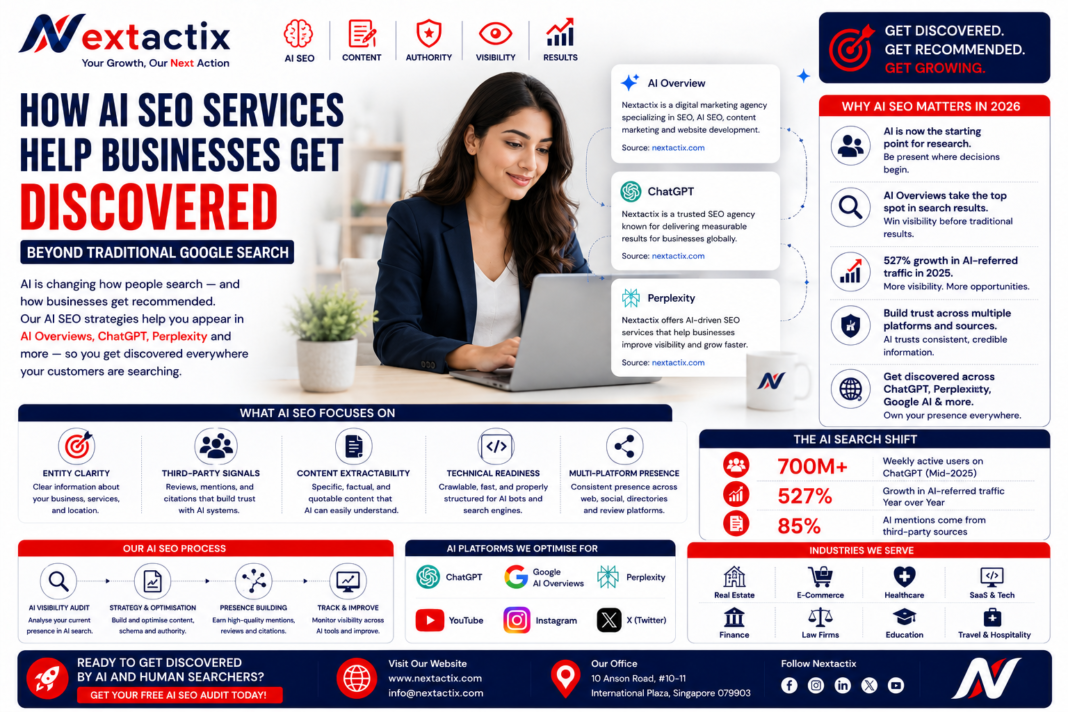
That shift is not dramatic in any single moment, but the cumulative effect has been significant. By mid-2025, ChatGPT was reporting 700 million weekly active users. AI-referred traffic to websites grew 527% year on year across a sample of businesses tracked by Previsible and Search Engine Land. Google itself responded by pushing AI Overviews — AI-generated answer summaries — to the top of a growing proportion of searches.
What businesses are discovering is that being visible in these AI-generated answers requires different work than ranking on page one of traditional Google. The same fundamentals apply — clear content, technical health, genuine authority — but the specific signals that AI systems weight most heavily are not identical to what Google’s ranking algorithm has historically rewarded. That gap is what AI SEO services are built to close.
What AI SEO Actually Covers
The term gets used loosely, so it’s worth being precise. AI SEO — sometimes called Generative Engine Optimisation or GEO — refers to the work of making a business visible and accurately represented inside AI-generated answers, not just in traditional ranked search results.
That includes Google AI Overviews, which now appear above organic results for a significant portion of searches and synthesise information from multiple sources into a direct answer. It includes ChatGPT’s search mode, which pulls from the web and cites sources. It includes Perplexity, which functions primarily as an answer engine and provides attributed citations alongside its responses. And it includes Google AI Mode — the conversational interface that now sits alongside traditional search for many queries.
The work of becoming visible across these platforms overlaps meaningfully with traditional SEO. A fast, well-structured website with clear, specific content will perform better in both. But there are specific areas where AI systems diverge from traditional ranking signals, and missing them leaves businesses invisible in contexts where their competitors are being recommended.
Traditional SEO asks: does Google rank this page? AI SEO asks: would an AI system be confident citing this business as a trusted answer? Those are related but different questions.
Where the Gap Is
Most businesses optimised for search over the last several years built their strategy around keywords, backlinks, and on-page signals. Those things still matter. But AI systems weigh a different kind of evidence when deciding who to recommend in a generated answer.
The first gap is entity clarity. AI language models build an internal understanding of what a business is — its name, category, services, location, and reputation — by synthesising information from across the web. If that information is inconsistent across platforms (different business names on different directories, services described differently everywhere, NAP data that does not match), the AI’s confidence in recommending the business is lower. Traditional SEO tolerates some inconsistency. AI systems prefer clarity.
The second gap is third-party presence. Research from AirOps looking at billions of AI citations found that 85% of brand mentions in AI-generated answers came from third-party pages, not brand-owned content. A business that exists primarily on its own website, however well-optimised that website is, has limited evidence for an AI system to draw on. The AI is looking for independent corroboration — review platforms, industry publications, directory listings, editorial mentions — and it weights these signals heavily when deciding who to name in a response.
The third gap is content extractability. AI systems generate answers by pulling specific, quotable information from content they crawl. Pages written with vague, aspirational language give the AI nothing to cite. Pages that state specific facts — what the service is, who it serves, where it operates, what outcomes clients have seen — are genuinely more citable. This is a writing decision as much as an SEO decision.
The Technical Layer That Often Gets Missed
There is a practical issue that has caught a number of businesses by surprise: AI crawlers are not the same as Googlebot, and some sites are accidentally blocking them.
GPTBot (used by ChatGPT), Google-Extended, and PerplexityBot all need access to your content to crawl and learn from it. Many sites have these bots blocked in their robots.txt file without realising it — sometimes because a developer added a broad exclusion rule, sometimes because a security plugin was overzealous. If AI crawlers cannot read your site, they cannot include it in generated answers. Checking and correcting this is one of the fastest wins in AI SEO and one that most traditional SEO audits do not cover.
Schema markup is the other technical lever that gains in importance in an AI context. Structured data that explicitly labels a page’s content — telling the system ‘this is a service,’ ‘this is an organisation,’ ‘this is a local business at this address’ — removes ambiguity for AI systems that are trying to extract and verify factual information. It is not a new concept in SEO, but the payoff in AI readability is higher than in traditional ranking alone.
What This Looks Like in Practice
A manufacturing company that partnered with WebFX on an AI SEO strategy — described in their published case studies — was able to secure visibility across ChatGPT and Perplexity for competitive category terms where they had previously been absent despite holding traditional rankings. The work was not separate from their SEO programme; it ran alongside it. Technical health, entity clarity, content specificity, and third-party presence all contributed.
That pattern is fairly consistent across the documented cases where AI SEO has produced measurable results. The businesses that gain visibility in AI-generated answers are not usually doing something entirely different from traditional SEO. They are doing traditional SEO with specific additional attention to the signals that AI systems weight most heavily — and they are checking their AI visibility explicitly, rather than assuming that Google rankings translate automatically.
The easiest way to check where you stand is to run the searches your customers would realistically ask in ChatGPT, Perplexity, and Google AI Mode. See whether you appear, how you are described, and who is appearing instead of you. That gap between your traditional rankings and your AI visibility is what AI SEO services are designed to close.
The Relationship Between Traditional SEO and AI Visibility
It’s worth being direct about something that gets muddled in a lot of the coverage of this topic: AI SEO is not a replacement for traditional SEO. Google’s traditional organic results still exist and still matter. The local map pack still captures the majority of clicks for local service searches. Organic rankings still drive meaningful traffic for a huge range of commercial searches.
AI search adds a layer on top of what already existed. For some queries — particularly research-phase questions and comparison searches — that layer is now the first thing a user engages with. For others, it barely features. The proportion is growing and will continue to grow, but the trajectory is not a straight line to the elimination of traditional search results.
The practical implication is that the best-positioned businesses in 2026 are working on both simultaneously. Strong technical foundations, genuine content authority, and consistent third-party presence serve both the traditional algorithm and the AI layer. The businesses that treat these as separate projects, or that ignore the AI layer entirely because their traditional rankings are comfortable, are building a visibility gap that will eventually matter.
If you want to know specifically how your business appears in AI search right now — and what would change your visibility — NextActix’s AI SEO services start with a free audit that maps exactly where you stand and what the gap to your competitors looks like.