


SEO for UK Businesses,
Built City by City
Search your city below to see how we approach SEO where you actually trade — or get a free audit and we'll show you exactly where you stand today.
Featured On
Why SEO Looks Different Across the UK
Google's algorithm doesn't have a Scottish setting or a Yorkshire setting. It works the same way whether the search happens in Penzance or Perth. So why does the same SEO advice land differently depending on where a business is based?
Proximity, relevance and prominence — the three pillars of local ranking — mean the same thing everywhere. What changes is who else is nearby, and how strong they are.
Because the algorithm might be constant, but everything it's reacting to isn't. The competitor density in central Manchester bears no resemblance to the competitor density in a market town like Ludlow. A plumber in Zone 1 London is fighting for space against dozens of other plumbers within a two-mile radius. A plumber in rural Powys might be the only relevant result within twenty miles — and their challenge isn't beating competitors, it's convincing Google their business listing is complete enough to show up at all.
In Rotherham it's a "cob." In the North East it's a "stotty" or a "bun." In parts of Scotland it's a "roll" or a "bap." A bakery optimising for the wrong regional word is invisible to exactly the people searching for it.
Then there's language. Search terms carry regional dialect the same way conversation does, and most keyword research tools flatten that difference into a single national number. A genuine keyword research problem hides inside something as ordinary as what people call a bread roll.
School holidays alone move search volume for family-focused businesses by two to three weeks, depending on whether a business sits in England, Scotland, Wales or Northern Ireland — each nation sets its own term dates.
Even timing shifts. A half-term surge in searches for kids' activities doesn't land on the same week nationwide, so a national content calendar built around one set of school terms quietly misses everyone outside it.
None of this means SEO principles change from city to city. It means the inputs feeding those principles — who you're up against, what your customers actually call the thing they want, and when they're looking for it — are never quite the same twice. That's the part a copy-pasted strategy always misses, and it's the part we start with on every city page we build.
Find your city
Search or filter by region — every result links straight to that city's own SEO page.
Different Industries. Different Search Journeys.
A search for an emergency plumber and a search for a divorce solicitor don't behave the same way — the urgency, the research, and the decision all move at different speeds.
The search happens the moment there's a problem — often on a phone, often in a hurry.
The map pack gets checked before the website does. Three names, three phone numbers.
Reviews and how fast someone answers decide the call — not homepage design.
Whoever picks up the phone first often wins, regardless of ranking position.
A Google Business Profile that's accurate right now, and an enquiry response time measured in minutes, not hours.
The search starts well before any contact — usually triggered by a life event: a house purchase, a tax deadline, a dispute.
Several sites get compared carefully — credentials, past outcomes, and tone all get weighed up.
A guide answering the exact question someone's Googling at 11pm often earns the click before a service page does.
Trust signals — named staff, accreditations, real case outcomes — matter more than price on the page.
Content that answers the specific question someone's actually asking, and credibility signals woven through the whole site.
Product-specific searches — a model number, a very particular need — often skip the homepage entirely.
Comparison shopping happens across several open tabs at once, not on one site at a time.
Reviews on the product itself carry more weight than reviews of the business in general.
Increasingly, an AI shopping assistant summarises the options before anyone clicks through at all.
Clean, structured product data and genuine reviews — written so both people and AI assistants can compare fairly.
Photos on the Google Business Profile get checked before anything written does.
Availability and booking speed decide the winner among a handful of similar-looking options.
Recent reviews carry far more weight than an older pile of five-star ratings.
"Near me" and "open now" searches spike outside normal business hours — evenings and weekends especially.
Fresh photos, live availability, and reviews that stay recent — not just plentiful.
How a Customer Searches in 2026
Meet Sarah. She needs a dentist. Here's what actually happens between "my tooth hurts" and booking an appointment — device by device.
7:45am — on the commute
Tooth's been aching since last night. She asks her phone's AI assistant: "find a dentist near Leeds train station taking new patients." She gets three names, not ten blue links.
12:30pm — lunch break
She checks the two closest options on Google Maps. One has photos from three years ago and no replies to reviews. The other looks active and answers every review politely.
6:15pm — properly researching now
She reads a guide about what to expect from an emergency dental appointment — and the practice that wrote it earns her trust before she's even picked up the phone.
8:41pm — booked
A quick look at recent reviews on the practice's own site confirms it. She books online — never having spoken to a single human being yet.
One Search. Three Places to Win.
The same customer, typing the same words, is judged by three completely different sets of rules at once.
The ten blue links
This is the version most people mean when they say "SEO" — organic rankings below the ads. Winning here still comes down to relevance, technical health, and content that actually answers the question. It's the slowest of the three to move, and still the one that sends the most reliable long-term traffic.
No scroll, just an answer
When someone asks ChatGPT or Gemini to recommend an accountant, there's no page of results — just a name, or not. Winning here depends on how clearly AI systems can understand who you are: consistent facts repeated across the web, structured content, and genuine third-party mentions AI can cross-check.
The three-result local pack
This is where "near me" searches live, and it runs on its own rules again — proximity, a complete Business Profile, and review volume and recency matter more here than anything on your actual website. A beautifully built site with a neglected profile still loses the map pack.
Three different scoring systems, one customer. Most businesses are set up to win one of these and hope the other two follow. We build for all three from the start.
SEO built for how people search in 2026, not 2016
One national template, city name swapped on each page
Keyword-stuffed content written for algorithms, not people
Success measured only by Google rankings
Reports full of jargon and screenshots, little explanation
A dedicated strategy per city, built from real local data and competition
Content written for the person searching first, structured so both Google and AI answer engines can read it
Success measured by rankings, enquiries, and visibility in AI-generated answers
A monthly report you can actually understand, and a team that explains it
Built for Google — and everywhere else people search now
 Google
 ChatGPT
 Gemini
 Perplexity
 Claude
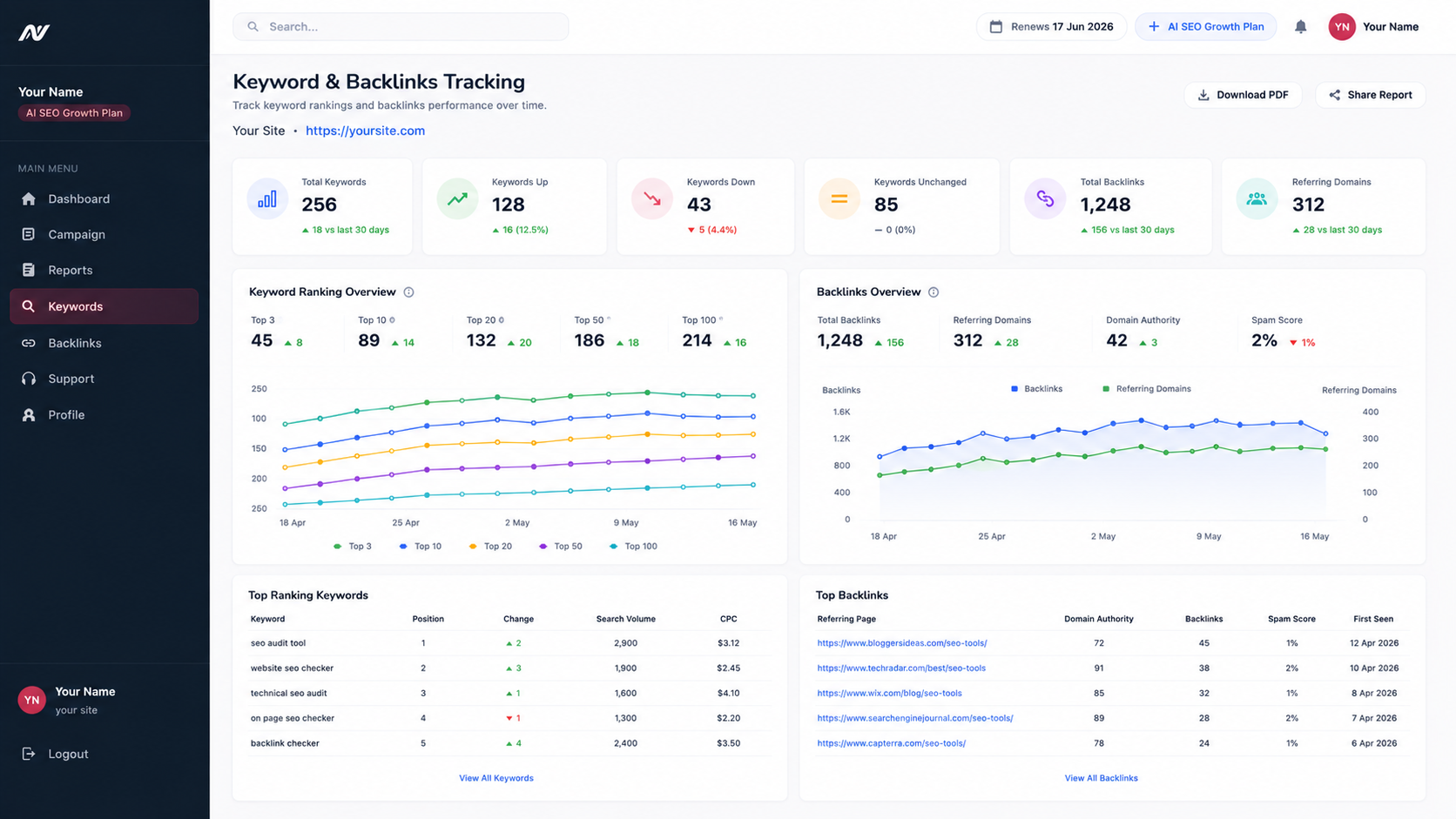
Every ranking, every citation, in one login
No waiting for a monthly email. Log in whenever you like and see exactly what's moving.
-
Live ranking tracker
Track your target keywords in your city, updated automatically rather than pasted into a monthly PDF.
-
AI citation tracking
See where your business is being mentioned inside ChatGPT, Gemini and AI Overview answers — not just Google's blue links.
-
Competitor benchmarking
See exactly how you compare to the businesses currently outranking you in your city.
-
Exportable reports
Download a clean, plain-English summary any time you need to share progress internally.
Built around Google's own trust signals — Experience, Expertise, Authoritativeness, Trust
Google ranks pages it trusts. EEAT is Google's own framework for deciding that — so it's the framework we build every client site around too.
Experience
Every strategy is shaped by hands-on delivery across real UK campaigns — not theory copied from a blog post.
Expertise
Specialists across technical SEO, content and local search, working from your audit data rather than a generic checklist.
Authoritativeness
We build the same entity and authority signals we ask Google to trust in your business — real reviews, real citations, real backlinks.
Trust
Transparent monthly reporting, no lock-in contracts, and everything we build stays yours if you ever leave.
Why UK Businesses Lose Rankings
Most ranking drops aren't a mystery once you look underneath them. Here are the six causes we see most often.
How We Build Every City Strategy
Think of it less like a template and more like a recipe — the same method every time, but the ingredients change depending on what we find.
Local business and population data for that specific city — not a national average.
A full technical crawl of the site as it stands today.
An honest look at who's actually ranking there right now, and why.
Real customer language, pulled from reviews, local forums and support questions.
The current state of the Google Business Profile, warts and all.
Whatever's already been tried before, and what actually happened when it was.
Lay every ingredient side by side and find the actual gap between where the business ranks and where its real competitors sit.
Rebuild the keyword list around the words local customers actually use — not the industry terms only insiders recognise.
Fix whatever's technically holding the site back before writing a single new page.
Build or rewrite the content that's genuinely missing, starting with whatever will move the needle fastest.
Set up tracking that reflects that specific city — not a generic national dashboard.
Review monthly, and adjust based on what the data says, not what the calendar says.
UK case studies
A snapshot of the kind of work behind these numbers. Ask us for the full case study on any of these during your audit call.
Organic enquiry growth over 6 months following a technical rebuild and local content overhaul for a UK service business competing in a crowded city-centre market.
Increase in organic revenue after restructuring product and category pages for both traditional search and AI-generated shopping answers.
Number of UK city locations ranking on page one, after each location page was rebuilt with genuinely distinct, city-specific content.
"We partnered with NextActix to improve our search visibility in a competitive UK market. Their team was responsive, transparent, and focused on measurable results. Within a few months, we saw stronger keyword rankings and a noticeable increase in qualified enquiries."
UK SEO Resource Centre
Straightforward guides on the questions we get asked most — written to actually explain things, not to sell you something.
UK-wide SEO, answered plainly
See exactly where you stand — wherever you trade
Tell us your city and website, and we'll show you precisely how you perform today and what it would take to move up.
WhatsApp Support UK