


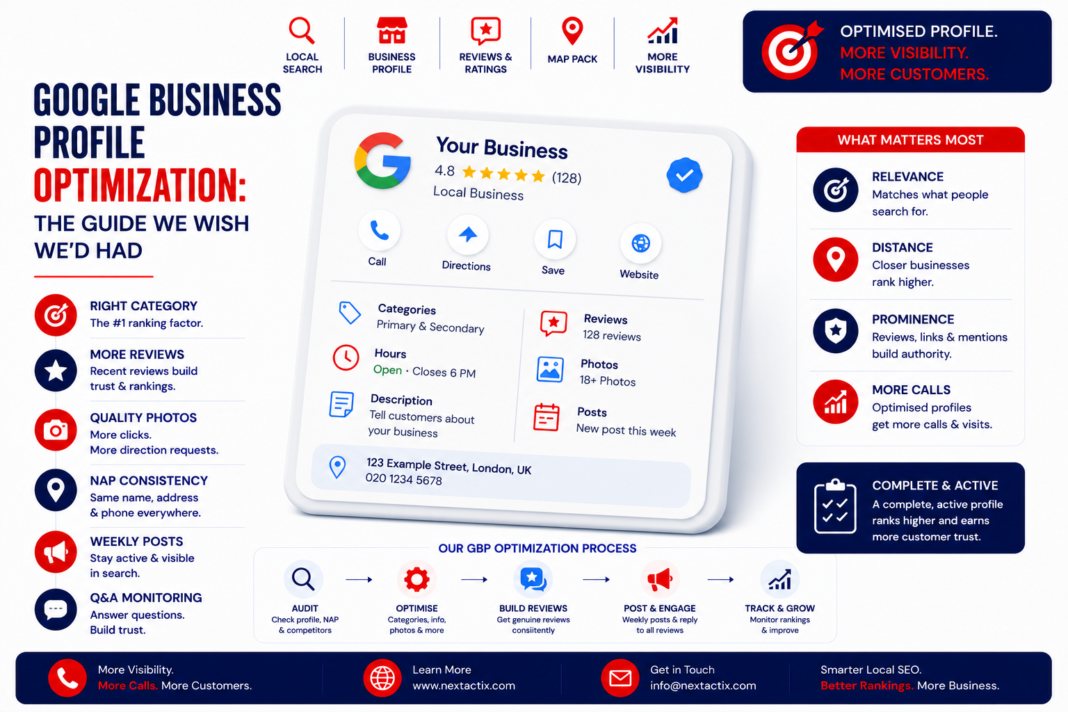
We’re rewriting this one for a specific reason: our old version of this article still called it “Google My Business.” Google renamed it Google Business Profile back in 2022. If you’ve been reading local SEO advice that still uses the old name, there’s a decent chance the rest of the advice in it hasn’t been updated either — and in an area that changes as fast as local search, that’s not a small problem. So we scrapped the old article, checked what’s actually ranking and actually true right now, and rebuilt this from the ground up.
What Google Business Profile actually is, in plain terms
Google Business Profile (GBP) is the free listing that shows up when someone searches your business name directly, or searches for a service near them and Google decides you’re a relevant match. It’s what populates the map pack — the box of three businesses with a map that appears above the regular search results for local searches — and it’s also what shows up on the right-hand panel when someone searches your business by name.
It’s free to claim and set up. Where most businesses lose ground isn’t the setup, it’s everything after — the profile sits half-finished, the category is vaguely right instead of exactly right, and nobody’s touched it in eight months.
Why this matters more than most business owners assume
A large share of local searches now show a map pack before they show anything else, and increasingly, people are making a decision — call, visit, or skip — based entirely on what they see in that box, without ever clicking through to a website. That means your Google Business Profile isn’t a secondary listing that supports your website. For a lot of local businesses, it functions as the actual homepage most customers see first.
The businesses that treat it that way — genuinely complete, current, and actively maintained — consistently pull far more calls, direction requests, and website clicks than listings sitting at 60% complete with a description nobody’s touched since the business first opened.
The fields that actually carry ranking weight
Not every field on your profile matters equally. Here’s what genuinely moves the needle, roughly in order of impact:
Primary category. This is the single most influential field on the entire profile. The mistake we see constantly is businesses choosing a broad, safe-sounding category — “Contractor,” “Store,” “Consultant” — instead of the specific one that matches what people actually search for. If you’re a kitchen remodeler, “Kitchen Remodeler” as your primary category will consistently outperform the vaguer “Contractor,” because it tells Google exactly what query you’re relevant for.
Secondary categories. These extend your reach into related searches without diluting your primary relevance. A tattoo studio might add “piercing shop” as a secondary category if that’s genuinely a service they offer — but padding this list with categories that don’t reflect real services tends to backfire rather than help.
Business description. Write this like you’re actually explaining your business to a person, in your own words, mentioning the areas you serve and the specific services you offer — not a paragraph stuffed with every keyword you’re hoping to rank for. Google and customers can both tell the difference.
Photos. Profiles with a solid, regularly refreshed set of real photos — exterior, interior, team, work examples — consistently earn more clicks and direction requests than sparse ones. Start with at least ten genuine photos rather than four blurry ones, and add new ones regularly rather than treating this as a one-time task.
Reviews. This is one of the heaviest trust signals on the entire profile. It’s not just star rating — Google factors in how many reviews you have, how recently they’ve arrived, whether specific services or keywords are mentioned inside them, and whether you’re replying. A business with 100 reviews and consistent, thoughtful replies will generally outperform a business with the same number of reviews and total silence from the owner.
Q&A section. This part is publicly visible and, importantly, anyone can answer a question on your profile — including someone with no connection to your business. Left unmonitored, this section can end up with wrong information sitting there indefinitely. Check it regularly and answer common questions yourself before a stranger answers them incorrectly.
Posts. Google Business Profile lets you publish short updates — offers, events, general posts — directly to your listing, and they show up in both Search and Maps. Most post types expire after about a week, so this rewards consistency far more than a single polished post.
NAP consistency: the quiet ranking killer
NAP stands for Name, Address, and Phone number, and it needs to match exactly across every place your business appears online — your website, your GBP listing, directories, industry-specific listing sites, even old delivery app profiles you forgot existed. Google cross-references your business against a huge number of sources to judge how trustworthy and established you are, and small mismatches — an old phone number still live on one directory, “St.” instead of “Street” on another — quietly erode that trust even though nothing looks obviously wrong to you when you check your own listing.
This is one of the least glamorous parts of local SEO and also one of the most consistently underestimated. Businesses that have moved location, rebranded, or changed phone numbers in the past few years are especially likely to have old, conflicting listings still live somewhere.
What “optimised” actually looks like in practice
A genuinely optimised profile has: the correct primary category and every relevant secondary category, complete hours including holiday hours kept current, a description written for humans, a steady stream of real photos, an active review request system rather than sporadic asks, weekly posts, a monitored Q&A section, and NAP details that match perfectly everywhere else the business is listed. None of these individually is dramatic. Together, they’re the difference between a listing Google trusts and one it treats as an afterthought.
How we handle this for clients
When we take on Google Business Profile work, we start with a full audit — category accuracy, NAP consistency across every directory we can find, review health, and how complete the existing profile actually is compared with what’s realistically achievable. From there we rebuild the profile properly, set up a review generation system that runs on autopilot rather than depending on someone remembering to ask, and put a regular posting and photo cadence in place so the profile stays active rather than going stale again in six months. We also keep an eye on the Q&A section so incorrect answers from strangers don’t sit there unaddressed.
If your listing hasn’t been touched since you first set it up, that’s usually the fastest, cheapest visibility gain available to a local business — faster than a website rebuild, faster than a paid ad campaign. Get in touch and we’ll show you exactly what’s missing.