

Most SEO audit tools give you a score. A big number, usually out of 100, and then a list of errors sorted by colour. Red bad. Green good. And then you’re left wondering: okay, but what do I actually do now?
That frustration is what pushed us to build something different. The NextActix free AI SEO audit tool isn’t trying to give you a report card. It’s trying to give you a clear picture of why your site is or isn’t showing up when your customers search for you — and what to do about it, in plain language.
This post explains how the tool works, what it looks at, and why we made some of the choices we did. If you’ve been wondering whether your website has SEO problems (spoiler: it almost certainly has at least a few), this might be useful to read before you run the audit.
Why Most SEO Audits Aren’t That Helpful
There are dozens of free SEO audit tools already. Screaming Frog, SEMrush, Ahrefs, Moz — they all do audits. So why build another one?
The issue isn’t the data. These tools collect enormous amounts of it. The issue is interpretation. Getting 847 technical errors dumped into a spreadsheet doesn’t tell you which three of those actually matter for your business right now. It tells you there are 847 things that could theoretically be improved, and then leaves you to figure out the rest.
For a developer or a seasoned SEO, that’s fine. They know how to triage. But for the vast majority of business owners — people running shops, agencies, clinics, services — it’s overwhelming. So they either hand it to someone and hope for the best, or they close the tab and forget about it.
We wanted to build something that bridges that gap. Something that collects the right data and then actually explains what it means.
What the Tool Looks At
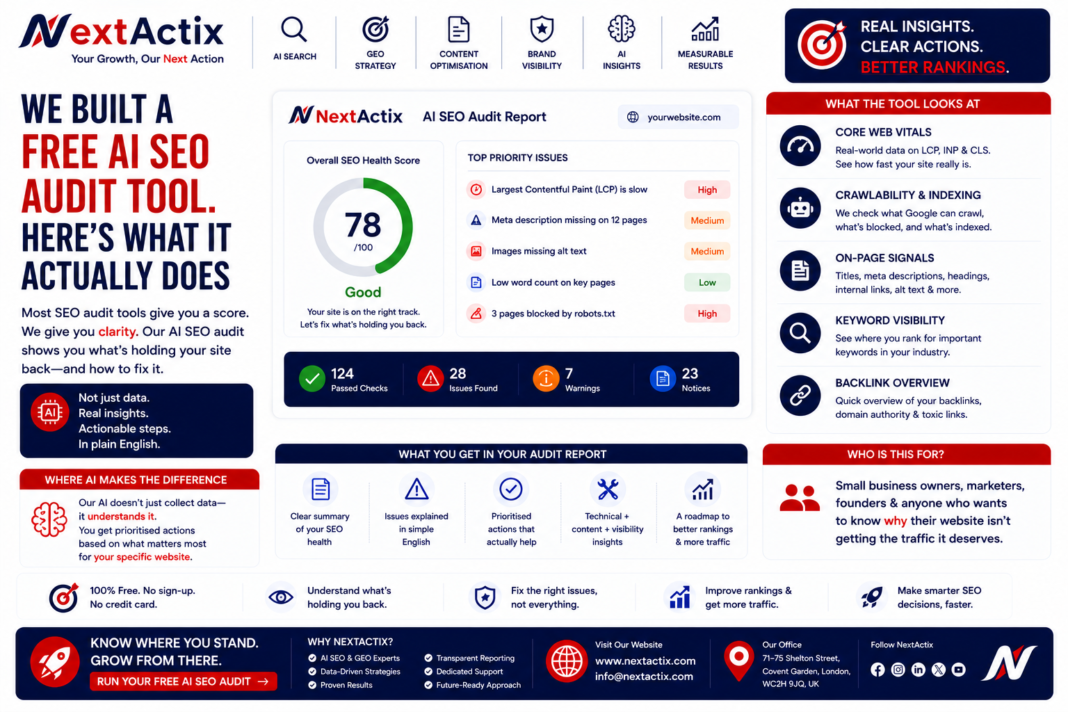
The NextActix AI SEO audit examines your website across several layers. Some of these are technical, some are content-related, and some are about how your site shows up in search results right now. Here’s a plain-English breakdown:
Core Web Vitals
Google officially uses Core Web Vitals as a ranking signal. These measure how fast your page loads (LCP), how quickly it responds to interaction (INP), and how stable the layout is as it loads (CLS). The tool pulls real-world data from Google’s dataset where available, which means you’re seeing what actual visitors experience, not just a lab simulation.
Most websites fail at least one of these. The most common culprit is images — either uncompressed, not lazy-loaded, or too large for the viewport they’re being served to. The audit flags this and explains which pages are affected.
Crawlability and Indexing
If Google can’t crawl your pages, they won’t rank. Sounds obvious, but a surprising number of websites have robots.txt rules, noindex tags, or canonicalisation issues that accidentally block search engines from pages the business actually wants to rank. The tool checks your sitemap, crawl directives, and indexing status so you know exactly what Google is and isn’t seeing.
On-Page Signals
Title tags, meta descriptions, heading structure, internal linking, image alt text — the basics of on-page SEO that still matter. The AI layer here doesn’t just tell you that a title tag is missing. It checks whether your existing titles are actually optimised for search intent or just describe what the page is, which are often two very different things.
Keyword Visibility
The tool checks where your site currently ranks for a set of relevant terms based on your industry and location. This gives you a baseline — not a perfect picture, since keyword rankings vary by user, location, and device, but a reasonable snapshot of where you stand before any work is done.
Backlink Profile Overview
Backlinks still matter. The audit gives you a high-level view of your domain’s link profile — how many referring domains you have, what their authority looks like, and whether there are any obviously toxic links that could be dragging your rankings down.
Where the AI Part Comes In
The tool itself collects data the way any decent audit tool does. The AI part is in what happens next — the interpretation and the recommendations.
Rather than producing a list of fixes sorted by technical severity, the AI synthesises the findings into a prioritised set of actions based on what’s most likely to move the needle for your specific site. A brand-new website with no backlinks and thin content has different priorities from a five-year-old site with strong links but slow page speed. The recommendations adapt to the situation.
It also writes in plain English. No jargon, no acronyms without explanation, no assuming you know what ‘canonical tag’ means. If you do know, you can skim the explanations. If you don’t, they’re there.
How to Use the Audit Results
When you get your results, you’ll see an overall summary and then a breakdown by category. Each issue comes with a severity rating (not just a colour — an actual explanation of why it matters), a plain-English description of what the problem is, and a recommended fix.
Some of these you can action yourself. Others will need a developer or an SEO specialist. The tool tries to be clear about which is which, because telling someone to ‘fix their Core Web Vitals’ without acknowledging that this often requires a developer isn’t actually helpful.
The audit is free to run. There’s no credit card, no trial, no ‘basic plan’ that locks all the useful data behind an upgrade. We believe that if we show you what’s wrong with your site clearly and honestly, you’ll trust us to help fix it. That’s the deal.
Who Is This For?
Honestly? It’s for anyone who has a website and isn’t completely sure whether it’s doing its job. That covers a lot of ground. It’s for the small business owner who was told their site was ‘fine’ but isn’t seeing any organic traffic. It’s for the marketing manager who wants to sense-check their agency’s work. It’s for the founder who just launched a site and wants to know what to prioritise next.
It’s not a replacement for a full SEO strategy. If your business depends on organic traffic and you’re in a competitive market, you need more than an audit — you need an ongoing programme of content, links, and technical maintenance. But every programme starts somewhere, and knowing where you stand is always step one.
You can run the NextActix free AI SEO audit tool at nextactix.com. It takes a few minutes to complete and you’ll have your results shortly after. No account needed.