


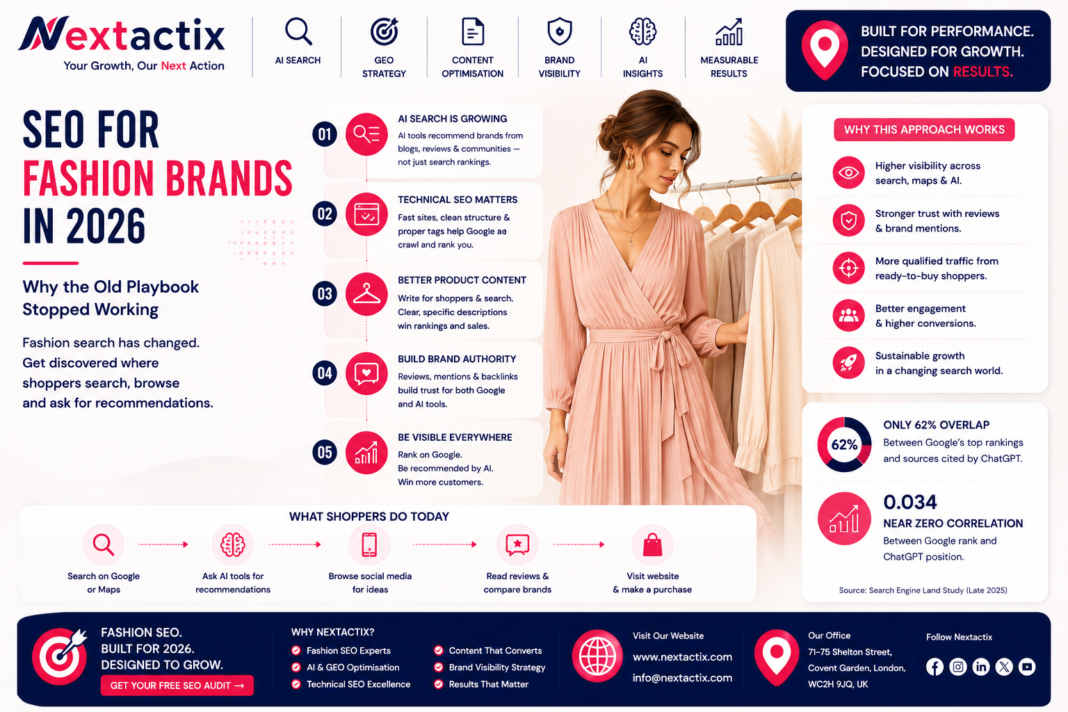
A Shopify store owner posted a comment in April 2026 that summed up a problem a lot of fashion brands are quietly dealing with. She said: ‘Our SEO person says our rankings are solid. But ChatGPT seems to pull from blogs, Reddit threads, gift guides, and Etsy pages — not from our actual product pages. I don’t understand what’s causing it.’
She is not alone. And she is not wrong about her rankings. The issue is that holding a page-one position on Google and being the brand AI tools mention when someone asks ‘what are the best sustainable fashion labels in the UK’ are now genuinely different outcomes — built on different signals, requiring different work.
Fashion brands are discovering this gap faster than most industries because fashion search is heavily research-driven and emotionally motivated. Buyers do not search for a single thing. They browse by occasion, by vibe, by material, by price, by season. They ask AI assistants for outfit ideas. They follow a TikTok creator and then Google the brand. The purchase journey crosses five platforms before it hits a checkout. Getting SEO right for a fashion brand in 2026 means understanding where that journey starts and making sure you are visible at each stage.
The Gap Between Google Rankings and AI Recommendations
Gartner predicted that traditional search engine volume would drop 25% by 2026 as AI tools absorb more query types. Whether that specific figure holds, the directional shift is already visible in how fashion discovery actually works. Someone deciding between two sustainable knitwear brands does not necessarily open Google and scan ten blue links. They ask Perplexity. They ask ChatGPT. They check Google AI Overviews. And the answer they get names two or three brands — not ten websites.
The brands named in those answers are not always the ones with the strongest traditional SEO. An analysis of ChatGPT fashion recommendations found it pulling heavily from editorial blogs, Reddit style communities, gift guide roundups, and trusted review sites — not from the brand’s own product catalogue. That pattern reveals something important about what AI trusts: not what you say about yourself, but what independent sources say about you and in what context.
This does not mean traditional fashion SEO is irrelevant. It means a fashion brand in 2026 needs both layers working simultaneously: ranking on Google for the searches your customers type, and being cited by AI tools when they make recommendations. The mechanics of each are related but not identical.
In fashion search, your product pages compete for keywords. Your brand competes for recommendations. Most brands only work on the first of these.
The Technical Side That Most Fashion Sites Neglect
Fashion ecommerce sites are structurally complex in ways that create specific technical SEO problems. A single dress available in twelve colours and eight sizes can generate ninety-six URL variants. Without a clear policy on canonical tags and noindex directives, those variants create duplicate content at scale — and Google penalises the domain for it, not individual pages. It dilutes crawl budget and fragments the ranking signals that should be concentrating on your key category and product pages.
This is not a theoretical concern. Ahrefs’ audit of over a million sites consistently identifies oversized images and slow loading speeds as the top technical issues on fashion ecommerce sites specifically. A single hero image that has not been compressed costs seconds off your page load time, and Google’s March 2026 core update tightened the LCP threshold to 2.0 seconds. Sites that were previously passing that threshold are now being ranked differently.
Beyond speed: over 65% of fashion browsing happens on mobile devices. Google evaluates the mobile version of your site when making ranking decisions. A fashion site with a stunning desktop layout that is awkward to navigate on a phone is being evaluated primarily on the awkward version.
The practical checklist for fashion technical SEO is not long, but it requires consistent attention: compress images and serve them in WebP format, implement canonical tags across product variants, ensure your XML sitemap excludes low-value filter and search result pages, fix broken links quickly as products go out of stock or are discontinued, and make the site structure as shallow as possible — home, category, subcategory, product, ideally no deeper than four levels.
Product Descriptions: The Difference Between Ranking and Selling
Most fashion product descriptions are written for the brand, not the customer. They use aspirational language, describe the mood of the collection, and reference the designer’s inspiration. None of that is what Google reads to understand what the page is about, and none of it is what a buyer types when they search.
A product description that says ‘our sage green linen co-ord set captures the essence of coastal living, crafted for the free-spirited woman’ gives Google almost nothing to work with. A description that says ‘relaxed-fit linen co-ord set, slightly oversized cut, perfect for summer travel or beach days, runs true to size’ is what Google uses to match the page to searches like ‘loose fit linen co-ord set UK’ or ‘linen co-ord for holiday packing.’ The second version also converts better, because customers making purchasing decisions want specificity, not poetry.
Image alt text is an extension of this problem. ‘Model wearing sage green linen co-ord set with white sandals’ tells Google, visually impaired users, and Google Lens exactly what the image contains. ‘IMG_2398.jpg’ tells none of them anything. Fashion is increasingly discoverable through visual search, and Google Lens searches for clothing have grown consistently year on year. Every image without descriptive alt text is a missed discovery opportunity.
Category Pages Carry More Ranking Weight Than Product Pages
This is counterintuitive but consistently true across fashion ecommerce: category pages — women’s dresses, men’s knitwear, sustainable outerwear — carry more ranking potential than individual product pages, for most of the high-value commercial terms fashion brands want to rank for.
Product pages rank best for specific, long-tail searches: ‘navy linen wide-leg trousers size 14 under £200’ — the kind of search a buyer makes when they know exactly what they want. These convert extremely well. But the volume is low per term, and the rankings are often temporary as products change seasonally.
Category pages, by contrast, can hold rankings for terms like ‘women’s linen trousers’ or ‘sustainable men’s knitwear UK’ for months or years if they are well-structured. The key is treating category pages as content hubs — not just product grids. A category page with a brief editorial introduction explaining the collection, clear filtering options that do not create duplicate URL problems, and internal links to related editorial content is a page that earns and holds rankings. One that is purely a product grid with no text content is one that Google has very little to say about.
Content Strategy: The Fashion Blog Done Properly
Style guides, occasion dressing posts, seasonal lookbooks — this content category is where fashion brands have the biggest gap between what they publish and what actually earns traffic and AI visibility.
The fashion blogs that rank consistently in 2026 share specific characteristics. They target specific, searchable moments: ‘what to wear to a winter wedding as a guest,’ ‘how to style wide-leg trousers for a petite frame,’ ‘sustainable alternatives to fast fashion for workwear.’ Each of these matches a real question a real person types into Google at a specific moment in their wardrobe decision-making.
They also earn links and citations — which is the bridge between traditional fashion SEO and AI visibility. A ‘Top 10 Sustainable Fashion Brands UK 2026’ post from a credible fashion editor that mentions your brand creates an external citation that AI systems actively pull from when generating recommendations. A well-timed trend article, pitched to the right editorial contact at the right moment, earns exactly the kind of third-party mention that teaches AI systems what your brand is known for.
One practical note on timing: fashion search demand is deeply seasonal, but searches for summer styles begin climbing months before summer arrives. Brands that publish and optimise content at peak season are already too late. The content needs to exist and build authority before the search volume spikes — which means planning your content calendar three to four months ahead of the season you are targeting.
Pinterest, Social Media and Google Search Now Connect
Pinterest is a visual search engine, and it is often underused by fashion brands focusing entirely on Instagram and TikTok. Every pin is indexable. Keyword-rich pin descriptions, board names that match actual search terms, and links back to relevant category or product pages create a network of discoverable content that functions as both SEO and brand discovery simultaneously.
Since July 2026, Google Search Console tracks how Instagram, TikTok, X, and YouTube content performs in Google Search through the new platform properties feature. This means fashion brands can now see which social posts are generating Google Search impressions — and for which queries. A TikTok video about ‘how to style cargo trousers for a night out’ that is generating Google Search traffic tells you something valuable: that topic has organic search demand beyond the TikTok audience, and the brand’s content is already matching it. That is actionable information for both content strategy and keyword targeting.
FAQs and the Sections That Earn AI Overview Visibility
Google AI Overviews select content based on how directly and specifically it answers a clear question. For fashion brands, the FAQ section on category pages and product pages is the most underutilised vehicle for this.
Questions like ‘does linen shrink in the wash,’ ‘how should I size a wide-leg trouser,’ ‘what is the difference between linen and cotton for summer wear,’ ‘can I return items bought in sale’ — written in the natural language customers actually use — are exactly the kind of content AI Overviews extract and present. A fashion brand with a well-structured FAQ section on its main category pages is essentially providing Google with pre-formatted answers that it can surface directly in AI-generated responses.
Schema markup supports this further. FAQ schema, Product schema with price and availability, and BreadcrumbList schema help both Google and AI systems understand the structure and content of fashion pages without having to infer it. Structured data is no longer optional for fashion brands serious about search visibility — it is the difference between Google guessing what your page contains and Google knowing exactly.
What Actually Moves Fashion SEO Forward in 2026
The brands holding strong organic visibility through the 2024 and 2026 algorithm updates share a pattern. They are not the ones with the most content or the most technical sophistication. They are the ones whose content is specific, consistent, and genuinely better than what their competitors published on the same topics. Generic AI content is now the baseline in fashion — every brand’s product descriptions and blog posts read similarly because they were produced by similar tools. The brands that stand out are the ones adding real editorial perspective, honest product information, and the kind of specific detail that only comes from knowing the product and the customer.
That is both the challenge and the opportunity. The bar for generic content has been permanently lowered by AI tools. The bar for genuinely useful, credible, specific content is the same as it always was — it just matters more now because so many competitors are below it.
NextActix works with fashion brands and ecommerce businesses on the full picture — technical SEO, content strategy, product page optimisation, and AI search visibility. If you want to know how your brand currently appears across Google and AI search, start with a free audit.