


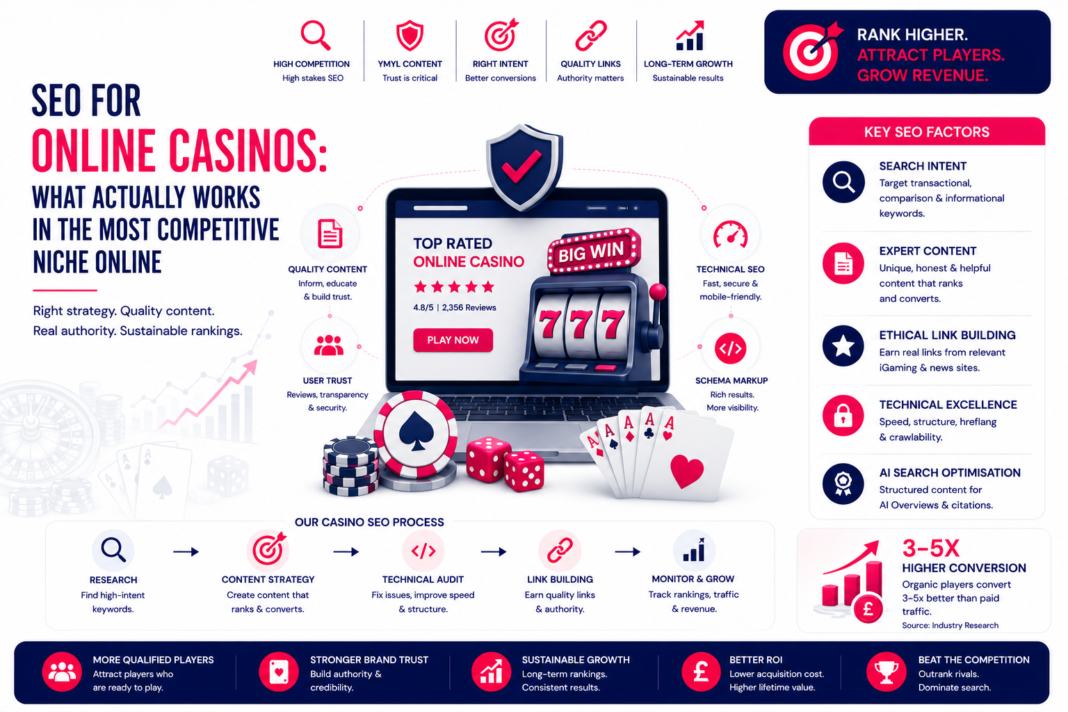
Online casino SEO is not harder than other niches because gambling keywords have high search volume. It is harder because of everything that surrounds the content. Advertising restrictions mean organic search is often the only scalable acquisition channel. Google classifies gambling content as YMYL — Your Money or Your Life — applying the same heightened quality standards it applies to medical and legal content. And the link-building ecosystem is one of the most heavily manipulated in all of SEO, which means the history of a casino domain can carry significant penalties that have nothing to do with current ownership or strategy.
Getting iGaming SEO right in 2026 requires understanding why the niche is different before applying any tactics. The strategies that move a restaurant or a software company up the rankings can trigger manual penalties on a gambling site within weeks. The fundamentals are the same — good content, technical health, genuine authority — but the execution is considerably more precise.
Why Search Intent Is the Starting Point for Every iGaming Content Decision
Players come to gambling websites through three broad types of search. They are looking for a platform to register with. They are comparing bonuses or reviewing whether a specific site is trustworthy. Or they are looking for information about how games work, what the odds are, or how a specific variant of poker is played.
These three types of search require completely different content to capture them — and they convert at very different rates. Transactional searches, from players ready to register and deposit, are the most commercially valuable. They are also the most competitive, because every operator is targeting them. Comparison and review searches come from players close to a decision but not yet committed. They convert well when the content is honest and specific enough to answer their actual question. Informational searches attract players early in their journey — educating them builds brand familiarity and trust, but it rarely converts immediately.
A casino website that focuses exclusively on transactional terms — ‘best online casino UK,’ ‘top rated slots site’ — will struggle to rank for them because it has no surrounding content authority. The sites that consistently hold those positions have built extensive content across all three intent types, creating topical authority that Google interprets as evidence of genuine expertise in the subject area.
Players who find a casino through organic search convert three to five times better than those from paid acquisition — because they trusted the brand enough to search for it deliberately. That trust starts with content, not with an ad.
Content That Builds Trust in a Trust-Deficient Industry
Online gambling has a reputation problem that SEO cannot solve but content can address. Players are wary of new platforms for entirely rational reasons — there are genuinely untrustworthy operators in the market, and the consequences of choosing badly can be significant financially. Content that acknowledges this reality and provides genuinely useful guidance is far more credible than content that reads like marketing.
The content that earns trust — and that Google rewards with rankings in this category — is specific, honest, and demonstrates real knowledge of how the products work. A guide to understanding variance in slot games that explains what it actually means for a player’s session length and bankroll management is useful. A page that describes slots as ‘exciting and entertaining with huge jackpots’ is marketing copy. Google’s quality systems have become increasingly able to distinguish between the two.
Withdrawal and payment content is consistently one of the highest-traffic categories for casino websites, and it is also one where most operators produce thin, inadequate content. Players want to know exactly how long withdrawals take, what documentation is required, what happens if there is a dispute, and whether their preferred payment method has any specific conditions. These are pre-deposit questions that directly determine whether someone registers. A casino that answers them clearly and honestly, with specific details rather than vague reassurances, is both more trustworthy and more likely to rank.
The Link Building Reality for iGaming Sites
Backlinks matter more in iGaming than in almost any other category, and the risks of getting link building wrong are higher too. Casino websites operate in a niche where low-quality link building has been common for years, and Google’s spam detection systems have been specifically tuned to identify the patterns — PBN links, link farms, mass guest post networks — that were widespread in gambling SEO.
A manual penalty in the gambling niche does not just reduce rankings. It can effectively remove a domain from Google’s index entirely, and the recovery process is long, uncertain, and expensive. One bad agency relationship with a casino site has been documented as setting organic growth back by 12 to 24 months. The asymmetry of risk is significant.
The link-building approach that works sustainably in iGaming is built around genuine editorial placements — being covered by iGaming news publications, being cited by affiliate review sites on the basis of genuinely competitive products, earning links from industry association memberships, and contributing expert commentary to respected gambling industry publications. None of this is fast, and none of it is cheap. But the links it produces are durable, and they build domain authority that holds through algorithm updates rather than evaporating when a penalty arrives.
Technical SEO Specific to Casino Websites
Casino websites are technically complex in ways that create specific SEO problems. Live game lobbies often rely heavily on JavaScript rendering, which can create indexing issues if the content is not accessible to crawlers without JavaScript execution. Geo-blocking — restricting access to users from certain countries where the licence does not apply — needs to be implemented carefully to avoid accidentally signalling to Google that the site is unavailable in markets it actually serves.
Duplicate content from multiple currency or language variants of the same page, without proper hreflang implementation, is common and creates ranking fragmentation — the authority that should concentrate on one canonical page gets split across multiple versions. Affiliate tracking parameters that create unique URLs for every referral source add thousands of thin, near-duplicate pages to the index if they are not handled correctly with canonical tags.
Page speed is particularly critical for casino websites because players have high expectations for instant responsiveness — especially in live casino environments where connection quality and loading time directly affect the game experience. A site that loads slowly loses players both to competitors and to Google’s performance ranking signals.
How AI Search Is Changing Casino Discovery
The rise of AI-generated answers in Google is reshaping the top of the search results for many gambling queries. Informational questions — how does a no deposit bonus work, what is the house edge on roulette, what does wagering requirement mean — are increasingly answered inside Google’s AI Overview rather than through a click to a casino website.
For casino operators, this has two implications. The first is that informational content that was previously driving meaningful direct traffic now needs to be structured for AI citation rather than just for ranking — written in a way that makes it easy for Google’s AI to extract and reference the key point, with clear headings and direct answers in the opening sentence of each section. The second is that the value of transactional and comparison content, which tends not to be answered within an AI Overview, increases relative to informational content. The clicks that remain after AI Overviews absorb the informational searches are higher-intent than before.
Casino sites that structure their content with both these outcomes in mind — written to earn AI citations for informational queries and to convert the transactional traffic that bypasses AI answers — are building for how iGaming search actually works in 2026, not how it worked two years ago.
NextActix provides SEO services for iGaming and casino websites, covering content strategy, technical audits, ethical link building, and AI search visibility. Contact us to discuss what a sustainable casino SEO programme looks like for your platform.