


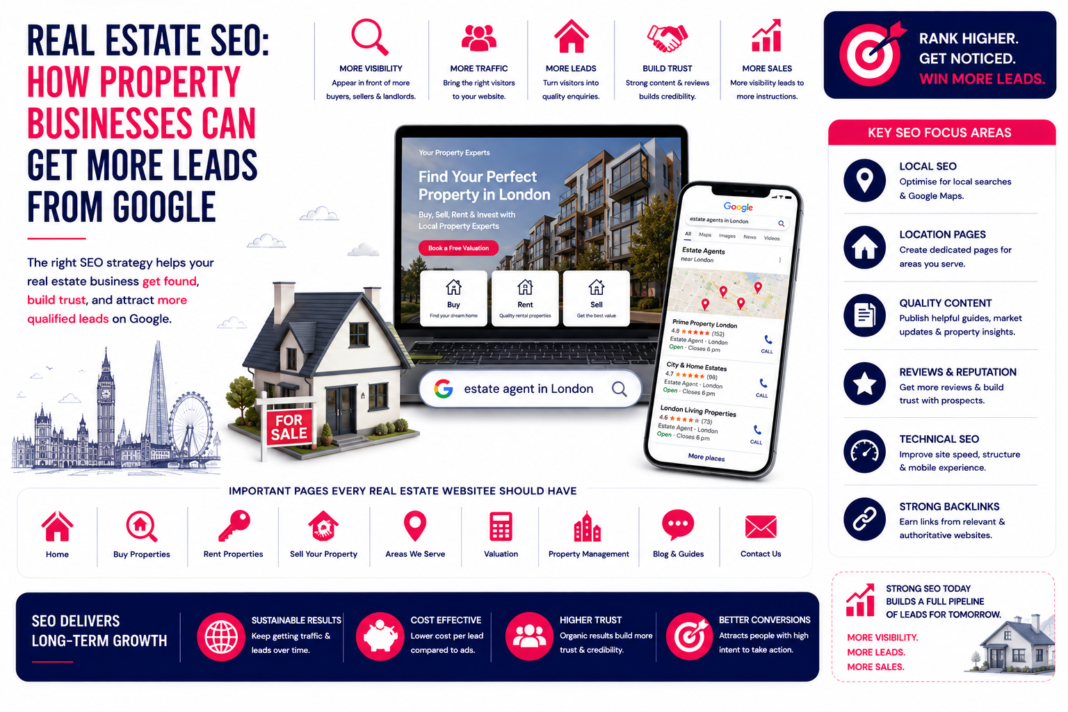
For a property business, being visible on Google can make a noticeable difference to the number of people who discover your services. Buyers search for properties, landlords look for reliable agents, sellers compare local agencies, and investors research areas before they ever speak to a business.
The challenge is that real estate search is highly competitive. A property business is rarely competing only with another local estate agent. Depending on the search, the results may also include Rightmove, Zoopla, OnTheMarket, property portals, large national agencies, local competitors, directories, property publications and Google’s own local results.
This is where real estate SEO becomes important.
Search engine optimization for a property business is not simply about adding the words “estate agent” to a website or publishing a few blog posts. It involves making the entire website more useful, technically accessible, locally relevant and closely aligned with what potential customers are actually searching for.
The objective is not traffic for the sake of traffic. The objective is to attract people who may eventually become buyers, sellers, landlords, tenants, investors or property-management clients.
For businesses operating in competitive markets such as London, that distinction becomes even more important.
What is real estate SEO?
Real estate SEO is the process of improving a property business’s website and online presence so that its relevant pages can appear more prominently when people search for property-related services, information and locations.
A useful strategy considers several parts of the search journey.
Someone might begin with a broad search such as:
“estate agents near me”
Another person may search for:
“estate agents in Wimbledon”
A seller could search:
“best estate agent to sell my house in London”
A landlord might search:
“property management company in East London”
Someone researching the market could search:
“London property prices 2026”
These searches have different intentions. They should not all lead to the same generic page.
A good real estate SEO strategy maps different types of searches to appropriate pages and content. Service pages can target commercial searches, location pages can address local demand, property pages can help individual listings appear for relevant searches, while informative articles can answer questions people have before they are ready to contact an agent.
This creates a website that supports the customer throughout the research and decision-making process rather than trying to sell to everyone from a single homepage.
Why SEO is particularly important for property businesses
Property decisions usually involve considerable research.
A person looking for a new home may compare dozens of listings. A homeowner thinking about selling may investigate several estate agents before requesting a valuation. A landlord may compare management services, fees, reviews and local expertise.
This means search engines can influence the process long before a potential customer fills in an enquiry form.
A strong organic presence can help a property business become visible at several points during that journey.
For example, a potential seller might first discover an agency through an article about preparing a London property for sale. Later, they may find the agency’s valuation page. They might then look at the agency’s local pages, reviews and previous results before making contact.
SEO can therefore contribute to brand discovery, trust, website traffic and enquiries at the same time.
It also provides an important advantage over relying entirely on paid advertising. Advertising can put a business in front of people while a campaign is running, but organic search visibility can continue bringing relevant visitors after individual pages have been published and optimized.
That does not make SEO free or effortless. Quality content, technical work, research and ongoing improvement all require investment. But the visibility created can become an asset that continues working for the business.
Real estate SEO is different from ordinary local SEO
A property website has some of the same requirements as any local business website, but it also has several unique challenges.
An ordinary local business may have a relatively small set of important pages:
- Homepage
- Services
- About
- Contact
- Location
- A few supporting articles
A real estate website can contain hundreds or even thousands of URLs.
There may be:
- Individual property listings
- Property type pages
- Location pages
- Areas served
- Sales services
- Lettings services
- Valuation pages
- Property management services
- Buyer guides
- Seller guides
- Market reports
- Blog articles
That scale creates opportunities, but it also creates SEO problems.
If every property page uses similar descriptions, search engines may have difficulty determining which pages provide unique value. If old listings remain online after properties have been sold, the site can accumulate pages that no longer serve a useful purpose. If dozens of location pages contain almost identical copy, they may provide little additional value.
Real estate SEO therefore requires website architecture and content management, not just keyword optimization.
What should a real estate SEO strategy focus on?
There is no single optimization that will make a property website successful in Google. The strongest results generally come from several improvements working together.
1. Start with the searches that actually matter to the business
Before changing website content, it is important to understand what potential customers are searching for.
A property business might be interested in terms related to:
- Estate agents
- Letting agents
- Property management
- Property valuation
- Homes for sale
- Flats for sale
- Houses for rent
- Commercial property
- Buy-to-let
- Property investment
- Local property services
But search volume alone should not determine the strategy.
A keyword with thousands of searches may be less valuable than a smaller search with strong commercial intent.
For example, someone searching “London property market” may simply want to read about market conditions.
Someone searching “property valuation London” could be much closer to becoming a customer.
The goal is therefore to understand search intent, not simply collect keywords.
2. Build pages around different customer needs
One of the most common mistakes on property websites is expecting the homepage to rank for everything.
A stronger structure gives important services and locations their own useful pages.
For example, a property business might have dedicated pages for:
Services
- Residential sales
- Lettings
- Property management
- Property valuation
- Commercial property
Locations
- Central London
- North London
- South London
- East London
- West London
- Individual boroughs or areas
Property types
- Houses
- Flats
- Luxury properties
- New-build properties
- Commercial properties
The exact structure should depend on what the business genuinely offers.
Creating dozens of pages simply because a keyword exists can result in thin or repetitive content. Every page should have a real reason to exist and provide information that is useful for that particular search.
3. Make location pages genuinely local
For an estate agent operating in London, simply replacing the city name on a template is not enough.
A useful location page should demonstrate actual knowledge of the area.
Depending on the business, this could include information about:
- Property types commonly found in the area
- Local buyer or renter considerations
- Transport connections
- Nearby neighbourhoods
- Typical customer requirements
- Local property services
- The company’s experience serving the area
- Relevant market considerations
- Areas covered nearby
The objective is to make the page useful to somebody who actually lives in or is considering moving to that location.
This becomes particularly important when targeting competitive searches such as real estate SEO London, because search engines have many possible pages they can show for London-related property queries.
Property listing pages need their own SEO strategy
Property listings are often the largest section of a real estate website.
They can also be one of its biggest SEO opportunities.
A property page should provide substantially more than a title, price and a gallery.
Useful information may include:
- Property type
- Location
- Price
- Number of bedrooms
- Key features
- Property description
- Floor plan where available
- Relevant specifications
- Nearby amenities
- Transport information
- Viewing information
- Availability
- Clear enquiry options
Images should also be properly handled, including meaningful file names and useful alternative text where appropriate.
However, there is an important issue with property listings: properties change.
A home may be sold or rented. A listing may become unavailable. A similar property may be replaced by a new listing.
This means a real estate business needs a sensible policy for managing expired property URLs.
Automatically deleting every old page can waste useful history and create broken links. Keeping thousands of useless expired listings online can create a different problem.
The right approach depends on the site’s structure, the value of the individual URL and whether there is a relevant replacement or useful content to direct visitors toward.
Duplicate content can become a major problem
Real estate websites frequently have similar information appearing in multiple places.
For example, a property might appear under:
- Houses for sale
- Three-bedroom properties
- A specific neighbourhood
- A postcode
- Search filters
- A property type category
If the website creates a separate URL for every combination of filters, the number of pages can grow very quickly.
Not all of these URLs need to be indexed.
A technical SEO review should examine how search engines discover and interpret these pages and whether the website is creating unnecessary crawlable URLs.
Canonicalization, internal linking, indexing controls and website architecture all become important at this stage.
Technical SEO matters more as the website grows
A beautiful property website can still struggle in search if its technical foundation is poor.
Important areas include:
Crawlability
Search engines need to be able to discover the pages that matter.
Navigation, internal links, XML sitemaps and appropriate technical configuration all contribute to this.
Page speed
Property websites often contain many large images, maps, galleries and interactive elements.
Without optimization, these can make pages unnecessarily slow.
Images should be appropriately sized and compressed, while unnecessary scripts and third-party resources should be controlled.
Mobile experience
Many property searches happen on mobile devices.
A potential buyer should be able to browse properties, view images, understand the location and contact the agency without struggling with the interface.
Indexation
Not every URL generated by a property website deserves a place in Google’s index.
Search results pages, filters, duplicate URLs and outdated listings need to be handled carefully.
Structured data
Where appropriate, structured data can help search engines understand information about a page.
It should represent the actual content of the page rather than being added simply to try to manipulate search appearance.
Content can bring in customers before they search for an agent
Not everyone starts their property journey by searching for an estate agent.
Many people begin with a question.
A homeowner may search:
“How much is my house worth?”
A landlord might ask:
“Should I manage my rental property myself?”
A buyer could search:
“Is it better to buy a flat or house in London?”
A seller might search:
“How can I prepare my property for sale?”
These searches provide opportunities for useful content.
A property business can create guides that answer genuine questions and then help readers discover relevant services when they are ready.
For example, an article about preparing a property for sale could naturally connect to the company’s valuation or sales service.
The important word is naturally.
The content should answer the question first. The commercial service should be presented as a logical next step rather than turning every article into an advertisement.
How internal linking helps a real estate website
Internal links are particularly valuable on large property websites because they help users and search engines move between related information.
Imagine a guide about selling a property in London.
It could naturally link to:
- The valuation service
- The residential sales service
- A relevant London location page
- A guide about preparing a property for sale
A location page might link to:
- Relevant property types
- Local services
- Area guides
- Available properties
This creates relationships between pages.
It also helps distribute the authority and relevance of the website’s stronger pages to other important pages.
Internal linking should be based on usefulness rather than inserting links into every possible sentence.
Local visibility is essential for London property businesses
A property business rarely serves an abstract market.
It operates in specific areas.
That makes local search particularly important.
Someone searching for an estate agent in a particular London area is showing much stronger geographic intent than someone searching for a general property article.
A complete local SEO strategy can include:
- Google Business Profile optimization
- Accurate business information
- Consistent contact details
- Genuine customer reviews
- Relevant local pages
- Local citations where appropriate
- Location-focused content
- Internal links between relevant areas and services
- Local reputation building
Reviews deserve particular attention.
They can influence how potential customers perceive an agency even when they are not a direct ranking shortcut. A property business with genuine, detailed customer feedback can provide prospective clients with additional confidence when comparing agencies.
Real estate SEO should also prepare businesses for AI search
Search behaviour is changing.
People increasingly ask AI systems questions that they previously would have typed into a traditional search engine.
Potential customers may use tools such as ChatGPT, Gemini or Perplexity to research:
- Estate agents
- Property markets
- Local areas
- Property investment
- Buying decisions
- Selling decisions
- Letting services
- Property management companies
This creates another reason to build a website around clear, useful and trustworthy information.
AI search optimization should not mean writing artificial content designed to “trick” an AI system into mentioning a company.
Instead, the fundamentals remain important:
- Clear information
- Strong topical coverage
- Helpful answers
- Consistent business information
- Relevant local expertise
- Well-structured pages
- Demonstrable experience
- Useful supporting content
For a real estate business, the opportunity is to become a credible source of information that search engines and AI systems can understand and reference.
This is an area where traditional SEO and AI search visibility increasingly overlap.
How real estate SEO can turn traffic into actual enquiries
Ranking is only one part of the process.
A property website can receive thousands of visitors and still generate disappointing results if the website makes it difficult for people to take the next step.
Every important page should have a clear purpose.
Depending on the service, that might mean encouraging visitors to:
- Request a valuation
- Book a viewing
- Enquire about a property
- Contact an agent
- Request property management information
- Register as a buyer
- Speak with a lettings specialist
Calls and forms should be easy to find without becoming intrusive.
The wording should also match the visitor’s intent.
Someone reading a detailed guide about property valuation may respond better to “Request a property valuation” than a generic “Contact us” button.
This is where SEO and conversion optimization meet.
The aim is not simply to increase the number of people arriving at the website. It is to increase the number of relevant people taking a meaningful next step.
What should a real estate SEO campaign measure?
A ranking report alone does not provide a complete picture.
A useful measurement system should connect search visibility with business outcomes.
Important metrics can include:
Organic traffic
How many visitors are arriving from unpaid search?
Search visibility
Which important topics and locations is the website becoming visible for?
Rankings
Are priority keywords improving over time?
Search impressions
How often are pages appearing in search results even when users do not click?
Click-through rate
Are searchers choosing the website when it appears?
Leads
How many enquiries are coming through organic search?
Calls
Are organic visitors contacting the business by phone?
Valuation requests
For sales-focused agencies, this can be a particularly valuable conversion.
Property enquiries
For agencies promoting listings, enquiries and viewing requests may matter more than raw traffic.
The most useful SEO reports connect these metrics rather than presenting rankings as the final objective.
How long does real estate SEO take to work?
There is no reliable universal timeline.
A new website with little authority may need considerably more time than an established property business with a strong online presence.
Results can also vary depending on:
- Competition
- Website history
- Existing authority
- Technical condition
- Content quality
- Search demand
- Location
- Number of competing businesses
- Strength of competitors
- Quality of the SEO work
Some improvements can produce relatively quick changes, particularly when a technical problem is preventing search engines from accessing important pages.
Competitive commercial searches can take much longer.
This is why a realistic SEO campaign should focus on measurable progress rather than promising a specific position by a particular date.
What mistakes should property businesses avoid?
Several SEO shortcuts can create more problems than they solve.
Creating hundreds of thin location pages
A page for every postcode or neighbourhood is not automatically a good strategy.
If the pages contain almost identical information, they may provide little value.
Copying property descriptions
Property descriptions should accurately describe the individual property.
Repeated or copied descriptions make it harder for pages to offer something distinctive.
Keeping every expired listing indexed
An old property page that no longer serves a useful purpose does not necessarily need to remain in Google’s index.
Stuffing keywords into content
Repeating phrases such as “London estate agent” in every paragraph does not make a page more relevant.
Natural language and genuinely useful information are more important.
Buying large numbers of low-quality backlinks
Links from irrelevant or poor-quality websites may provide little useful value and can introduce unnecessary risk.
A sustainable approach focuses on earning relevant mentions, relationships and references.
Publishing AI-generated articles without review
Property information affects real decisions.
Content should be checked for accuracy, relevance and usefulness rather than publishing large volumes of automatically generated pages.
Measuring success only through rankings
A ranking position means little if the traffic never turns into enquiries, valuations, viewings or clients.
A practical real estate SEO framework
A strong campaign can be approached in stages.
Stage 1: Understand the business
Identify the services, locations, property types, customer groups and commercial priorities.
Stage 2: Audit the existing website
Review technical SEO, indexation, architecture, content, internal linking, performance and existing visibility.
Stage 3: Map search intent
Determine which searches deserve service pages, location pages, property pages and informational content.
Stage 4: Improve the technical foundation
Fix crawlability, indexing, performance, mobile usability, duplicate URLs and other technical issues.
Stage 5: Build useful landing pages
Create or improve pages around the services and locations that genuinely matter to the business.
Stage 6: Develop supporting content
Answer questions potential buyers, sellers, landlords and investors are actually asking.
Stage 7: Strengthen internal relationships
Connect related services, locations, property types and guides through useful internal links.
Stage 8: Build authority
Earn relevant mentions, links, reviews and references that reinforce the business’s reputation.
Stage 9: Measure commercial outcomes
Track not only rankings and traffic but enquiries, calls, valuation requests, viewings and qualified leads.
Stage 10: Keep improving
Search behaviour changes, competitors publish new content and property markets evolve. SEO therefore works best as an ongoing process rather than a one-time website project.
Why London makes real estate SEO particularly competitive
London is not one uniform property market.
Different boroughs and neighbourhoods can have very different property types, prices, audiences and search behaviour.
A person looking for a family home in outer London has different requirements from someone searching for a central apartment, a rental property or an investment opportunity.
That creates a large number of specific search opportunities.
It also means that a generic page saying that a company is a “leading London estate agent” is unlikely to demonstrate enough relevance for every possible search.
A stronger strategy builds genuine depth around the areas and services the business actually understands.
For a London property company, that can mean developing useful location information, service-specific content, property expertise and local signals rather than attempting to rank one page for every variation of a property-related keyword.
The role of an experienced real estate SEO agency
Real estate SEO involves more than publishing articles.
An agency working with a property business needs to understand the relationship between the website, search behaviour and the business itself.
That includes knowing which pages deserve investment, which URLs should not be indexed, where content is missing, how property listings should be handled and which search terms can realistically generate valuable enquiries.
At NextActix, our approach to real estate SEO is built around that wider picture.
We look beyond individual keywords and consider how technical SEO, local search, content, website structure, authority, conversion optimization and AI search visibility can work together.
For businesses targeting London, this means building a strategy around the actual services and areas they serve rather than applying the same SEO template used for every industry.
You can explore our dedicated Real Estate SEO London service to see how we approach SEO for property businesses.
Real estate SEO is about becoming visible when people are ready to make a property decision
A successful property website does not need to rank for every possible search.
It needs to become visible for the searches that matter to the business.
That means understanding what people want, creating pages that genuinely answer those needs, making the website technically accessible, demonstrating local expertise and giving visitors a clear path toward becoming customers.
For an estate agent, that could mean appearing when someone is searching for a valuation.
For a lettings company, it could mean being discovered by a landlord looking for property management.
For a property business in London, it could mean becoming visible across the specific areas, services and questions that matter to its target customers.
The strongest real estate SEO strategies therefore treat search visibility as part of the wider customer journey.
Get the right information in front of the right person at the right stage, and organic search can become a long-term source of qualified property leads.