


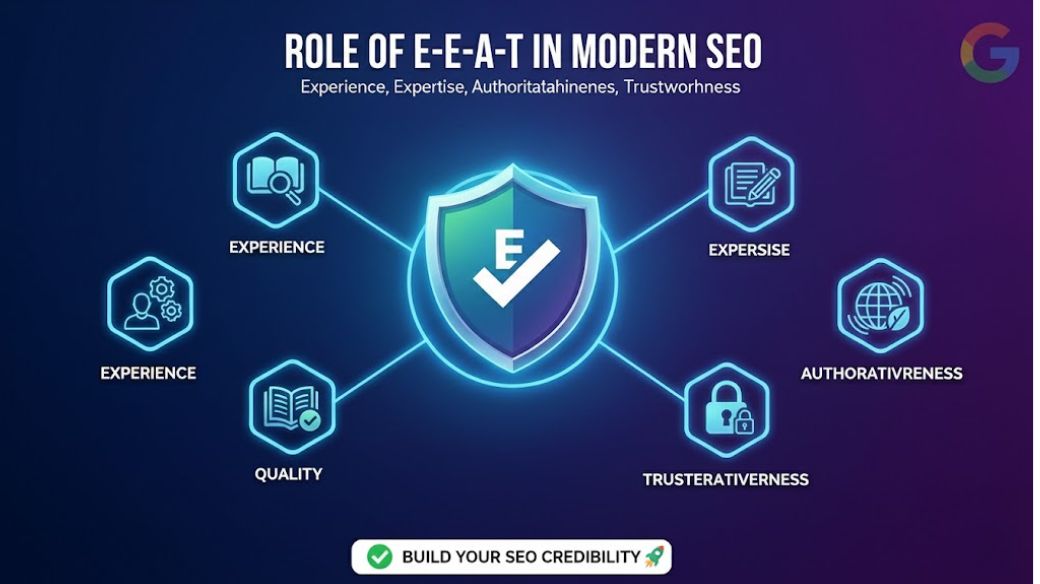
Search engines have evolved beyond basic keyword matching. Today, Google evaluates websites based on how reliable, credible, and useful they appear to users. One of the most important frameworks behind this evaluation is E-E-A-T, which stands for Experience, Expertise, Authoritativeness, and Trustworthiness.
While E-E-A-T is not a direct ranking factor, it plays a crucial role in how Google’s systems assess content quality and overall site credibility.
What Is E-E-A-T?
E-E-A-T is a quality framework used by Google to understand whether content can be trusted. It helps evaluate not just what is being said, but who is saying it and why it should be believed.
The four components work together:
- Experience reflects real-world involvement or firsthand knowledge
- Expertise shows subject understanding and accuracy
- Authoritativeness signals recognition beyond the website itself
- Trustworthiness ensures reliability, transparency, and consistency
Modern SEO increasingly depends on how well these elements are demonstrated.
Why E-E-A-T Matters in Today’s Search Environment
Search engines aim to protect users from misleading or low-quality information. As a result, content that lacks credibility struggles to perform consistently, even if it is technically optimized.
E-E-A-T matters because it helps Google:
- Evaluate content reliability
- Identify trustworthy sources
- Reduce misinformation
- Surface authoritative answers
This is especially important for competitive industries and informational topics where accuracy and trust are critical.
Experience: Demonstrating Real-World Knowledge
Experience focuses on whether content reflects firsthand understanding. Pages written with practical insight often perform better than purely theoretical explanations.
Experience can be demonstrated through:
- Practical explanations
- Real examples or use cases
- Clear understanding of user problems
- Content that reflects familiarity with the topic
Search engines recognize when content is written by someone who understands the subject beyond surface-level definitions.
Expertise: Showing Subject Understanding
Expertise refers to how well content explains a topic accurately and clearly. It does not always require formal credentials, but it does require correctness and depth.
Expertise is reflected in:
- Well-structured explanations
- Accurate terminology
- Logical flow of information
- Avoidance of exaggerated claims
Content that demonstrates expertise helps Google understand that a website knows what it is talking about.
Authoritativeness: Recognition Beyond Your Website
Authoritativeness is built when others recognize your website as a reliable source. This includes references, mentions, and links from relevant platforms.
Signals that support authority include:
- Mentions from reputable websites
- Consistent publishing within a topic area
- Strong internal linking across related content
- Brand recognition over time
Authority is not created instantly. It develops as search engines observe consistent patterns of credibility.
Trustworthiness: The Foundation of Visibility
Trustworthiness is the most critical component of E-E-A-T. Without trust, experience and expertise lose value.
Trust is supported by:
- Transparent business information
- Secure website infrastructure
- Accurate and up-to-date content
- Honest representation of services and claims
Websites that appear deceptive or unclear often struggle to maintain visibility.
E-E-A-T and Content Strategy
Modern SEO content strategies are built around E-E-A-T principles rather than keyword repetition. Content that answers questions clearly and supports understanding naturally aligns with this framework.
Strong content strategies:
- Focus on topic depth rather than volume
- Use clear, simple language
- Address related questions logically
- Avoid unnecessary optimization
This approach improves both user experience and search evaluation.
The Role of E-E-A-T in AI-Driven Search
As AI-driven search becomes more common, E-E-A-T plays an even greater role. AI systems must decide which sources are reliable enough to summarize or reference.
Websites with strong E-E-A-T signals are more likely to:
- Appear in AI-generated summaries
- Be referenced in contextual answers
- Maintain visibility even when click patterns change
This makes E-E-A-T essential for future-proof SEO.
Common Misunderstandings About E-E-A-T
One common misconception is that E-E-A-T can be “added” quickly. In reality, it is built through consistent behavior over time.
Another misunderstanding is treating E-E-A-T as a checklist. It is not about ticking boxes, but about creating content and experiences that naturally demonstrate credibility.
Building E-E-A-T Over Time
E-E-A-T grows as search engines observe patterns of reliability. Websites that prioritize clarity, accuracy, and transparency tend to strengthen these signals naturally.
Long-term trust is built by:
- Maintaining content quality
- Updating information regularly
- Avoiding manipulative practices
- Staying consistent across the website
Final Thoughts
The role of E-E-A-T in modern SEO is foundational rather than optional. As search systems evolve, credibility, clarity, and trust increasingly influence visibility.
Websites that focus on experience, expertise, authority, and trustworthiness are better positioned for stable rankings, stronger discovery, and long-term success. Instead of chasing short-term gains, building E-E-A-T creates a reliable path toward sustainable search visibility.