


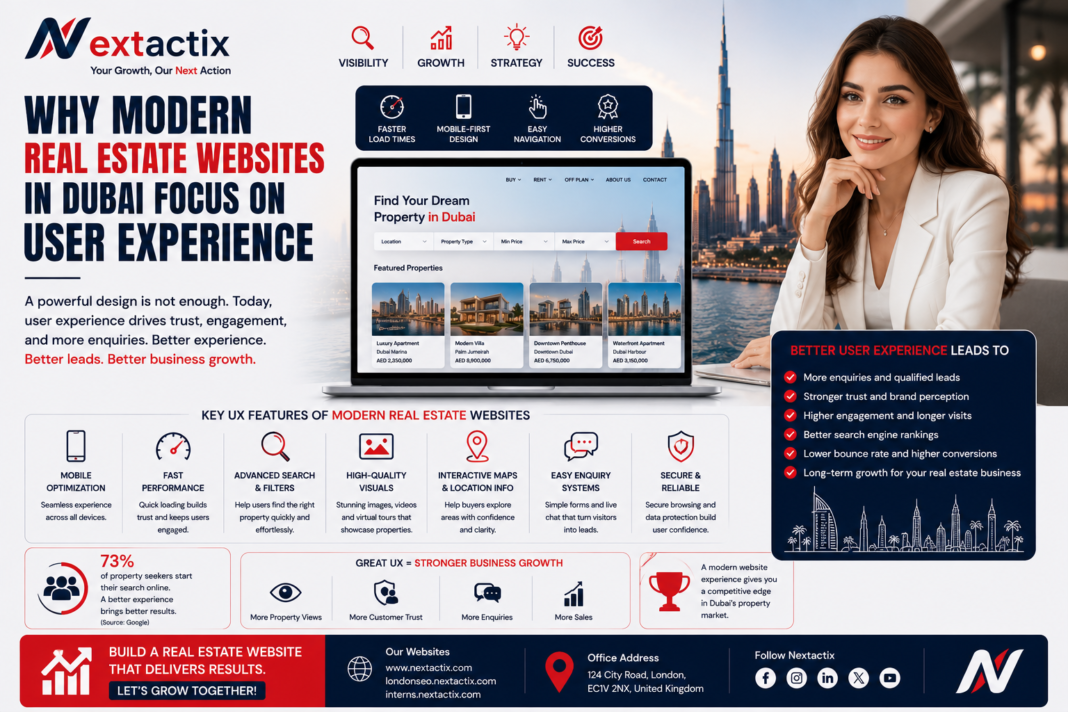
A few years ago, most real estate websites focused mainly on appearance. Agencies wanted large banners, luxury visuals, and attractive layouts that looked impressive at first glance. While design still matters, the way people interact with property websites has changed significantly.
Today, user experience has become one of the most important parts of real estate website development in Dubai.
Buyers no longer spend time struggling through slow websites, confusing navigation, or overloaded property pages. If a website feels difficult to use, most visitors simply leave and continue searching somewhere else. That behavior has pushed many real estate businesses in Dubai to rethink how their websites are built.
The goal is no longer just to create a beautiful website. The goal is to create a platform that helps users find information quickly and comfortably.
Dubai’s real estate market is extremely competitive. Buyers compare multiple agencies and developers online before making enquiries. In many cases, the website itself becomes the first impression of the business.
If a website feels modern, organized, and easy to navigate, users naturally trust the business more.
That trust matters.
People investing in property often move carefully. Before contacting an agency, they usually:
- browse listings
- compare locations
- check pricing
- review property details
- evaluate the professionalism of the company
A poor website experience creates doubt very quickly.
One of the biggest reasons user experience matters is mobile browsing.
Most property searches now happen on phones. People search while commuting, comparing projects, visiting locations, or discussing options with family members. Websites that only work properly on desktop devices struggle badly in modern search environments.
This is why modern Dubai real estate websites are increasingly designed mobile-first.
Users expect websites to:
- load quickly
- scroll smoothly
- display properties clearly
- allow fast filtering
- respond instantly
When those things do not happen, users lose patience.
Search engines also pay attention to this behavior.
Google now evaluates how users interact with websites. If visitors leave quickly because pages are slow or difficult to use, rankings often suffer over time.
This means user experience influences both conversions and SEO.
Navigation is another major part of modern real estate websites.
Many older property websites are overloaded with menus, categories, and unnecessary sections. Instead of helping users, this often creates confusion.
Modern websites simplify navigation.
The best-performing property websites usually guide users naturally through:
- property browsing
- filtering systems
- project information
- enquiry forms
- contact pages
The easier the experience feels, the longer users stay.
Property search functionality has also improved significantly.
Users now expect websites to behave almost like real estate apps. They want to filter properties based on:
- location
- price
- bedrooms
- property type
- amenities
- project status
Without good filtering systems, browsing large property inventories becomes frustrating.
Many real estate businesses in Dubai are now investing heavily in smoother search experiences because they understand how directly this affects enquiries.
Website speed has become another important part of user experience.
Real estate websites contain large visuals, videos, maps, and property galleries. Without proper optimization, these websites often become extremely slow.
A slow property website creates multiple problems.
Users become frustrated.
Search rankings weaken.
Lead conversion drops.
Modern websites focus heavily on performance optimization because even a small delay can reduce engagement significantly.
Visual presentation still matters, but the role of visuals has changed.
Earlier, websites often overloaded users with animations and oversized graphics. Today, the best real estate websites focus more on clarity.
Property visuals should:
- load quickly
- look professional
- support browsing
- improve understanding
The website should feel clean rather than overwhelming.
Another reason user experience matters so much in Dubai is the international nature of the market.
Many buyers are overseas investors.
These users often rely entirely on the website before contacting an agency. If the website lacks clarity or trust signals, international buyers often move on immediately.
This is why many modern real estate websites now include:
- area guides
- project explanations
- developer information
- payment plans
- market insights
Good user experience is not only about visuals. It is also about helping users understand information comfortably.
Trust plays a huge role in property decisions.
Modern websites help build trust through:
- organized property layouts
- transparent information
- responsive interfaces
- clear contact methods
- professional presentation
Users often associate website quality with business credibility.
If the website feels outdated or confusing, users may assume the business itself operates similarly.
Real estate websites are also becoming more interactive.
Many modern platforms now include:
- virtual tours
- interactive maps
- live chat systems
- instant enquiry forms
- AI recommendations
These features improve engagement because users feel more connected to the browsing process.
Another major shift is the importance of content.
Many successful Dubai property websites now publish:
- area guides
- investment articles
- market trends
- off-plan explanations
- buyer education content
This improves both SEO and user trust.
People searching for property often research extensively before making decisions. Useful content helps websites become part of that research process.
AI-driven search systems are also influencing how websites are evaluated.
Search engines increasingly prioritize websites that:
- explain topics clearly
- structure information properly
- improve user experience
- maintain consistency
This means websites focused only on visual design without usability often struggle long-term.
The businesses performing best online are usually the ones balancing:
- speed
- structure
- usability
- trust
- mobile experience
- SEO
User experience connects all of these areas together.
Modern real estate websites in Dubai are no longer just digital catalogues.
They are sales environments.
The easier they are to use, the more likely users are to stay, explore properties, and contact the business.
That is why user experience has become such a major focus in modern real estate website development.