


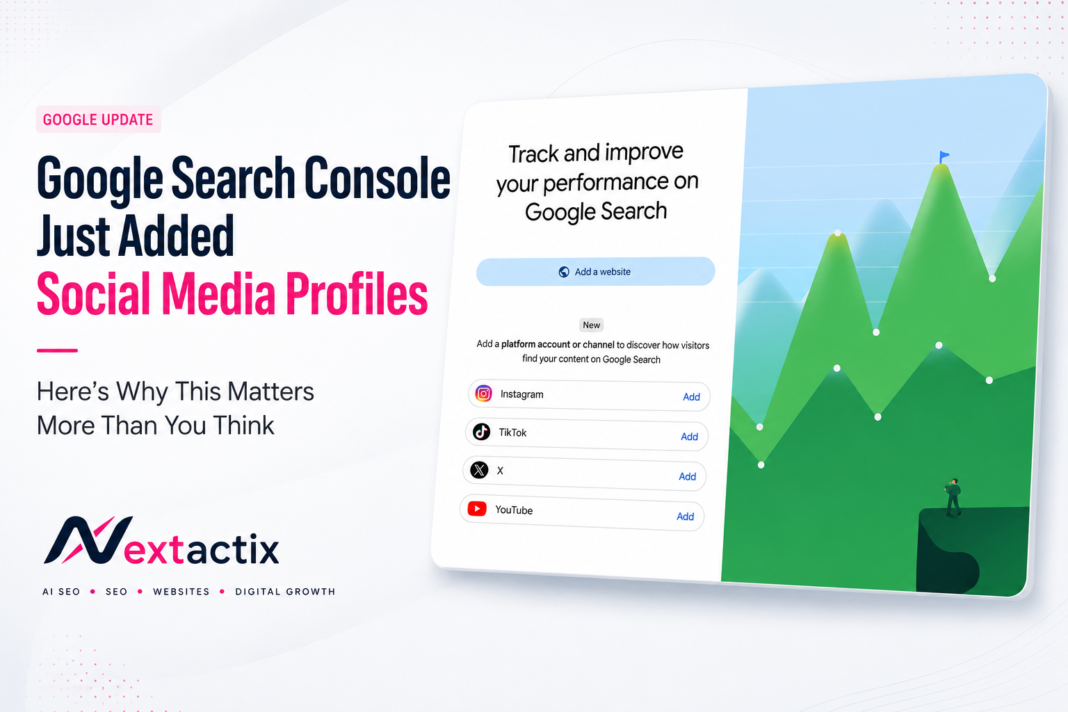
If you’ve opened Google Search Console recently, you may have noticed something that wasn’t there before. Where the property selector used to offer only “website,” there’s now an option to connect Instagram, TikTok, X or YouTube directly. For anyone who’s used Search Console for years purely as a website tool, it’s an odd moment — the kind of small interface change that’s easy to click past without registering what it actually means.
It’s worth slowing down on this one, because it’s a bigger shift than the announcement made it sound.
What Google actually changed
On the 7th of July 2026, Google introduced what it’s calling “platform properties” — a new type of property inside Search Console, sitting alongside the website property most people already know. Instead of verifying a domain, you authorise Google to connect to an Instagram, TikTok, X, or YouTube account, and Search Console then reports on that content the same way it’s always reported on a website: clicks, impressions, average position, and the actual search terms that led someone to a specific post or video.
Once connected, each platform property gives access to three reports. A Performance report, which is the most useful of the three, breaks down clicks and impressions by individual post and by search query, and lets you export the data. An Insights report gives a simpler, higher-level view of recent trends and top-performing content, useful for a quick weekly check rather than a deep analysis. And an Achievements report tracks click milestones over rolling 28-day windows, which is more of a progress marker than a proper analytics tool.
It’s genuinely new, not a rebrand of something that already existed. It builds on a smaller experiment Google ran quietly back in December 2025, which pulled some social data automatically into Search Console Insights. This version is different — you add and verify each account yourself, it works even for accounts that have no website attached to them at all, and it’s a dedicated property type with its own reporting rather than a side panel bolted onto an existing report.
Why Google is doing this now
The honest answer is that Google’s own crawlers have been indexing social and video content in search results for years — a TikTok video or an Instagram post has always been able to show up in a Google search. What’s never existed is a way for the person who made that content to actually see it happening. If someone found your Instagram Reel through a Google search, that click was completely invisible to you. Native platform analytics show you views and engagement inside the app, but they’ve never shown you anything about how Google itself was sending people your way.
Google framing this as closing that gap lines up with something else that’s been building for a while: search results increasingly include content that never lived on a traditional website at all. A homepage isn’t the whole story anymore, and Google seems to be treating that as simple fact rather than a trend to react to later.
What this tells us about the future of Search
This is really the more interesting part, once you sit with it for a minute. For as long as Search Console has existed, Google’s tools quietly reinforced a specific mental model — a business is a website, and everything else is secondary. Platform properties break that model on purpose. Google is now treating a brand’s presence across TikTok, Instagram, YouTube and X as something worth measuring with the same seriousness as a domain, not as an afterthought to it.
That’s consistent with a wider shift already underway. Search results are pulling in more video, more social content, and more AI-generated summaries drawing from a mix of sources — not just ranked website links. A tool built entirely around domain ownership was starting to look out of step with how search actually works day to day. This update is Google admitting that, in its own quiet way.
Who can access it today
The rollout started gradually from the 7th of July 2026 and is being extended over the following weeks, so it’s genuinely possible to check Search Console and not see the option yet — that doesn’t necessarily mean anything’s wrong with your account. At launch, four platforms are supported: Instagram, TikTok, X, and YouTube. Facebook and LinkedIn are both notably absent, and Google’s own announcement frames this as a starting point rather than a finished feature set, which is worth checking back on periodically.
One detail worth flagging clearly, because it’s already causing some confusion: platform properties are a different feature from “Search profiles,” which Google launched back in June 2026. A Search profile is a public, shareable page that consolidates a creator’s content for their followers to browse. A platform property is private — analytics only the account owner sees. Having one doesn’t mean you have the other, and the two get mixed up in coverage often enough that it’s worth being precise about which one you’re actually looking for.
Should you care if you don’t have the feature yet?
Yes, even before it appears in your account. The reporting itself is useful, but the bigger value is what it signals about where to focus attention generally. If a meaningful part of your audience already finds you through social or video content rather than your website, that traffic has always been real — you just haven’t been able to see the search intent behind it. Knowing that gap exists is worth planning around now, rather than waiting for the tool to confirm it later.
It’s also worth being clear about what this feature doesn’t do. It reports on Google Search and Discover specifically — not native platform engagement like TikTok views or Instagram likes, and not whether AI tools like ChatGPT or Perplexity are citing or recommending your content. That’s a separate, related, but distinct kind of visibility, and this update doesn’t touch it directly.
What businesses should do next
For a business already active on Instagram, TikTok, YouTube or X, the practical first step is simple: check whether platform properties has appeared in your Search Console account, and if it has, connect the accounts that matter. Once there’s a few weeks of data, the Performance report’s Queries tab is worth genuine attention — it shows the actual terms people searched for on Google before landing on a specific post, which often surfaces topics and phrasing a business never deliberately targeted.
From there, it’s worth cross-referencing that data against your website’s own Search Console performance. If a social post is generating impressions for a search term your website doesn’t rank for at all, that’s a genuine content gap worth addressing directly — either with a dedicated page, or with more content built around that same theme.
For a business without much social presence yet, the update is a reasonable prompt to ask a slightly different question than usual: not just “should we be doing more on social media,” but specifically “is Google already sending people to content we haven’t been measuring.” For some businesses, the answer turns out to be yes, and platform properties is the first real way to see it clearly.
Final thoughts
None of this replaces a properly built website, a genuinely useful Google Business Profile, or the fundamentals of technical SEO — Google has been consistent that those still matter as much as ever. What’s changed is the size of the picture Search Console is willing to show. For years it drew a hard line around “your domain” and reported on nothing outside it. That line has just moved, and it’s moved in a direction that matches how people are actually finding businesses now — across a website, yes, but also across a video, a post, or a profile that Google has quietly been indexing the whole time.