


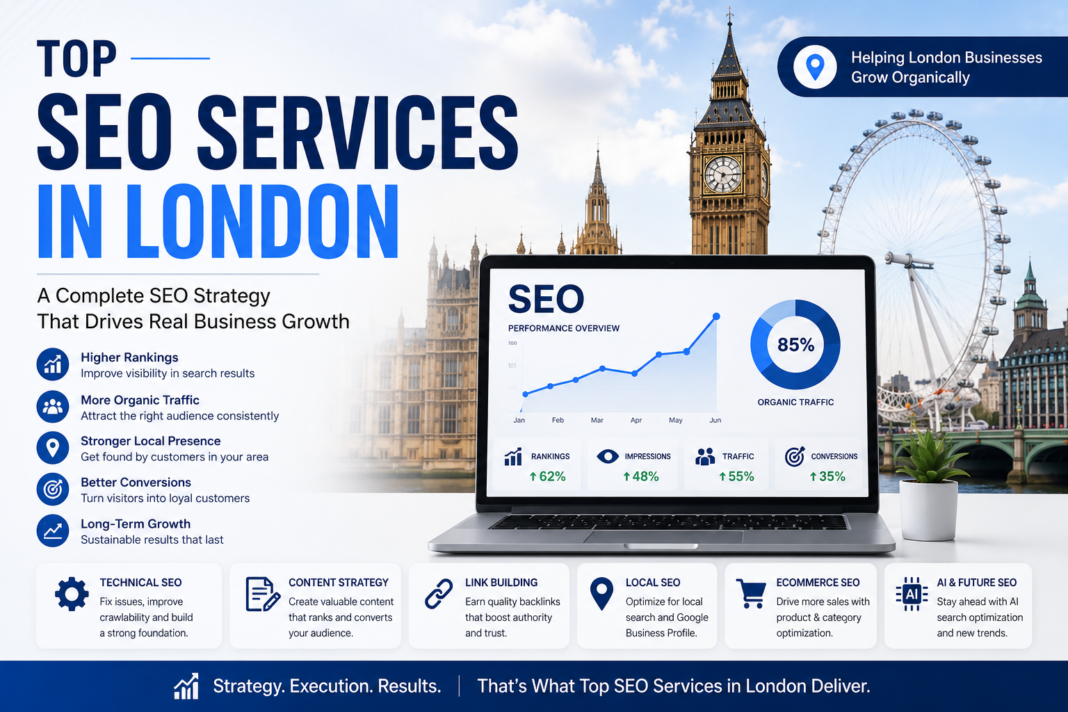
When a business starts looking for SEO help in London, the first thing it often sees is a long list of agencies offering very similar services.
Technical SEO. Content marketing. Link building. Local SEO. Keyword research. Google Business Profile optimisation. Ecommerce SEO. AI search optimisation.
The list can become confusing quite quickly.
The bigger question is not how many SEO services an agency offers. It is whether those services work together to solve the search problems of a particular business.
A company with a new website may need to build its search foundation from scratch. An established business may already have hundreds of pages, existing rankings and a strong backlink profile, but still struggle to turn organic visibility into enquiries. An ecommerce website can have an entirely different set of problems because products, categories, filters and technical URLs create a much larger search environment.
This is why a good SEO strategy needs to look at the whole website and the business behind it.
For businesses comparing the top SEO services in London, the following areas are worth understanding before choosing an agency.
Technical SEO is where many search problems begin
A website can look perfectly normal to a visitor while having problems that make it harder for search engines to understand.
Important pages may not be indexed. Internal links may not point clearly towards commercial pages. Redirects may be creating unnecessary chains. Several URLs may contain very similar information. Canonical tags may not match the preferred version of a page. A large website may also have sections that are difficult for crawlers to reach.
Technical SEO is about finding these problems and deciding which ones actually matter.
A useful technical review should therefore go beyond producing a long spreadsheet of errors. It should explain the relationship between an issue and the website’s search performance.
For example, if an important service page is not being indexed correctly, that deserves considerably more attention than a minor technical recommendation on a page that already performs well.
Technical SEO can involve areas such as:
- Crawling and indexing
- XML sitemaps
- Robots directives
- Canonical URLs
- Redirects and broken URLs
- Internal linking
- Website architecture
- Duplicate or thin pages
- Mobile usability
- Core Web Vitals and page performance
- Structured data where appropriate
The exact priorities should come from the website rather than from a standard checklist.
Keyword research should begin with what customers are trying to do
Keyword research is often presented as simply finding phrases with high search volume.
That is only part of the job.
A search term becomes useful when an agency understands why someone is searching for it and what they expect to find.
Someone searching for “SEO services in London” is likely to have a different intention from someone searching for “what does SEO do for a business”. The first may be comparing providers, while the second is still researching the subject.
Those searches should not necessarily lead to the same page.
Good keyword research looks at the relationship between the search, the customer and the business. It considers commercial intent, informational searches, location, competition and the stage of the buying process.
This helps prevent websites from targeting hundreds of phrases without knowing which ones can realistically contribute to growth.
On-page SEO should make important pages clearer
Once the right search opportunities have been identified, individual pages need to communicate their subject clearly.
On-page SEO can involve titles, headings, page copy, internal links, images, structured information and other elements that help both visitors and search engines understand the page.
But optimisation should not make the page awkward to read.
A service page written only to include a keyword repeatedly can feel unnatural and may fail to answer the questions a potential customer actually has.
A stronger page might explain what the service involves, who it is suitable for, how the process works, what affects pricing, what results can reasonably be expected and how the customer can take the next step.
The keyword helps identify the subject.
The usefulness of the page determines whether the subject has been covered well.
Content strategy should create a useful reason to visit the website
A business website should not publish articles simply because an SEO calendar says that four posts are required this month.
Content has a job to do.
Some pages should attract people who are researching a problem. Others should help someone compare solutions. Service pages should explain what the company actually provides. Case studies can demonstrate experience. Guides can answer detailed questions that sales pages do not have room to cover.
The best content strategy connects these different types of pages.
For example, an article answering a customer’s question can naturally introduce a related service. A detailed guide can link to a relevant commercial page. A case study can support a service page by showing how a similar problem was handled.
This creates a website that is useful as a whole rather than a collection of disconnected blog posts.
Local SEO is important when customers search by location
London is not a single search market in the way a simple city label might suggest.
People can search for businesses using neighbourhoods, districts and nearby areas, while some businesses may want customers from across Greater London. Others may operate from London but serve customers throughout the UK.
The local strategy should reflect that reality.
For a business that depends on local enquiries, its Google Business Profile, reviews, business information, location relevance and website pages all form part of its online presence.
Local landing pages can also be useful when the business genuinely serves different areas.
However, creating a separate page for every London location does not automatically create stronger local SEO.
If ten pages contain almost identical copy with only the area name changed, there is little reason for a visitor to prefer one page over another. A useful location page should provide information that is genuinely relevant to that area, service coverage or customer experience.
Link building should focus on reputation rather than numbers
Backlinks remain an important part of SEO, but the number of links on a monthly report does not tell you whether a campaign is doing good work.
A hundred irrelevant links are not necessarily better than a smaller number of relevant references.
A business can build authority through many legitimate routes. Industry publications, expert commentary, useful research, partnerships, professional organisations, digital PR and original resources can all create opportunities for relevant websites to mention the company.
The important question is:
Why would another website want to reference this business or its content?
If there is a genuine answer, the resulting mention is generally more meaningful than a link created simply to increase a monthly backlink total.
When comparing SEO providers, businesses should therefore ask how an agency approaches authority building and how it decides whether a link opportunity is actually relevant.
Ecommerce SEO requires a different approach
An online store can have hundreds, thousands or even millions of URLs.
Products may belong to several categories. Filters can generate additional URLs. Products may go out of stock. Variants can create duplication. Category pages may be more commercially important than individual products, while some product pages may attract searches that category pages cannot satisfy.
This makes ecommerce SEO more complicated than simply optimising product descriptions.
A proper ecommerce strategy may look at category architecture, internal linking, indexation, product information, navigation, structured data, pagination, filters and the relationship between commercial and informational content.
The aim is to help search engines understand which pages matter while making it easy for shoppers to find what they need.
SEO should also consider what happens after the click
Getting someone onto a website is not the final objective.
Imagine a page receives hundreds of visitors from organic search but very few people contact the business. Increasing traffic further may not solve the underlying problem.
The page might be targeting the wrong intent. The offer may be unclear. The contact process may be difficult. There may be insufficient trust information. Visitors may simply not understand what makes the company different.
This is where SEO and conversion optimisation overlap.
Improving a page’s structure, adding useful evidence, making the next step clearer and removing unnecessary friction can sometimes create more value than publishing another article.
The best SEO strategies therefore consider what happens after someone finds the website.
Reporting should show what is changing, not just what was completed
A report saying “four articles published and twenty backlinks built” tells a client what happened.
It does not necessarily tell them whether the campaign is moving in the right direction.
A stronger report can connect activity with changes in search visibility and business performance.
Depending on the project, this might include:
- Search impressions
- Organic clicks
- Important landing pages
- Ranking movement for relevant searches
- Organic enquiries
- Conversion activity
- Local visibility
- Technical improvements
- Content performance
- Changes in competitor visibility
Not every metric needs to increase every month.
SEO is affected by competition, seasonality, website changes and search-system updates. What matters is whether the overall evidence supports the direction of the strategy.
AI search is becoming another part of online visibility
The way people discover information is expanding beyond traditional Google results.
AI-powered search tools can answer questions conversationally, summarise information and recommend businesses or sources depending on the query.
This has led to growing interest in AI SEO and generative engine optimisation.
For businesses, the practical lesson is not simply to produce content labelled as “AI SEO”. The website still needs strong underlying information.
Search systems need to be able to understand what the company does, who it serves, where it operates, what it knows and why its information can be trusted.
That makes clear service pages, detailed useful content, strong internal relationships between topics, consistent business information and credible external references increasingly valuable.
AI search should therefore be considered alongside traditional SEO rather than treated as a replacement for it.
Website development and SEO should not be treated as separate projects
A website redesign can create major SEO consequences.
Changing URLs, removing pages, altering navigation or moving content can affect organic visibility if the migration is not handled carefully.
The same applies when a business adds a new section of the website or changes its content management system.
SEO should ideally be involved before major development work takes place.
This allows the team to consider URL structures, redirects, internal links, page hierarchy, metadata, performance and indexation before changes go live.
For businesses investing in both web development and SEO, having these activities connected can reduce the risk of building a better-looking website that performs worse in search.
How much SEO work does a London business actually need?
There is no fixed amount.
A small local business with twenty important pages may not need the same level of work as an ecommerce company with 20,000 URLs.
Likewise, a website with strong authority but poor technical foundations has different priorities from a technically healthy new domain with almost no visibility.
The competitive environment matters as well.
If several established companies already dominate the important searches, the campaign may need a longer-term content and authority strategy. If competitors have obvious weaknesses, there may be quicker opportunities to capture visibility.
This is why a good proposal should be based on the website rather than simply selling the same number of hours or deliverables to every client.
How to compare the top SEO services in London
When comparing agencies, look beyond the service names.
Instead of asking only whether an agency offers technical SEO, content or link building, ask how those services will be used for your website.
A useful conversation should cover your current position, your customers, your strongest commercial opportunities, your competitors and the problems that may be limiting growth.
You should also understand how the agency will prioritise the work.
If everything is described as urgent, nothing is truly prioritised.
A strong strategy should be able to say what needs attention first, what can wait and what evidence will be used to make the next decision.
The right SEO service should fit the business, not the other way around
There are plenty of SEO providers in London, and many of them can deliver technically competent work.
But technical competence alone does not guarantee that the campaign will help the business grow.
The better question is whether the agency can connect search visibility with the wider business.
That means understanding the website, customers, competitors, content, local presence, authority, conversion journey and the changing search environment.
For some businesses, the priority may be local SEO. For another, it could be ecommerce architecture. Another may need to rebuild its content and authority from the ground up.
The top SEO services in London should therefore not be judged by how many items appear in a package.
They should be judged by whether the work is relevant, well prioritised, clearly explained and connected to a measurable business objective.
That is what turns SEO from a collection of monthly tasks into a long-term digital growth strategy.