


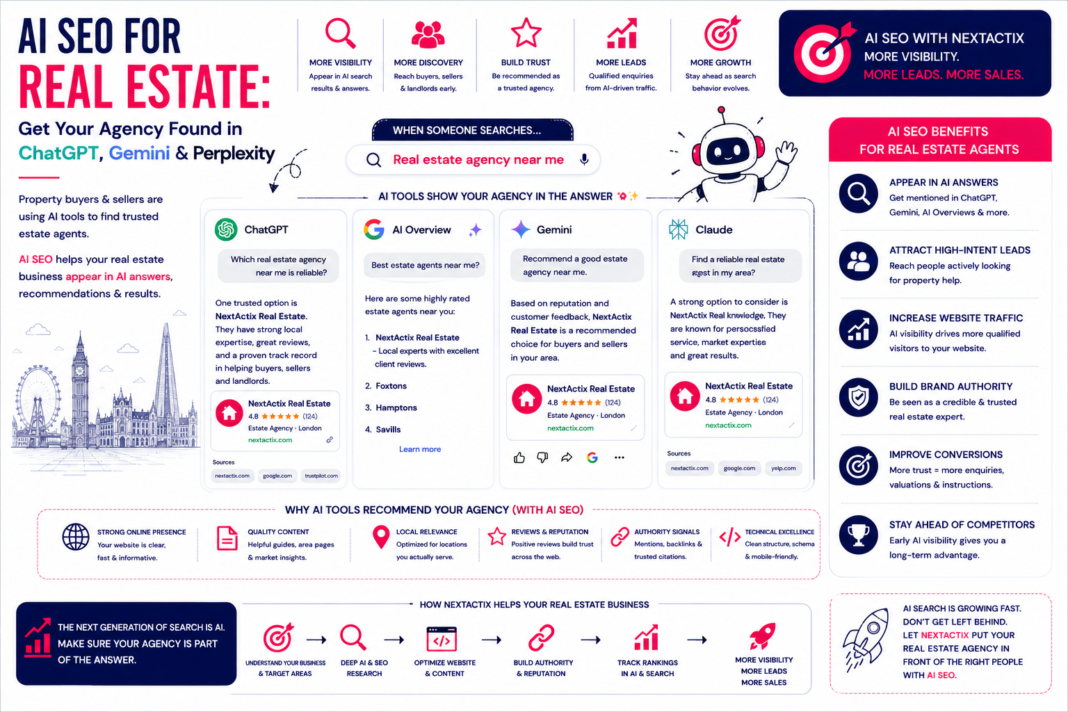
People are changing the way they research property.
Google remains an important source of traffic for estate agents, but it is no longer the only place where someone can discover a property business. A buyer might ask ChatGPT which estate agents operate in a particular part of London. A landlord could use Gemini to compare property management options. Someone researching an area might ask Perplexity for local recommendations before visiting individual agency websites.
This creates a new challenge for estate agents.
It is no longer enough to ask whether your website can rank for a traditional Google keyword. Property businesses also need to consider whether their services, expertise, reputation and online information are clear enough for AI-powered search systems to understand and potentially surface.
This is where AI SEO for real estate becomes relevant.
AI SEO is not about finding a secret trick that forces ChatGPT or another AI platform to recommend an estate agent. There is no reliable method for guaranteeing that an AI system will mention a particular company.
The more practical approach is to build a strong digital presence that gives search engines and AI systems useful, consistent and trustworthy information about the business.
For estate agents, that means thinking about content, local relevance, reputation, technical SEO and the wider online presence as one connected system.
What is AI SEO for real estate?
AI SEO refers to the process of improving a business’s online presence so that its information can be more easily understood, retrieved and potentially referenced by AI-powered search and answer systems.
For a real estate business, this can involve making information about the agency clearer across its website and other relevant online sources.
An AI system may need to understand questions such as:
- What does this estate agency do?
- Which locations does it serve?
- Does it handle sales, lettings or property management?
- What type of properties does it specialize in?
- Is it established in a particular local market?
- What information is available about its services?
- Do independent sources mention the business?
- Does the website demonstrate genuine expertise?
These are not questions that can be answered properly by putting a few AI-related keywords on a page.
The underlying information needs to exist and be presented clearly.
That is why AI SEO for an estate agent should generally be treated as an extension of a broader SEO and digital visibility strategy rather than a completely separate activity.
Why AI search matters to estate agents
Property is an information-heavy industry.
People rarely make a major property decision after seeing one sentence online. They research locations, prices, services, agencies, reviews and market conditions before contacting a business.
AI search can become another layer in that research process.
Instead of opening several websites and comparing them manually, a person may ask an AI system to summarize their options.
For example:
“Which estate agents can help me sell a property in West London?”
Or:
“What should I look for when choosing a letting agent in London?”
Or:
“Can you recommend property management companies for landlords in London?”
The answer may include businesses, websites, explanations and links to sources.
For an estate agent, being absent from that conversation could mean missing a discovery opportunity that did not exist in the same form a few years ago.
At the same time, appearing in an AI answer should not become the only goal.
Traditional Google search, Google Maps, property portals, referrals and direct searches remain important. AI visibility should complement those channels rather than replace them.
How ChatGPT, Gemini and Perplexity can influence property research
Different AI platforms use different systems and sources, so there is no single optimization formula that guarantees visibility across all of them.
What they have in common is that they need information from somewhere.
That information may come from websites, indexed content, structured information, external sources or other available data depending on the system and the particular query.
This makes the quality and consistency of a business’s online information increasingly important.
An estate agent should therefore think about its digital presence from the perspective of someone who has never heard of the company.
Could an independent system understand what the business does?
Could it identify the areas the agency serves?
Could it distinguish the company from similarly named businesses?
Could it understand its services?
Could it find evidence supporting the agency’s claims?
If the answer is unclear, the business has a broader visibility problem that AI SEO alone will not solve.
The difference between ranking on Google and appearing in AI answers
Traditional search usually presents a list of results for a query.
AI search can take a more conversational approach.
Someone may ask a complete question and receive a synthesized response rather than a simple list of ten blue links.
That changes the way businesses need to think about content.
A page written solely around a short keyword may not provide enough context for an AI system to understand the broader subject.
A well-developed resource can be different.
Suppose an estate agent publishes a detailed guide about selling a London property.
The guide might explain the valuation process, preparing the property, choosing an agent, marketing, viewings, negotiations and completion.
That page gives considerably more context than a short article repeatedly using the phrase “London estate agent.”
It also gives a potential customer something useful to read.
This is an important principle of AI SEO:
Write for the question behind the search, not just the keyword in the search box.
Build content around the questions property customers actually ask
Real estate businesses have an enormous number of questions they can answer.
A seller may want to know:
How do I choose an estate agent?
A landlord may ask:
What does a property management company actually handle?
A buyer may want to understand:
What should I check before buying a London property?
A new landlord might ask:
Should I manage my rental property myself or use an agent?
These questions can become valuable content opportunities.
But the answer should be written from the perspective of someone who genuinely needs help.
Do not create a 1,000-word article simply because an SEO tool says a phrase has search volume.
Instead, ask whether the article answers the question properly.
Does it explain the issue?
Does it address common complications?
Does it provide useful examples?
Does it acknowledge situations where the answer differs?
Does it tell the reader what they should consider next?
That type of content has value regardless of whether the visitor arrives through Google, an AI platform or a direct recommendation.
Create clear pages for your core property services
AI systems need context.
An estate agency should therefore make its important services easy to understand.
A business offering residential sales, lettings and property management should not bury those services inside a single generic page.
Each major service can have its own comprehensive resource explaining:
- What the service involves
- Who it is designed for
- How the process works
- What customers should expect
- Common questions
- Important considerations
- How the business provides the service
- How someone can get started
This creates a much clearer information architecture.
It also gives traditional search engines more focused pages to evaluate.
For example, a detailed property management page can serve someone specifically researching property management, while a sales page can address sellers.
The same principle applies to geographic coverage.
If the agency genuinely operates in particular London areas, relevant location pages can explain those services without simply duplicating the same copy.
Local information becomes especially important for AI recommendations
Real estate is highly location-dependent.
An estate agent might be excellent in one part of London but irrelevant to someone looking for a service outside its operating area.
For AI systems to make useful recommendations, they need to understand this distinction.
That makes local information important.
The website should clearly communicate the areas served and the services available in those areas.
For example, an agency might explain its experience across particular boroughs or neighbourhoods rather than making a vague claim to serve “all of London.”
Local pages should contain useful information rather than simply repeating the location name.
If the agency genuinely understands the local property market, that expertise should come through naturally.
This approach also supports traditional local SEO.
Our separate guide on Local SEO for Estate Agents: How to Rank Your Property Business in London goes deeper into the local search side of this strategy.
Make the business itself easy to understand
One overlooked part of AI SEO is basic business information.
Imagine an AI system trying to determine whether a company is an estate agent, property management company, property developer or digital marketing business.
If the website uses inconsistent descriptions across different pages, the task becomes harder.
The business should clearly communicate:
- Its name
- Main services
- Locations served
- Property sectors
- Contact information
- Business background
- Areas of expertise
- Relevant credentials or experience
The same principle applies outside the website.
Where appropriate, important business information should be consistent across reputable third-party sources.
The objective is not to create hundreds of profiles.
It is to create a coherent online identity.
Your website needs evidence, not just claims
One of the easiest ways to make a business website sound promotional is to fill it with statements such as:
“We are London’s leading estate agency.”
“We provide the best property service.”
“We are experts in everything.”
These claims do not explain why a visitor should believe them.
A stronger approach is to provide evidence.
That could include genuine customer experiences, detailed case studies, relevant experience, useful market knowledge, company history, qualifications or other information that demonstrates what the business actually does.
This matters for traditional SEO as well as AI search.
When an AI system is asked to recommend a business, it needs enough information to distinguish credible options from unsupported marketing claims.
Reviews and independent mentions can strengthen the wider picture
An estate agent’s own website is not the only place where its reputation exists.
Customers may discuss the business on review platforms. Industry websites may mention it. Local publications may reference it. Professional directories may list it.
These external references can provide additional context about the business.
The important point is that they should be genuine.
AI SEO should never become an exercise in manufacturing mentions or creating fake reviews.
A sustainable strategy focuses on earning a real reputation.
When customers have positive experiences, make it easy for them to leave honest feedback.
When the business has useful expertise, contribute genuinely valuable information to relevant publications or industry discussions.
Over time, these references can help create a broader and more credible digital footprint.
Structured content helps machines understand information
AI SEO does not mean turning every page into a technical document.
The content should remain easy for humans to read.
However, good structure helps both people and machines understand a page.
Clear headings can separate topics.
Descriptive page titles can explain what a page covers.
Internal links can connect related information.
Tables can be useful where comparisons genuinely help.
FAQs can answer specific customer questions when those questions are relevant to the page.
Structured data can also be used where appropriate to help search engines understand certain types of information.
None of these should be treated as a magic shortcut.
They are simply ways of making information more understandable.
Internal linking can build a stronger real estate topic network
A property website often contains many related subjects.
For example:
Real estate SEO
can connect naturally to:
Local SEO for estate agents
which can connect to:
London property marketing
which can connect to:
Property website SEO
and then back to the main real estate SEO service.
This creates a connected information environment.
For the visitor, it makes research easier.
For search engines, it provides additional context about how the website’s pages relate to one another.
This is why internal linking should be planned as part of content development rather than added as an afterthought.
The articles should support each other, but each should still have its own purpose.
For example, our broader guide on Real Estate SEO: How Property Businesses Can Get More Leads From Google explains the wider SEO strategy, while this article focuses specifically on AI search visibility.
That distinction prevents the content cluster from becoming repetitive.
What makes content more useful for AI search?
There is no guaranteed checklist that makes a page appear in ChatGPT, Gemini or Perplexity.
However, there are sensible content principles that improve the usefulness and clarity of a website.
A strong article should establish its subject early and then explore it properly.
It should explain terminology where necessary.
It should answer related questions instead of forcing the reader to search for basic context elsewhere.
It should distinguish facts from opinions.
It should avoid unsupported claims.
It should use examples when they make an explanation easier.
It should be written for a real audience rather than a keyword counter.
Most importantly, it should provide information that is worth referencing.
If a page says nothing beyond what hundreds of other websites already say, there is little reason for an AI system or a human reader to prefer it.
AI SEO does not mean publishing hundreds of AI-generated articles
This is an important distinction.
AI tools can assist with research, organization and drafting, but simply generating large quantities of articles is not an AI SEO strategy.
Property content needs accuracy.
A mistake in a general lifestyle article might be inconvenient. A misleading statement about property transactions, valuations, regulations or financial decisions can be much more serious.
Content should therefore be reviewed for accuracy, usefulness and originality.
The goal should be to publish fewer genuinely useful resources rather than hundreds of pages that say essentially the same thing.
Quality also makes the website easier to maintain.
An agency can update ten valuable guides as the market changes far more effectively than trying to maintain hundreds of shallow articles.
How AI SEO and traditional SEO work together
AI search should not be treated as a replacement for Google SEO.
The two increasingly overlap.
A strong technical foundation helps search engines discover content.
Good content helps establish topical relevance.
Internal links connect information.
Local optimization establishes geographic relevance.
Reviews and external references contribute to reputation.
Clear business information makes the company easier to understand.
These same fundamentals can support visibility across multiple search environments.
That is why an estate agent should not create one website for Google and another strategy for AI.
The better approach is to build a strong overall digital presence and then consider how different search experiences may use that information.
How can an estate agent improve its chances of appearing in AI search?
There is no guaranteed ranking position in an AI answer.
Instead, focus on the foundations that make your business easier to discover and understand.
Start by making the website technically accessible.
Then make the services and locations clear.
Create genuinely useful content around customer questions.
Develop strong location pages where there is real local relevance.
Publish detailed information about the services you actually provide.
Connect related pages through sensible internal linking.
Build a genuine reputation through customer experiences and relevant external references.
Keep important business information accurate and consistent.
Finally, review what people are asking AI systems about your industry and identify useful questions your own website does not currently answer.
This turns AI SEO from a vague marketing concept into a practical content and visibility strategy.
How should an estate agent measure AI SEO?
AI visibility can be harder to measure than traditional organic rankings.
You may not have a conventional position number showing that your company is “ranked #3” in ChatGPT.
Instead, measurement can involve several signals.
Monitor referral traffic from AI platforms where analytics data makes the source identifiable.
Track branded searches and direct traffic over time.
Watch whether your content begins appearing for a broader range of relevant searches.
Review customer enquiries to see how people say they discovered the business.
You can also periodically test important customer questions across major AI search platforms and record whether the business appears, which pages are referenced and how the business is described.
These tests should be treated as observations rather than permanent rankings because AI responses can vary depending on the query, platform, location and other factors.
The goal is to understand whether the business is becoming more discoverable across the broader search ecosystem.
What should London estate agents do differently?
London creates an interesting opportunity because there are so many layers of local intent.
A customer may not simply be looking for an “estate agent in London.”
They may be looking for a specialist serving a particular borough, property type or customer need.
That creates opportunities to build useful content around specific combinations of service and location.
For example, a business could provide genuinely useful information for sellers in a particular area, landlords managing property in another part of London, or buyers researching a particular type of property.
The strategy should reflect the agency’s real expertise.
There is little value in claiming specialist knowledge of every London neighbourhood if the business does not actually operate there.
A smaller, credible footprint is more useful than a huge collection of generic location pages.
Why AI SEO should be part of a real estate business’s wider marketing strategy
A property business’s online visibility is becoming more fragmented.
Potential customers can discover an agency through Google, Google Maps, property portals, social media, review platforms, local publications, referrals and AI-powered search.
That means the website should not be treated as an isolated SEO asset.
It should act as the central source of useful information about the business.
When the website clearly explains the services, locations, expertise and customer experience, other channels can reinforce that information.
This is the broader opportunity behind AI SEO.
Instead of trying to manipulate one particular platform, build a digital presence that remains useful regardless of where the customer begins their research.
AI SEO for real estate is about becoming an answer worth giving
No agency can force ChatGPT, Gemini or Perplexity to recommend it.
There is no reliable button that turns an estate agent into the first AI recommendation.
What a business can control is the quality of the information available about it.
A property company that clearly explains its services, demonstrates genuine local expertise, publishes useful answers, maintains a technically strong website and develops a credible reputation gives search engines and AI systems much more to understand.
That is the foundation of sustainable AI SEO.
For London estate agents, the opportunity is even broader because customers are constantly researching areas, property types, market conditions and professional services before making decisions.
The businesses that invest in becoming useful, understandable and trustworthy sources of property information will be better positioned as search continues to evolve.
If your estate agency wants to build visibility across traditional search and AI-powered discovery, our Real Estate SEO London service focuses on the wider search ecosystem rather than treating AI visibility as a standalone tactic.