


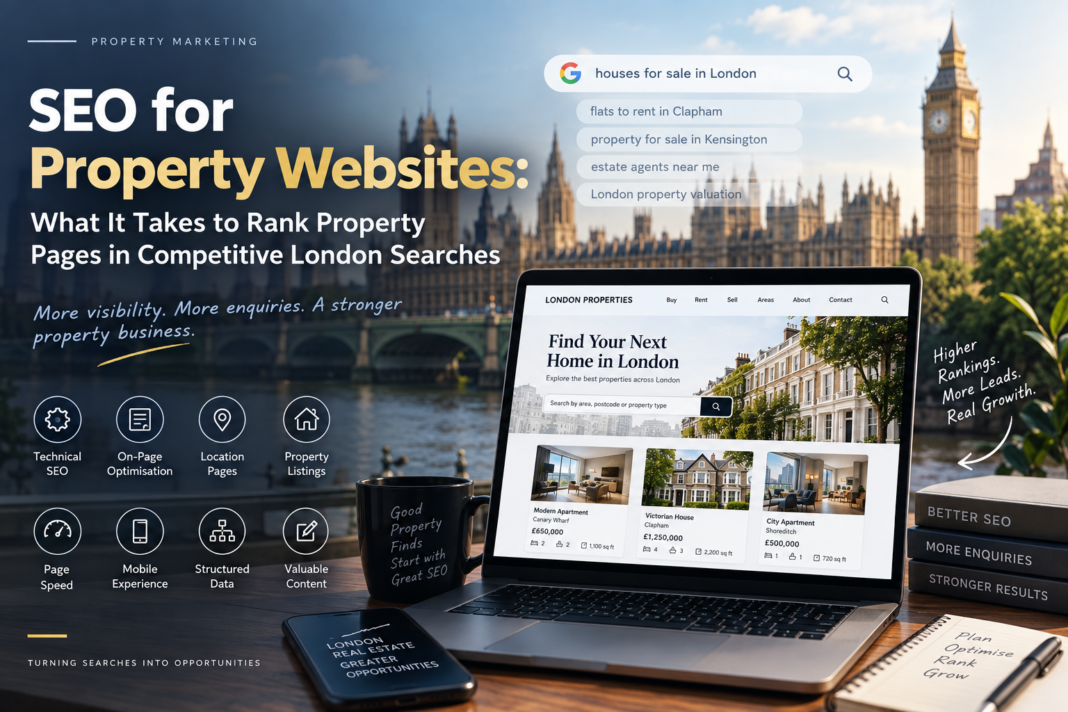
A property website can contain hundreds, sometimes thousands, of pages. Every property may have its own URL, description, images, location and specifications, while the website may also contain pages for sales, lettings, valuations, neighbourhoods and other services.
That creates a very different SEO challenge from a typical business website.
For an estate agent, simply getting the homepage to rank is not enough. A potential buyer might search for a particular type of property in a particular part of London and land directly on a property page, an area page or a service page.
The question is whether your website is strong enough for those individual pages to be discovered, understood and considered useful.
London makes this particularly competitive. Estate agents are competing with other agencies, large property portals, specialist websites and established local businesses for searches that can have significant commercial value.
This is why SEO for property websites needs to account for both traditional search optimization and the way property websites actually work.
Why property website SEO is different from ordinary business SEO
A normal service business may have a relatively small number of important pages.
An estate agent can have an entirely different structure.
A single website might contain:
- Property listings
- Property type pages
- Location pages
- Sales service pages
- Lettings pages
- Valuation pages
- Landlord information
- Buyer guides
- Area guides
- Market reports
Each section serves a different search intent.
A property listing is designed around a specific property.
A location page is designed around a geographic market.
A service page explains what the agency provides.
An area guide may answer informational questions from people researching a location.
Treating all of these pages in exactly the same way usually leads to a weak SEO structure.
The first step is therefore understanding what each page is supposed to accomplish.
Property pages need more than a property title and a photograph
One of the most common problems with property websites is that individual listings contain very little unique information.
A page might show a title such as:
“2 Bedroom Flat for Sale in London”
followed by a short description, a gallery and contact details.
That may be enough for someone who already knows the property reference.
It gives search engines considerably less information about the page.
A stronger property page can provide useful details about the property, its setting and the reason the listing is relevant.
The content should still sound natural. There is no need to turn a property description into an SEO document.
The objective is to give visitors enough information to understand the property while making the page genuinely useful.
Location is one of the most important parts of property SEO
Property searches are heavily influenced by location.
A buyer may not simply search for:
“two bedroom flat for sale.”
They may search for:
“two bedroom flat for sale in Clapham.”
Or:
“houses for sale near Wimbledon.”
Or:
“apartments to rent in Canary Wharf.”
That means property pages need clear geographic context.
The location should be represented naturally in the page title, relevant headings, property information and surrounding content where appropriate.
But repeating the location name in every sentence is not the solution.
A good property page should make the location obvious because the property itself is located there, not because the page has been filled with repeated keywords.
Property descriptions should help buyers understand the home
Property descriptions have two audiences.
The first is the person considering the property.
The second is the search engine trying to understand what the page contains.
The first audience should always come first.
A useful description can explain the property’s layout, condition, notable features, outdoor space, parking, transport considerations and other genuinely relevant characteristics.
For example, instead of relying on a generic sentence about a “beautiful property in a desirable location,” the description can explain what actually makes the property interesting.
Specific information is naturally more useful than promotional filler.
It also gives search engines more context about the page.
Don’t create hundreds of pages that contain almost identical content
Large property websites can accidentally create duplicate or near-duplicate content at scale.
The same description may appear on the estate agent’s website, a property portal and other listing platforms.
Within the website itself, similar properties may also have descriptions that differ by only a few words.
This creates a difficult SEO environment.
Not every property URL needs to rank independently for broad keywords.
The important thing is to determine which pages genuinely deserve organic visibility and make those pages useful.
For temporary listings, the SEO strategy may be different from that of permanent service or location pages.
This is one reason property SEO requires more careful URL and indexing decisions than simply publishing every possible page.
What should happen when a property is sold or rented?
Property inventory changes constantly.
A property that exists today may no longer be available next month.
If the URL simply disappears, visitors and search engines may encounter broken links.
If every old property page remains live forever with a generic message, the website can accumulate large numbers of outdated URLs.
There is no universal solution because the correct approach depends on the type of page and whether it has continuing value.
For example, an old listing with useful historical information and meaningful organic traffic may deserve a different treatment from a temporary listing that attracted almost no visibility.
The important point is to have a clear lifecycle for property URLs.
Property websites should decide what happens when listings become unavailable rather than handling every expired page differently.
Technical SEO becomes more important as the website grows
A small website might have fifty important URLs.
A property platform can have thousands.
At that scale, technical problems can multiply quickly.
Important areas include crawlability, indexability, canonical URLs, redirects, internal linking and sitemap management.
Search engines need to be able to discover the pages that matter without being overwhelmed by unnecessary URLs.
Property websites can generate additional URLs through filters, searches, sorting options and other functionality.
Not every generated URL needs to become a search result.
A technically well-managed property website makes a clear distinction between useful indexable pages and URLs that exist mainly for website functionality.
Make the most important property pages easy to discover
Search engines need links to discover pages.
A property listing that is buried several clicks away from the main website structure may be harder to discover than one that is properly connected to relevant categories and locations.
Internal linking can help.
A property page might be connected to its relevant property type, location and service pages.
For example, a London apartment listing could be accessible through an appropriate residential property section and relevant location content.
This does not mean every page needs dozens of internal links.
The structure should make sense to the visitor.
If a user can easily move from a location page to relevant properties and from a property page to related information, the website becomes easier to navigate as well as easier to understand.
Your property category pages can target broader searches
Individual property listings are not always the best pages for broader searches.
Imagine someone searches:
“houses for sale in South West London.”
A single property listing may not be the ideal result.
A well-built property category or location page can potentially provide a much better experience because it can introduce the market and present multiple relevant properties.
This creates an important distinction in property SEO.
Individual property pages can target specific property intent, while category and location pages can address broader searches.
A successful website uses both.
Location pages should provide more than a list of properties
An area page can become much more valuable when it explains the location rather than simply displaying inventory.
A useful London area page might discuss the kinds of properties found there, who typically considers the area, local amenities, transport considerations and the services the agency provides.
The information should be genuinely useful and kept current where appropriate.
This also creates opportunities for internal links to relevant property listings, valuation services and other resources.
A location page can therefore become a central piece of the website’s SEO structure rather than just another landing page.
Property images are important, but they are not the whole SEO strategy
Property is highly visual.
High-quality photographs help people evaluate a home before arranging a viewing.
From an SEO perspective, images also need to be handled properly.
Relevant file names, descriptive alternative text where appropriate, sensible image sizes and good page performance can all contribute to a better website experience.
Large property galleries can become a performance problem if images are not optimized.
A beautiful property page that takes several seconds to become usable is not providing the same experience as a fast, well-optimized page.
Image quality and website performance therefore need to work together.
Page speed matters on property websites
Property pages often contain many images, maps, scripts, galleries and interactive elements.
All of those can affect performance.
A website does not need to remove useful functionality simply to become fast. Instead, technical optimization should focus on delivering those features efficiently.
This can involve optimizing image sizes, reducing unnecessary scripts, improving caching and reviewing how third-party tools are loaded.
Performance should be measured on the pages that matter most, particularly mobile.
A prospective buyer browsing properties from a phone should not have to wait for a large collection of unnecessary assets before they can see the property information.
Mobile SEO is particularly important for property searches
Property research often happens away from a desktop.
Someone may see a property on social media, hear about it from a friend or search for an address while travelling around London.
The website therefore needs to work properly on smaller screens.
Important information should remain accessible.
Images should display correctly.
Navigation should not become frustrating.
Contact options should be easy to find.
Forms should work without unnecessary friction.
A technically mobile-friendly website is not just a ranking consideration. It directly affects whether a potential buyer or landlord continues using the site.
Structured data can help search engines understand property information
Structured data provides a way of describing certain information in a machine-readable format.
For property websites, there may be opportunities to use relevant structured data where the implementation genuinely matches the content on the page.
However, structured data should not be treated as a way to make unsupported claims or force search features.
The information in the markup needs to accurately represent what users can see on the page.
This is another example of why technical SEO should support the website rather than exist separately from it.
Property websites need a sensible indexation strategy
One of the biggest SEO questions for a large property website is:
Which pages should actually be indexed?
A website can generate many URLs that are useful for users but not necessarily valuable as independent search results.
Examples can include internal search combinations, filters, sorting URLs and temporary pages.
If everything is allowed into search indexes without a clear strategy, the website can become unnecessarily complicated.
The objective should be to help search engines focus on the pages that provide genuine value.
That normally requires reviewing how URLs are generated and deciding which page types deserve long-term organic visibility.
Don’t forget the pages that generate business
Property listings are important, but they are not the only pages that can generate enquiries.
Consider a homeowner searching for:
“property valuation London.”
They may not care about a particular listing.
They are looking for an agency.
Likewise, a landlord may search for:
“property management company London.”
These searches require service-focused pages rather than individual property listings.
This is why a strong property website should balance inventory SEO with service SEO.
The property listings attract people researching individual homes.
The service pages attract people choosing a professional.
The location pages connect the two.
Content can support property pages without competing with them
A real estate website can build useful supporting content around the questions customers ask before making decisions.
For example, articles can explain:
How to prepare a home for sale.
What buyers should look for during a viewing.
How property valuations work.
What landlords should consider when choosing an agent.
How to compare estate agencies.
What affects property demand in different parts of London.
The purpose is not to publish content for the sake of increasing the number of URLs.
Each article should have a clear reason for existing.
It should also connect naturally to the relevant commercial or location pages.
This creates a website where informational content helps people move towards the services they may eventually need.
Internal linking should connect the whole property website
A strong internal linking structure can make a large property website much easier to understand.
A useful structure might connect:
Real estate SEO London
to relevant service information.
Service pages can connect to appropriate location pages.
Location pages can connect to relevant property categories.
Property categories can lead visitors to individual listings.
Supporting guides can answer questions and then direct readers towards the appropriate service.
The links should make sense in context.
There is no need to force an exact-match keyword into every anchor text.
Natural descriptive links are often clearer for the reader.
What makes a London property website competitive in search?
London has no shortage of property information.
Large portals already have enormous amounts of inventory, established websites and significant authority.
An individual estate agent therefore needs to offer something more useful than simply another copy of a property listing.
Local expertise can become an advantage.
A specialist agency can explain the market it actually works in.
It can publish useful guides.
It can demonstrate knowledge of the areas it serves.
It can provide detailed information about its services.
It can build relationships with customers and earn genuine reviews.
The website then becomes more than a catalogue of properties.
It becomes a useful resource around the agency’s market.
SEO for property websites should support the customer journey
A person rarely goes directly from a Google search to completing a property transaction.
There are usually several stages.
Someone may first research an area.
Then they may compare property types.
Later they may view individual listings.
A seller may research valuations.
A landlord may compare agencies.
Eventually, they may contact a business.
SEO can support each stage.
Informational content can introduce the business.
Location pages can establish local relevance.
Property pages can capture specific inventory searches.
Service pages can convert commercial searches.
A good SEO strategy connects these stages instead of treating every URL as an isolated ranking opportunity.
What should estate agents monitor?
Property SEO needs ongoing measurement because inventory, competition and search behaviour change.
Useful areas to monitor include organic impressions, clicks, search queries, indexed pages and traffic to important property and service pages.
It is also worth looking at which pages actually generate enquiries.
A page receiving thousands of visits but no meaningful enquiries may not be as valuable as a smaller page attracting highly relevant potential clients.
For an estate agency, SEO success should therefore be connected to business outcomes.
The real question is not simply whether the website has more traffic.
It is whether the right people are finding the right pages and taking meaningful next steps.
The best property SEO strategy is not about ranking every property
A common misconception is that the objective of property SEO is to make every listing rank in Google.
That is not necessarily realistic or even desirable.
Property inventory changes.
Competition varies dramatically by search.
Some properties have almost no search demand.
Others may be highly competitive.
Some pages will naturally have short lifespans.
The stronger objective is to build a website where the right page can compete for the right type of search.
That means individual listings, location pages, service pages and educational resources all have different jobs.
Once those roles are clear, the website becomes much easier to optimize.
Building a property website that can compete in London’s search results
SEO for a property website requires more than inserting property keywords into listing descriptions.
It requires a structure that search engines can crawl, content that customers can understand and pages that correspond to genuine search intent.
The technical foundation needs to support the scale of the website.
Property listings need useful and accurate information.
Location pages need genuine local value.
Service pages need to explain what the agency actually provides.
Internal links need to connect related information.
Old listings need to be handled intelligently.
Images and interactive features need to work without making the website unnecessarily slow.
And the overall website needs to demonstrate why the agency is relevant in the market it serves.
For businesses operating in London, that becomes even more important because the competition is strong and customers have many alternatives.
At NextActix, our approach to real estate SEO in London looks beyond individual keywords. We work on the wider search presence of a property business, including technical SEO, content, local visibility, service pages and emerging AI search opportunities.
You can explore the full Real Estate SEO London strategy here.
For the local search side of property marketing, you can also read Local SEO for Estate Agents: How to Rank Your Property Business in London.
And for businesses looking at AI-powered discovery, our guide to AI SEO for Real Estate: How Estate Agents Can Appear in ChatGPT, Gemini and Perplexity covers that side of the search ecosystem in more detail.