


Updated On: – July 11, 2026
Most people start learning SEO by doing the wrong thing first. They write blog posts. They stuff keywords into headings. They sign up for a tool they are not ready to use yet. And then, six months later, they wonder why nothing has moved.
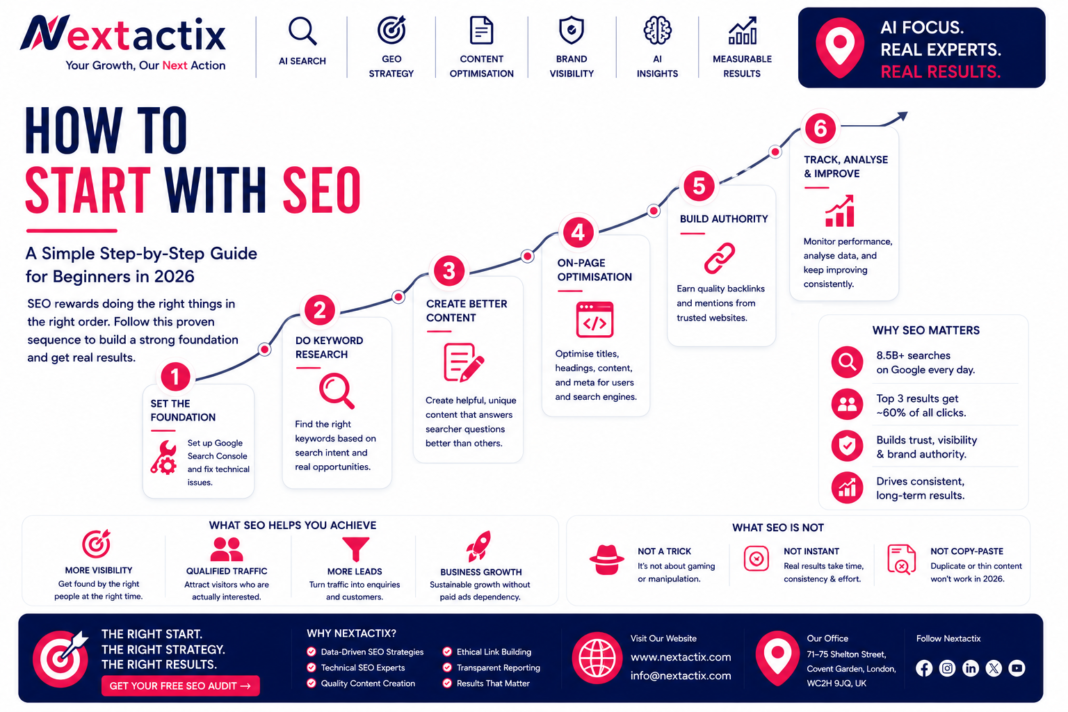
The problem is not effort. The problem is sequence. SEO in 2026 rewards doing a small number of things in the right order, not doing everything at once or starting wherever feels most intuitive. This guide explains what that order looks like, why it matters more now than it did in 2020, and what has genuinely changed about search that beginners need to understand before they write a single word of content.
What SEO Is — and What It Is Not
SEO stands for Search Engine Optimization. The practical definition is this: it is the work of making your website more likely to appear when someone searches for something relevant to what you offer, without paying for that appearance.
Google processes around 8.5 billion searches every day. The top three organic results on any given search page receive approximately 60% of all clicks. The businesses and websites that occupy those positions are not there by accident. They earned those placements through relevance, trust, and a decent technical foundation — and they continue holding them because they stay relevant and keep building trust.
What SEO is not: it is not a trick. It is not a way to fool Google into ranking you. The strategies that tried to game the algorithm — keyword stuffing, bulk link buying, thin content padded with synonyms — worked briefly in Google’s early years and have been systematically eliminated through algorithm updates ever since. The June 2026 spam update was specifically built to catch the patterns that scaled, template-driven content creates. If you are reading this guide in 2026, you are starting in an environment where doing SEO honestly and thoroughly is not just the ethical choice — it is the only reliable strategy.
The One Thing Google Is Actually Trying to Do
Understanding this makes everything else in SEO click into place. Google’s job, commercially and technically, is to give the person searching the most useful answer to their query as quickly as possible. That is it. Every algorithm update, every ranking factor, every quality guideline exists in service of that one goal.
When you understand that, the question ‘how do I rank higher?’ becomes a different, more useful question: ‘how do I become the most genuinely useful result for the people searching for what I offer?’ Those two questions sometimes have the same answer. When they do not, Google’s algorithm — which has become sophisticated enough to measure real user behaviour, content quality, and source credibility — tends to side with genuine usefulness over clever optimisation.
The businesses pulling ahead in 2026 are not the ones with the most technically optimised pages. They are the ones whose content is specific, credible, and demonstrably better than what their competitors published.
Before You Write Anything: The Technical Foundation
Here is the step that almost every beginner skips, because it feels less exciting than writing content. But it is the most important first action you can take, because without it, everything else you do is harder to measure and slower to produce results.
Set up Google Search Console. It is free. It connects your website to Google directly, shows you which queries are generating impressions for your site, which pages Google has indexed, and whether there are any technical errors preventing your pages from appearing in results. Without Search Console, you are building in the dark. With it, you have a live feedback system telling you what Google can and cannot see on your site.
Then check the basics: does your site load in under two seconds on a mobile connection? Does it render correctly on a small screen? Are there any pages returning errors? Google’s March 2026 core update tightened its performance thresholds — the LCP (Largest Contentful Paint) benchmark for a ‘Good’ score moved from 2.5 seconds to 2.0 seconds. Sites that were passing before March are now in the ‘Needs Improvement’ zone if they have not been updated. You can check this using Google’s free PageSpeed Insights tool — it takes three minutes and tells you exactly where your site stands.
Fix what is broken before building on top of it. A technically sound foundation means that every piece of content you publish afterward has the best possible chance of being crawled, indexed, and ranked.
Keyword Research: What It Actually Is in 2026
Keyword research is the process of understanding what your potential customers type into Google when they are looking for what you offer. The goal is not to find the words with the highest search volume — that approach consistently leads beginners toward terms they cannot compete for. The goal is to find the specific phrases where the intent behind the search matches what your page offers, and where the competition is at a level your site can realistically beat.
Search intent is the concept that changed keyword research most significantly over the last five years. Google now classifies every search into one of four intent types: informational (the person wants to learn something), navigational (they want to find a specific website), commercial investigation (they are comparing options before deciding), and transactional (they are ready to act now). The reason this matters is that Google ranks different types of content for different intent types — and publishing the wrong content type for a keyword’s intent, however well-optimised that content is, will consistently underperform.
A quick example: if someone searches ‘best SEO tools 2026,’ Google knows they are in commercial investigation mode — comparing options. The pages that rank for this term are comparison articles and listicles, not product pages and not introductory guides. If you publish a product page targeting this keyword, it will not rank well regardless of how many times you include the phrase. The mismatch with intent is the problem, and no amount of technical optimisation fixes it.
How to find keywords you can actually win
Start with the free version of what is available. Google Search Console (once you have data accumulating) shows you what queries your site is already getting impressions for — these are your starting points, because Google has already connected you to these searches even if you are not ranking highly for them yet.
Google’s own autocomplete is underused as a research tool. Type your main topic into Google and look at what it suggests completing. These suggestions are based on what real people are actually searching for, not what a tool predicts. The ‘People also ask’ section on search results pages shows you related questions your content should answer if it wants to be considered comprehensive.
For deeper research, tools like Ahrefs, Semrush, and Mangools offer keyword difficulty scores alongside search volume — which means you can see not just how many people search for a term, but how hard it is to rank for it given your current site’s authority. For beginners, prioritising keywords with difficulty scores below 20 (on a 0-100 scale) is a reliable starting point. They have lower traffic ceilings, but they are genuinely achievable — and ranking for ten lower-volume keywords produces more total traffic than chasing one high-volume keyword for twelve months without getting close.
Content: The Part Everyone Talks About and Most Get Wrong
There is a piece of received wisdom in SEO that says ‘content is king.’ It has been repeated so often that it has lost most of its meaning. The more precise version — the one that actually guides good decisions in 2026 — is that specifically useful, experience-backed, clearly structured content is what Google rewards. Generic content that covers the same ground as a hundred other pages is not king. It is noise.
Google’s helpful content system, which became a permanent part of its core ranking algorithm after the 2024 updates, is designed specifically to identify and demote content that exists primarily to rank rather than to genuinely help the person reading it. The signal it uses is not just the content itself — it looks at the overall pattern of a website’s publishing. A site with a hundred thin, template-structured articles alongside a handful of good ones can see the good ones suppressed because the overall pattern signals low quality.
This is the direct cause of why many websites, including some with years of publishing history, saw sharp traffic drops in 2024 and 2026. The content looked fine page by page. Across the whole site, it read like it had been produced at scale without genuine expertise behind it.
What makes content worth reading — and worth ranking
Write from a position of knowing something, not from a position of covering a topic. The difference shows. An article about ‘how to start with SEO’ written by someone who has done SEO work — who has seen what actually moved rankings for specific clients, who has a view on what the common mistakes are based on experience, not just theory — reads differently from one assembled by someone summarising other articles.
Be specific where other content is vague. If you are writing about keyword research tools, name the tools, say what each one does well and where it falls short, give a concrete example of the kind of keyword it would help you find. Specific claims are citable. Specific claims demonstrate knowledge. Specific claims are what AI Overviews pull from when generating answers. Vague descriptions do none of these things.
Keep the structure clean but do not make it rigid. Use headings to help readers navigate. Write paragraphs of varying length — some short and punchy, some longer and explanatory. Avoid the pattern of one heading followed by exactly three bullet points followed by one heading followed by exactly three bullet points. That pattern reads as template, not authorship, and it is one of the patterns the June 2026 spam update was explicitly designed to catch.
The Part About Links — Kept Honest
Backlinks — links from other websites to yours — remain one of Google’s most significant ranking signals. The logic behind this has not changed: a credible website choosing to link to your content is an endorsement, a signal that your content is worth pointing people toward. Google uses the volume, quality, and relevance of those endorsements as a proxy for authority.
What has changed is the risk calculus. Buying links, participating in link schemes, or publishing guest posts on low-quality sites purely for the link have all become progressively more detectable and more consequential. The penalty for a spammy backlink profile is not a gentle ranking adjustment — it can effectively remove a site from Google’s index for months. For a beginner, the cost-benefit of shortcuts here is straightforwardly negative.
The beginner-friendly approach to link building is to create content that other sites have a reason to reference, and then make sure those sites know it exists. Original research, genuinely comprehensive guides, specific tools or resources, and data that is not available elsewhere are the categories that earn links naturally. Distributing that content in relevant communities — industry forums, relevant subreddits, newsletters, professional networks — is not link buying. It is visibility. The links that follow from genuine interest are the ones that hold long-term value.
Measuring Progress Without Losing Your Mind
SEO does not produce results in days. For a new website, meaningful ranking movement typically starts appearing in three to five months of consistent, quality work. For competitive terms on a new domain, significant results take longer. This timeline is not a reason for panic or for abandoning a strategy that is working — it is the nature of how search authority builds.
The metrics worth watching in Google Search Console are impressions (how many times your pages appeared in search results), clicks (how many of those appearances converted to a visit), average position (where your pages are showing in results for specific queries), and Core Web Vitals (whether your technical performance is passing Google’s thresholds). Track these monthly, not daily. Daily fluctuation is noise. Monthly trends are signal.
One practical habit that produces consistent results: every month, identify the pages on your site that are getting impressions but low clicks. These are pages where Google has already decided you are relevant enough to show — but something about your title or description is not compelling the click. Improving the title tag and meta description on these pages often produces ranking improvements faster than publishing new content, because you are working with existing Google recognition rather than starting from zero.
The 2026 Layer: AI Overviews and What They Mean for Beginners
Google AI Overviews — the AI-generated summaries that appear at the top of many search results pages — are now part of the search landscape that beginners need to be aware of, even if they are not the primary focus at the start.
The good news is that the same practices that produce traditional SEO rankings also improve your chances of appearing in AI Overviews. Well-structured pages, specific and accurate content, proper schema markup, and a technically sound website are all signals that AI systems use when deciding which sources to draw from. You do not need a completely separate AI SEO strategy — you need a fundamentally good website, and the AI optimisation follows.
The one specific addition worth making early: an FAQ section on your key pages, written in the language your customers actually use when they ask questions. AI systems look for direct, quotable answers to specific questions. An FAQ that answers ‘how long does SEO take for a small business’ or ‘how much does SEO cost in the UK’ gives the AI something concrete to extract and present in an Overview — which puts your brand in the answer even for users who never click through to your site.