

Most businesses expanding into Korea make the same assumption early on: that whatever worked for their SEO in the US, the UK, or Europe will transfer with a bit of translation. It doesn’t. Naver, not Google, is where most Korean searches happen, and Naver doesn’t rank things the way Google does, doesn’t display results the way Google does, and doesn’t reward the same kind of content Google rewards.
That gap is exactly why so many global brands quietly underperform in Korea despite a genuinely good product and a well-built website everywhere else. Choosing an agency that understands this isn’t a nice-to-have. It’s the whole decision.
Why Naver Still Runs This Market
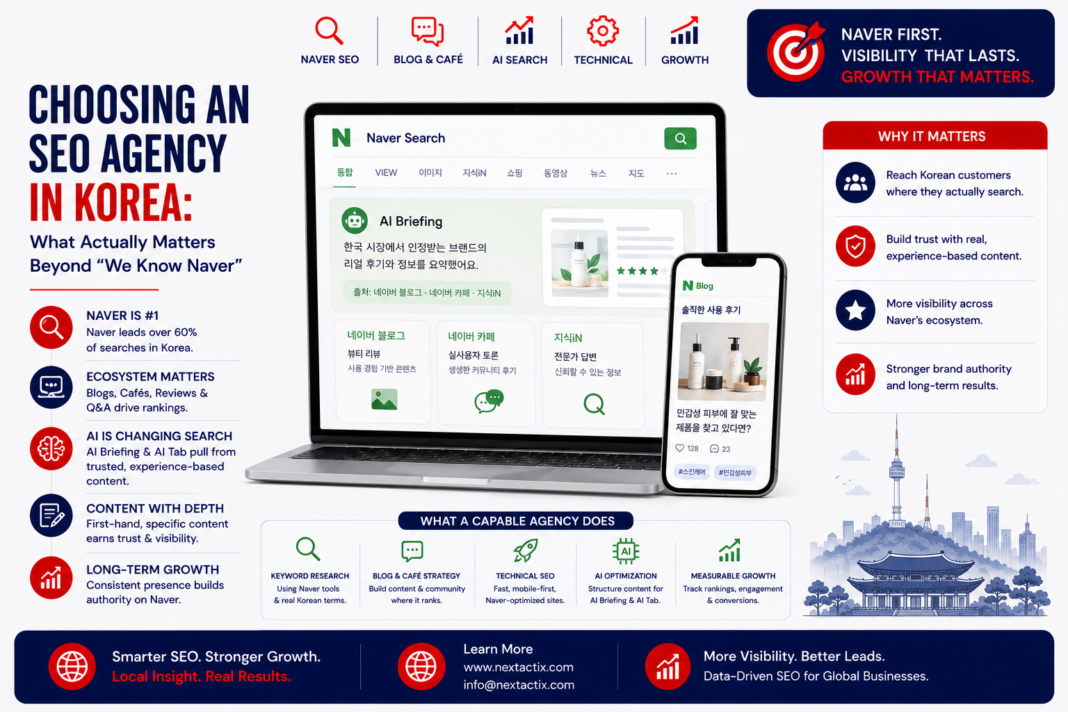
Naver holds somewhere around six in ten Korean searches, depending on whose measurement you trust, with Google taking a meaningful but distinctly secondary share and Daum trailing behind both. That gap hasn’t closed the way it has in most other markets, and there’s a real reason for it: Naver isn’t just a search engine. It’s an entire ecosystem — blogs, community cafés, a shopping platform, a knowledge Q&A service, maps, and increasingly AI-generated summaries — all feeding into and drawing from each other.
That matters practically because ranking on Naver was never just about a website. Naver’s results page pulls heavily from its own properties: Naver Blog posts, Naver Café discussions, and user-generated reviews often sit above or alongside standard web links, sometimes outranking a brand’s own official site for its own name. A business that only optimises its website and ignores its presence across Naver’s ecosystem is fighting with one hand behind its back.
What’s Actually Changed in the Last Year
Naver’s own AI has moved from an experiment to something shaping real search behaviour. AI Briefing, Naver’s answer-summary feature, now appears for a meaningful share of informational searches, pulling together information from blogs, cafés, and its Q&A platform into a synthesised response near the top of the page — similar in concept to Google’s AI Overviews, though built entirely around Naver’s own content ecosystem rather than the open web. A separate conversational AI Tab has also launched, aimed specifically at Korean-language, multi-step queries a simple keyword search handles badly.
What’s notable about both is what they draw from. Naver has said directly that its AI features lean on first-hand, experience-based content — specific details about taste, atmosphere, how a product actually performed, practical travel tips — rather than generic, promotional copy. That’s a genuinely different bar than optimising for a traditional keyword match, and it rewards exactly the kind of specific, lived-in content that a lot of translated or adapted global content simply doesn’t have.
Naver’s blog ranking system, known as C-Rank, has also tightened around topical consistency. A blog account that sticks to one clear subject area, categorised properly rather than left for the algorithm to guess at, builds credibility within that category over time in a way that a scattergun approach doesn’t. This has real implications for how a brand should be running its Naver Blog presence — not as an occasional add-on, but as a maintained, topic-focused asset in its own right.
What a Genuinely Capable Agency Actually Does
A lot of agencies pitching “Korean SEO” are really offering a translated version of a global playbook — keyword research, backlinks, a handful of blog posts, delivered in Korean. That’s not nothing, but it misses most of what actually moves visibility on Naver specifically.
Real Naver SEO work starts with keyword research done inside Naver’s own tools, not translated from an English keyword list, because search volume and phrasing genuinely differ — Koreans often search in ways that don’t map cleanly onto a literal translation of an English query. It extends into managing a genuine presence across Naver Blog and Naver Café, since these aren’t just marketing channels but ranking inputs in their own right. It includes technical fundamentals that matter regardless of which search engine is involved — mobile performance especially, since the large majority of Korean searches happen on a phone, and Naver treats load speed as a direct factor in how content ranks. And increasingly, it means structuring content — clear sections, direct answers, credible sourcing — in a way that gives Naver’s AI Briefing something worth pulling into a summary, rather than skipping past.
A Realistic Example of Where This Goes Wrong
Picture a mid-sized European skincare brand entering the Korean market with a strong, well-optimised global website and a straightforward plan: translate the existing content into Korean and run the same SEO playbook that’s worked everywhere else.
Three months in, traffic from Korea barely moves, despite genuine product interest. The likely explanation, in a case like this, usually isn’t the product or the translation quality — it’s that a translated global website, sitting in isolation, has almost no presence on the platforms where Korean skincare research actually happens. Nobody’s discussing the brand on Naver Café. There’s no blog history building C-Rank credibility. Reviews, if they exist, are scattered rather than concentrated somewhere Naver’s algorithm actually credits.
Fixing this isn’t a matter of tweaking meta tags. It usually means building an actual Naver Blog presence from close to zero, seeding genuine reviews and discussion within relevant Naver Cafés, and restructuring key product content to answer the specific, practical questions Korean skincare shoppers are known to ask — how a product performs in Korea’s humidity, how it compares to well-known domestic brands, whether it’s suitable for sensitive skin types common in the local market. That’s a slower build than adjusting an existing SEO campaign, but it’s the version of the work that actually engages with how Naver evaluates a brand’s credibility.
Questions Worth Asking Before Signing Anything
A capable agency should be able to explain, specifically, how it approaches Naver Blog and Café strategy, not just website optimisation — if the answer is vague or entirely Google-focused, that’s a genuine gap. It’s reasonable to ask whether the team includes native or fluent Korean speakers actually producing the content, rather than working from a translated brief, since tone and formality carry more weight in Korean content than in English. And it’s worth being cautious of anyone promising fast, guaranteed rankings on Naver specifically — Naver’s algorithm rewards sustained credibility within its ecosystem over time, and a genuinely honest agency will describe realistic timelines rather than a quick win.
Reporting matters here too, in a way that’s easy to overlook. Growth in Korea often shows up first as engagement within Naver’s own platforms — blog followers, café activity, review volume — before it shows up as direct website traffic. An agency only reporting on rankings and sessions is missing a meaningful part of the picture in a market where visibility happens across an entire ecosystem, not just a results page.
Where NextActix Fits Into This
This is the kind of work NextActix takes on for clients entering the Korean market — building an actual presence across Naver’s ecosystem rather than treating it as a translated extension of a global SEO campaign, with native Korean content, ongoing Naver Blog and Café activity, and technical SEO work that accounts for how differently Naver’s platform actually behaves. Korea rewards patience and genuine local presence more than most markets. Any strategy built around anything else tends to show it fairly quickly.
Frequently Asked Questions
Is it worth optimising for Google at all in Korea, or should a business focus entirely on Naver? Google still carries real weight through Android usage, YouTube, and international visitors researching Korea from abroad, so it shouldn’t be ignored entirely. For most businesses targeting local Korean consumers specifically, Naver is where the bulk of the practical effort should go.
How long does it typically take to see results from Naver SEO? Naver can reflect genuinely valuable content updates relatively quickly, but building the kind of ecosystem credibility — blog history, C-Rank standing, community presence — that drives sustained visibility usually takes several months, similar to or somewhat longer than a comparable Google SEO campaign.
Does a business need a Naver Blog even if it already has a strong website? In most cases, yes. Naver’s own results and its AI-generated summaries draw heavily from Naver Blog and Café content specifically, not just from crawling a business’s website, so a strong website alone usually isn’t enough to compete.
Is machine-translated content good enough for Naver SEO? Generally not. Naver’s content evaluation, and its AI features specifically, favour natural, experience-based Korean writing, and machine-translated content tends to read as exactly what it is, which works against both user trust and how the content gets evaluated.
What happened to Naver Cue, and does it still matter for SEO? Naver Cue, an earlier conversational AI search feature, was discontinued in March 2025 and replaced by newer AI features including AI Briefing and the AI Tab. The underlying principle carries over regardless of the specific product name: Naver’s AI increasingly favours structured, specific, first-hand content over generic marketing copy.