


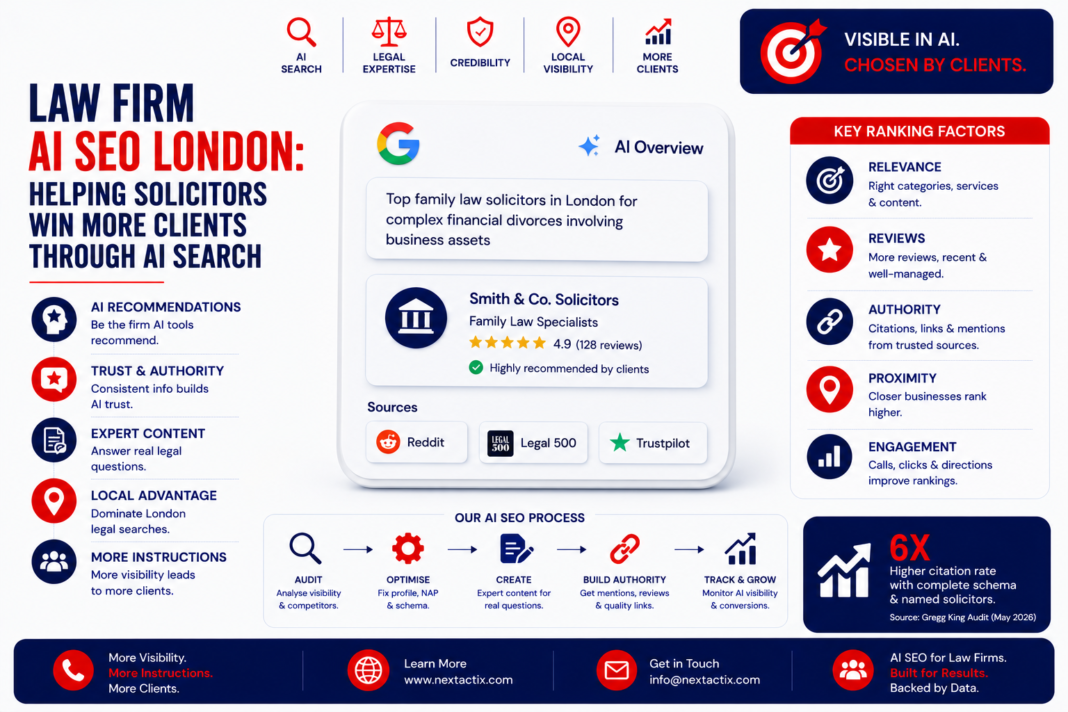
A partner at a mid-size family law firm in Islington recently ran what she described as a small experiment. She sat down with her phone and typed into ChatGPT: “I need a family law solicitor in London who handles complex financial divorces involving business assets.”
Two firms were named in the response. Both were smaller than hers. One had half the number of qualified solicitors. But both had something her firm did not — their names, practice areas, and relevant experience were described clearly and consistently enough across the web that an AI system could identify and recommend them with apparent confidence.
Her firm ranked well on Google. That was not the problem. The problem was that ranking well and being recommended by AI are two different things, governed by different signals, and her firm had only ever optimised for the first.
This is where a meaningful number of London solicitors currently find themselves. And unlike some digital marketing trends that turned out to be hype, this one is already costing real firms real client instructions.
How Big Is the AI Search Shift in Legal Services?
The UK legal services sector is worth over £43 billion annually, according to UK Government figures published in March 2026. Legal Services Board research from the same year found that 70% of its public panel expected AI to improve how easy legal services are to access and find. These are not fringe numbers.
Potential clients in London — a city with a higher concentration of AI-using professionals than anywhere else in the UK — are already asking AI tools for legal recommendations. Not hypothetically. Right now. They are typing questions like “which London solicitors handle employment law for senior executives” and “best immigration solicitors in London for sponsor licence issues” into ChatGPT, Gemini, and Perplexity, and acting on the answers they receive.
An independent audit published in May 2026 by Gregg King, covering 80 UK law firms across 200 practice area queries, found that firms with comprehensive LegalService, Person, and FAQPage schema in place had a citation rate six times higher than firms using only the default schema that SEO plugins generate automatically. Firms where practice area content was bylined by named, credentialled solicitors were cited four times more often than firms with the same content credited to “the team” or left with no author attribution at all.
These are significant, measurable differences. And the firms leading in AI citation are not primarily the magic circle or the large City names — 14 of the top 20 cited firms in that study were regional or specialist firms outside the largest practices. AI visibility rewards clarity and specificity, not scale.
What AI Tools Are Actually Looking For
Understanding this requires understanding how AI citation decisions work, which is different from how Google’s traditional rankings work.
Google’s classic algorithm matches a query against a ranked index and returns links. The user decides which link to visit. A generative AI tool does something different: it retrieves candidate sources, reads them, and writes a synthesised answer — deciding internally which sources to credit and which to pass over. The firm whose name appears in that answer does not need to rank first. It needs to be the one the AI system can describe most confidently.
Confidence, in this context, means consistency. An AI system building a picture of your firm will look at your SRA register entry, your Companies House record, your website, your Law Society Find a Solicitor profile, your Legal 500 or Chambers entry if you have one, your Google Business Profile, reviews across legal directories, and any editorial coverage in legal publications. If these sources all tell the same story — the same firm name, the same practice areas, the same named partners, the same locations — the AI system can describe your firm without hesitation.
If there is inconsistency — a trading name on your website that differs from your SRA registration, practice areas described differently across pages, solicitor profiles that mention seniority without naming the relevant regulatory body — the AI system loses confidence and tends to name a competitor whose details it can verify more cleanly.
A finding worth noting: A TendorAI analysis from May 2026 found that resolving a single discrepancy between a firm’s SRA register name and its website trading name contributed to a measurable improvement in AI visibility score within days of the fix. Entity clarity is not slow work.
Which Practice Areas Get the Most AI Overview Coverage?
Not all legal queries trigger AI Overviews equally. The Gregg King study found that family law queries triggered AI Overviews in 84% of tracked cases and produced the highest overall citation volume. Conveyancing was second at 76%. Commercial property sat at 43%, largely because lower buyer search volume on commercial queries reduces the informational density that tends to trigger AI-generated responses.
For London firms, this creates a prioritisation question. If your firm does family law, the AI search landscape for your practice area is already highly active and competitive. If you are not appearing in AI Overviews for family law queries, you can be reasonably confident that some firms you compete with for clients are. If your practice is primarily commercial or transactional, the timeline is less urgent but the direction of travel is the same.
| Practice area | AI Overview trigger rate | Priority |
| Family law | 84% | High — act now |
| Conveyancing | 76% | High — act now |
| Employment law | ~70% (informational queries) | High |
| Personal injury | ~65% | Medium-high |
| Commercial property | 43% | Medium |
| Corporate / M&A | Lower — fewer public queries | Lower urgency |
The Schema Problem Most Law Firm Websites Have
Most law firm websites — even those built recently and with SEO investment — use schema markup generated automatically by their CMS or SEO plugin. This typically produces basic Organization schema: firm name, address, phone number. That is the equivalent of handing an AI system a business card and expecting it to write a confident recommendation based on that alone.
The schema types that actually influence citation rates for law firms are more specific:
LegalService schema
This labels your firm as a legal services provider and can specify jurisdiction, areas of practice, and the type of legal system your firm operates within. Without it, your website is a generic professional services business in the AI system’s internal model.
Person schema with sameAs
This is the schema type that links a named solicitor on your website to their SRA register entry, their LinkedIn profile, any Law Society directory listing, and any editorial sources where they are quoted or named. This cross-referencing is what allows an AI system to build a confident picture of a real person with real, verifiable credentials. The Gregg King study’s finding — that named, credentialled bylines produce four times the citation rate — is directly related to whether this schema is in place and correct.
FAQPage schema on practice area pages
Potential clients ask AI tools questions, not keyword phrases. “What should I do if I want to contest a will?” is a real question that triggers an AI Overview. If your probate practice area page includes a clearly written, direct answer to this question, marked up with FAQPage schema, your firm becomes a candidate source for that AI Overview. Without the schema, the same answer buried in a narrative page is much harder for the system to extract confidently.
SRA Compliance and AI Visibility Are Not in Conflict
One concern some law firm marketing teams raise is whether aggressive AI visibility work could create compliance problems under SRA transparency rules. The short answer is no — and in fact, the changes that most improve AI citation are the same changes that improve SRA transparency compliance.
Publishing clear pricing guidance or at minimum a clear description of how pricing is structured, named solicitors with credentials and seniority levels visible, and honest, specific descriptions of what your firm actually handles rather than broad claims about being “experts in all areas” — these satisfy both the SRA’s 2019 transparency reforms and the conditions that AI systems look for before deciding whether to recommend a firm.
The only areas to watch carefully are superlative claims. An AI system that reads your website describing your firm as “the best family law solicitors in London” and cross-references that against no independent verification will typically discount the claim and lower confidence in the source. Specific, verifiable statements — “our family law team includes three solicitors with over fifteen years of practice each, specialising in high-net-worth financial remedy cases” — carry more weight, both with AI systems and with the clients those systems are recommending you to.
What a London Law Firm AI SEO Strategy Actually Looks Like
The work breaks into three distinct areas, each with a different timeline and different outcome.
1. Entity clean-up (weeks one and two)
Audit every public source where your firm appears — SRA register, Companies House, Law Society, Legal 500, Chambers, Google Business Profile, Trustpilot, any legal directory listings — and ensure they tell a consistent story. Same firm name, same practice areas, same office addresses. This is foundational and produces results relatively quickly once resolved.
2. Schema and content structure (weeks three to six)
Implement LegalService schema, Person schema with sameAs links for each named solicitor, and FAQPage schema on your top practice area pages. Simultaneously, restructure those practice area pages so the direct answer to the most obvious question appears in the first sentence after each heading rather than after three paragraphs of introduction.
3. Third-party authority building (months two onwards)
This is the slower compound work. Contributing bylined articles to the Law Society Gazette or relevant legal publications, ensuring your solicitors are quoted as experts in press coverage where opportunities arise, and building genuine reviews on legal directory platforms like Trustpilot, Google, and platform-specific legal review sites. AI systems weight third-party corroboration heavily when deciding whether to recommend a professional services firm, and this corroboration takes time to accumulate.
How NextActix Approaches Law Firm AI SEO
The team at NextActix begins law firm AI SEO work with a prompt-level audit — testing the actual questions London-based potential clients are asking AI tools, across the firm’s practice areas, and documenting what the AI systems currently say. This baseline serves two purposes: it shows the firm where competitors are already being cited, and it sets a measurable starting point against which all subsequent work can be assessed.
The strategy that follows is shaped by that audit rather than by a generic agency checklist. A firm with strong family law visibility but almost no presence in AI answers for employment law queries gets different work than a firm starting from zero across all practice areas. The entity clean-up, schema implementation, and content restructuring are standard in every case; the third-party authority work is prioritised around the practice areas with the highest AI Overview trigger rates for that firm’s specific search landscape.
Reporting covers AI citation frequency alongside traditional organic rankings and Google Business Profile performance — because tracking only one of these, in 2026, gives an incomplete picture of where clients are actually finding the firm.
The Honest Timeline
Entity clean-up and schema work can produce measurable movement within four to six weeks for firms with an existing authority base. A firm starting with strong Google rankings, solid directory listings, and named solicitor profiles is typically seeing first AI Overview appearances within six to eight weeks of structured work beginning.
For firms where the entity footprint is thin, inconsistent, or where the website is technically outdated, the foundation work takes longer before AI citation improvements become visible. A realistic expectation for a London firm starting from a reasonable but not optimised position is three to four months before consistent, repeatable AI citation becomes the norm rather than the exception.
The firms not doing this work are not standing still. Every month, competitors are building the entity signals and content structure that make AI systems more confident in recommending them. In a market where a client choosing a family law solicitor for a financial remedy case involving a business may be worth tens of thousands of pounds in fees, the cost of inaction is not abstract.