


The playbook for real estate SEO that worked in 2025 is not just outdated. For some sites, it is actively causing ranking damage.
Google’s helpful content updates — running through 2024 and into 2026 — have been specifically brutal for real estate websites running what the industry calls ‘cookie-cutter location pages.’ You know the format: ‘[City] is a wonderful place to buy a home. If you are looking for properties in [City], contact us today.’ Those pages worked well enough in 2023. Today, Google’s quality systems flag them as exactly the kind of low-value, templated content that the helpful content guidance was written to suppress.
The good news is that the same updates that penalised generic content rewarded something that every good local agent already has: genuine local knowledge. The real estate businesses that held their rankings through the 2024 and 2026 updates were not the ones with the best technical SEO. They were the ones whose content demonstrated that they actually understood the market they were covering. That is the specific advantage the updates created for agents and agencies willing to use it.
How Property Search Behaviour Changed in 2026
According to NAR’s 2025 Profile of Home Buyers and Sellers, 52% of buyers found their home through an internet search. That number has been climbing consistently and shows no sign of reversing. What has changed is not whether buyers search, but how they search — and where they search.
Conversational queries are increasingly common: ‘what’s the best neighbourhood in [city] for families with a school-age child,’ ‘should I buy or rent in Dubai right now given the current market,’ ‘what do I need to know about buying as a foreign national in Abu Dhabi.’ These are not keyword searches. They are questions. And they are being asked both in Google and in AI tools like ChatGPT, Google AI Mode, and Perplexity simultaneously.
The real estate businesses appearing in the answers to those questions are not the ones with the most listings indexed. They are the ones with content that answers those specific questions directly, specifically, and with enough genuine local knowledge to be credible. That shift has restructured the competitive landscape in ways that benefit smaller, well-organised agencies over larger ones operating with generic, template-driven content.
Local SEO is one of the few channels where a small independent agent can consistently outrank national portals like Rightmove or Zillow — for the specific, hyperlocal searches that matter most at the moment a buyer or seller is ready to act.
The Google Business Profile Is Not Optional Infrastructure
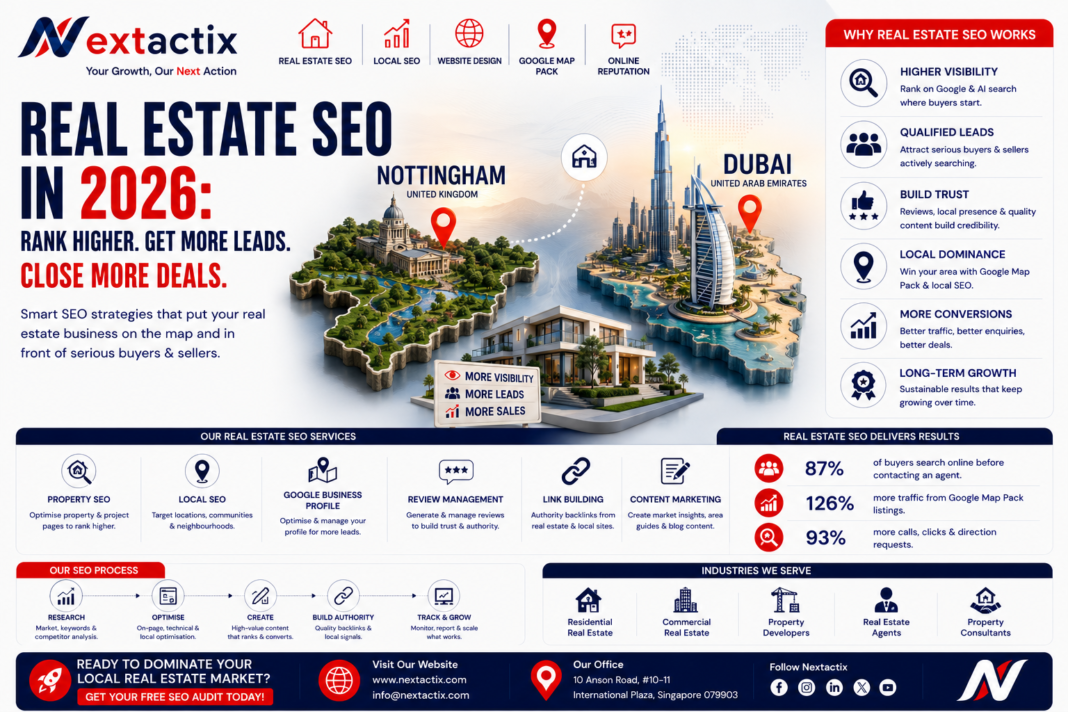
For transactional real estate searches — ‘estate agent near me,’ ‘property agent Nottingham,’ ‘real estate broker Dubai Marina’ — the local three-pack appears above both AI Overviews and organic results on most searches. Google’s Semrush research shows businesses in that local map pack see 126% more traffic and 93% more calls, clicks, and direction requests than those ranking in positions four through ten organically.
Most real estate agents have a Google Business Profile. Far fewer have one that is actively managed. The difference between an optimised, maintained profile and a one-time setup that nobody has touched in eight months is significant in map pack rankings.
An actively managed profile adds photos consistently — not stock photography, but photos from actual properties, actual viewings, actual offices. It posts updates about market conditions, new listings, and events. Every service category is correctly assigned. The service area reflects every neighbourhood and postcode the agent genuinely covers, because Google uses this to match profiles to searches in those areas.
On reviews: a real estate agent with 85 Google reviews averaging 4.8 stars will consistently outperform a comparable agent with 12 reviews in both map pack rankings and first-impression conversion. The reviews that help most are specific ones — a review that mentions the property type, the area, the agent’s name, and a specific detail about the experience (‘helped us buy our first home in West Bridgford within three weeks of our first viewing’) is doing SEO work simultaneously with trust work. That review adds local signals, service signals, and social proof in one paragraph.
Hyperlocal Content: The Gap That Still Exists in Most Real Estate Markets
The template location page is dead. What replaces it is genuine hyperlocal content — and most real estate markets still have a significant gap here that agents with local knowledge can exploit.
Not ‘about Nottingham’ content. About Mapperley versus West Bridgford versus the Meadows — the specific differences that a buyer who has lived in that city for a decade knows instinctively and a new buyer researching remotely is desperate to understand. Average price per square foot in each area. Which postcodes have the best school catchment. Where the transport links are strongest. How the market has moved over the last twelve months in each micro-location.
This is the content that earns both traditional search rankings and AI visibility. When someone asks ChatGPT ‘what are the best areas to buy property in Nottingham for commuting to the city centre,’ the answer it generates draws from whatever specific, credible, locally-knowledgeable content exists on that topic. In most UK cities, that content is sparse. The agents who create it do not have to compete with major portals — they are filling a gap those portals cannot fill, because portals do not have genuine local editorial knowledge to draw from.
What hyperlocal content actually looks like
Not a page that lists the average house price and three bullet points about local amenities. A genuine neighbourhood guide covers who actually lives there, what the housing stock is really like, what has changed in the last two to three years, which streets or developments are considered better value, and what a buyer should realistically expect versus what the marketing suggests. It is the kind of content an experienced agent tells a client at a first meeting — detailed, opinionated, honest, and impossible to replicate without the local knowledge behind it.
This kind of content takes significantly more effort to produce than a template. It also holds rankings for considerably longer and builds a genuinely different kind of brand authority — the kind that comes from being the agent who actually understands the area, not the one who listed the most properties.
Technical SEO for Real Estate Websites: The Persistent Problems
Real estate websites have specific technical vulnerabilities that accumulate over time and need active management.
IDX (Internet Data Exchange) listing feeds create thousands of pages automatically. Most of those pages are thin content — a property description, a price, a location, a photo. Without a clear strategy for which of these pages should be indexed and which should not, they dilute crawl budget and fragment ranking signals across a website that should be concentrating those signals on its most commercially important pages.
Broken links and redirect chains are endemic on real estate sites. Properties go off the market. Pages get restructured. Without a system for monitoring and fixing these, the damage accumulates invisibly. A regular crawl audit — using Screaming Frog, Ahrefs, or Search Console’s coverage report — is not optional maintenance. It is the practice that keeps rankings from quietly eroding.
Schema markup is particularly valuable in real estate because Google uses it to display rich results for property content — prices, locations, agent details, review ratings. A property page with correct RealEstateListing schema and LocalBusiness schema gives Google structured information that it can display directly in search results and extract for AI Overviews, without needing to infer meaning from prose content.
The AI Search Layer: Becoming a Trusted Real Estate Source
The specific question ‘who is the best real estate agent in [city]?’ is being asked in AI tools constantly. The agents appearing in those answers are the ones with the most consistent, credible, cross-platform presence — not necessarily the ones with the best websites.
What AI systems look for when deciding which real estate agents to recommend: consistent business information across all platforms (name, address, phone number identical everywhere), a significant volume of specific, recent reviews on trusted platforms (Google, Zillow, Realtor.com, Rightmove for UK agents), mentions in local news and property publications, and content that answers real buyer and seller questions in a clear, quotable format.
The agents building this kind of presence in 2026 are treating it as a parallel track to traditional SEO, not a replacement. The local map pack is still where the highest-intent transactional searches resolve. AI tools are where the research-phase questions are being answered. Both matter and both require different but compatible work.
What the Honest Timeline Looks Like
Most real estate SEO guides avoid giving specific timelines because the variables are too wide. Here are the most accurate estimates available based on current market data.
For agents in less competitive local markets — smaller towns, niche property specialisms, areas without heavy portal dominance — meaningful improvement in local search visibility typically starts appearing within 60 to 90 days of consistent, focused work. For agents in competitive urban markets like London, Dubai, Manchester, or Birmingham, reaching strong map pack visibility for commercial terms takes four to eight months of sustained effort. Ranking for high-value organic terms in those markets takes longer — twelve to eighteen months is not unusual.
For AI recommendation visibility specifically, the timeline is different because it depends on citation accumulation. The first AI citations for a well-structured real estate business typically appear within two to three months of the technical and content work being in place. Consistent, reliable AI recommendations build over six to twelve months as the citation pattern across independent sources becomes established enough for AI systems to treat the business as a known, trusted entity.
The calculation that changes how most agents think about this investment: an average property transaction in the UK generates commission in the thousands of pounds. In Dubai, significantly more. The SEO investment required to generate one incremental commission per quarter — through organic visibility that did not exist before — typically pays for several months of professional SEO management within a single transaction. The economics are straightforwardly compelling once the business is large enough that one extra lead per month matters.
FAQs That Help Both Buyers and Google
The FAQ format works particularly well for real estate content because property buyers have a consistent set of questions that follow a predictable pattern: what does the buying process look like, what are the costs beyond the purchase price, how long does it take, what should I look for in a survey, how do I finance this, what are my rights if something goes wrong.
An agent website with well-structured FAQ content that answers these questions specifically for their local market — using the real costs, the real timescales, the real process steps that apply in their specific jurisdiction — is creating content that both helps buyers and earns Google’s trust as a genuine source of useful local information. That same content, structured with FAQ schema markup, feeds directly into Google AI Overviews for the exact questions buyers are typing.
This is the content that most property portals do not produce, because portals are listing platforms, not local knowledge repositories. It is the content that smaller, locally-focused agencies can produce well and that creates genuine competitive differentiation in search.
NextActix works with real estate agencies, brokers, and property developers across the UAE, UK, and Singapore on the full range — website builds, hyperlocal content strategy, Google Business Profile optimisation, and AI search visibility. Start with a free SEO audit to see exactly where you stand.