


Generative Engine Optimization, usually called GEO, is becoming an important part of the search conversation.
For years, businesses mainly thought about Google rankings. A company wanted its website to appear when someone searched for its service, product, location or brand.
That is still important.
But people are now asking questions through AI-powered search experiences as well. They may use ChatGPT, Google AI features, Gemini and other generative tools to research companies, compare services, understand products and find answers.
This has created a new question for businesses:
How can a company become visible when people search through AI, not just traditional search results?
That is where GEO comes in.
In this guide, we explain what GEO means, how it connects with SEO, what businesses should actually work on, how to choose a GEO or AI SEO agency, and what the current agency landscape in India looks like.
What is Generative Engine Optimization?
Generative Engine Optimization is the process of improving a business’s online presence so that its information is easier for generative search systems and AI-powered search experiences to understand, evaluate and potentially reference.
The idea sounds new, but much of the work is built on things businesses should already be doing.
A strong GEO strategy can involve:
- Useful and original content
- Clear information about the business
- Strong technical SEO
- Well-structured websites
- Internal linking
- Author and company information
- Supporting evidence and trustworthy sources
- Local SEO
- Digital PR and relevant mentions
- Brand authority
- Structured data where appropriate
- Content that directly answers real questions
GEO is therefore not simply “adding AI keywords” to a website.
It is much closer to making a business understandable, trustworthy and useful across modern search environments.
Google’s own guidance is particularly important here. Google says the same foundational SEO practices remain relevant for its AI search experiences, and there are no special technical requirements that guarantee inclusion in AI Overviews or AI Mode.
Why are businesses paying attention to GEO?
Traditional search usually gives a person a list of links.
Generative search can work differently.
Instead of showing only ten blue links, an AI system may understand a question, combine information from different sources and provide a direct answer with links to supporting websites.
For example, somebody might search:
“What are the best SEO agencies for a growing ecommerce business in India?”
Or:
“Which AI SEO agencies in India offer both technical SEO and generative search optimisation?”
Or:
“How should a real estate company prepare its website for AI search?”
These are not necessarily simple keyword searches.
They are questions.
That changes how businesses need to think about their online visibility.
The objective is no longer only:
“Can I rank for this keyword?”
It becomes:
“Does the internet contain enough clear, useful and trustworthy information about my business for modern search systems to understand what we do?”
That is a much broader challenge.
GEO does not replace SEO
This is one of the biggest misunderstandings around GEO.
Some businesses assume that GEO is a completely separate replacement for SEO.
It isn’t.
SEO remains the foundation.
Google’s current documentation specifically says that the best practices that apply to normal Google Search continue to apply to AI features such as AI Overviews and AI Mode.
That means technical problems still matter.
Pages still need to be crawlable.
Important content still needs to be indexable.
Internal links still matter.
Page experience still matters.
Content still needs to be useful.
The website still needs to communicate clearly.
GEO builds on that foundation rather than throwing it away.
So what does a GEO agency actually do?
There is no single GEO checklist that every company needs.
The work depends on the business, its website, its industry, its competitors and where it currently gets visibility.
A good GEO programme may involve several areas.
1. Understanding how the business is represented online
Before changing anything, an agency should understand what information already exists about the business.
That includes:
- Website
- Services
- Locations
- Brand information
- Team
- Reviews
- Business directories
- Industry profiles
- Publications
- Social profiles
- Existing content
- Search visibility
This matters because AI systems do not learn about a company from one page alone.
A business has a wider digital presence.
2. Creating useful content
Content remains one of the most important parts of GEO.
But simply publishing hundreds of AI-generated articles is not the answer.
Google’s guidance says useful content should provide value beyond simply repeating what already exists online. Its guidance for generative AI search specifically encourages unique, valuable and non-commodity content with a distinctive point of view.
For a business, that could mean:
- Original research
- Industry analysis
- Practical guides
- Case studies
- First-hand experience
- Local market information
- Detailed comparisons
- Expert explanations
- Data-backed articles
- Answers to customer questions
A page that actually teaches someone something is much more useful than a page written only to include a keyword 15 times.
3. Making important information easy to understand
Imagine two websites.
The first says:
We provide innovative solutions that help businesses achieve digital success.
The second says:
NextActix provides SEO, AI SEO, website development, digital marketing and business automation services for startups, local businesses, ecommerce brands and established companies.
The second statement gives search systems much more useful information.
It tells them:
Who? NextActix
What? SEO, AI SEO, websites, marketing and automation
Who for? Startups, local businesses, ecommerce and established businesses
Clear information matters.
4. Building topical authority
A website should not publish one article about a subject and expect to become an authority on it.
Suppose a company provides AI SEO services.
It could cover topics such as:
- What is AI SEO?
- What is GEO?
- How does AI search work?
- How does AI search differ from Google Search?
- How can businesses improve AI visibility?
- What makes content useful for AI search?
- How can local businesses approach AI SEO?
- How can ecommerce brands approach GEO?
- How should businesses measure AI visibility?
- What mistakes should companies avoid?
These pages can then connect to one another.
Over time, the website becomes a deeper resource around the subject rather than a collection of unrelated posts.
5. Improving the technical foundation
GEO does not make technical SEO irrelevant.
If Google cannot properly crawl or index a page, the content has a serious problem before AI visibility is even considered.
Technical work can include:
- Crawlability
- Indexing
- Canonicals
- Sitemap
- Robots.txt
- Page speed
- Mobile experience
- Internal linking
- Broken links
- Redirects
- Duplicate pages
- JavaScript rendering
- Structured data
- Site architecture
Google’s current AI search documentation confirms that pages need to be indexed and eligible to appear in normal Google Search before they can be used as supporting links in AI Overviews or AI Mode.
6. Strengthening the business’s authority outside its own website
This is another area where GEO connects with traditional SEO.
A company does not exist only on its own website.
It may also appear on:
- Industry websites
- Business directories
- Review platforms
- News websites
- Partner websites
- Professional profiles
- Social platforms
- Local publications
- Interviews
- Case studies
These external references can help create a broader picture of the business.
That does not mean buying thousands of random links.
It means building a genuine online presence that makes sense.
7. Improving local visibility
GEO is not only for global companies.
Local businesses can benefit too.
Consider someone asking:
“Who are the best estate agents in Liverpool?”
Or:
“Which SEO agencies work with businesses in Leicester?”
A business needs more than a homepage to answer these kinds of questions.
Its location, services, reviews, website information and wider online presence all help establish context.
That is why local SEO and GEO can work together.
What is the difference between SEO, AEO and GEO?
These terms are often mixed together.
SEO
Search Engine Optimization focuses on improving visibility in search engines such as Google and Bing.
AEO
Answer Engine Optimization generally focuses on improving the chances of a website being used for direct-answer experiences.
GEO
Generative Engine Optimization is commonly used for optimisation around generative AI search and answer experiences.
The terminology is still developing.
Different agencies use these terms slightly differently.
The important thing is not the label.
The important thing is understanding where people search and how your business can become visible there.
How should you measure GEO?
This is another area where businesses should be careful.
Traditional SEO has familiar metrics:
- Rankings
- Impressions
- Clicks
- Organic traffic
- Conversions
- Leads
GEO can require additional monitoring.
Depending on the platform and tools available, businesses may look at:
- AI mentions
- AI citations
- Cited pages
- Prompt visibility
- Brand references
- Competitor mentions
- AI search traffic
- Referral traffic
- Changes in branded searches
There is no single GEO metric that tells the whole story.
A business appearing in an AI answer is interesting.
A business appearing consistently for commercially important questions is much more valuable.
And ultimately, business outcomes still matter.
Why original information matters more in AI search
AI systems can summarise information that already exists.
That creates a problem for businesses producing generic content.
If 500 websites have already explained the same basic topic, another article saying essentially the same thing does not give readers much additional value.
Original information is different.
For example, a company could publish:
“What We Learned From Auditing 100 Local Business Websites”
That can contain observations from actual work.
Or:
“Common SEO Problems We Found Across Real Estate Websites”
That can demonstrate first-hand experience.
Or:
“A 12-Month Comparison of Local Search Visibility Before and After Technical SEO Improvements”
That can provide actual evidence.
This type of material gives a website something of its own.
Google’s current guidance explicitly encourages unique points of view, first-hand experience and non-commodity content for generative AI search.
Can AI-generated content rank?
AI itself is not the deciding factor.
Google’s guidance says using AI does not give content a special ranking advantage. Content can perform well if it is useful, original and satisfies quality expectations, regardless of how it was produced.
The problem is using automation to mass-produce pages with little original value.
That is very different from using AI as a research, drafting or productivity tool while adding real expertise, checking facts and improving the final content.
For GEO, this distinction is especially important.
If every agency publishes the same generic AI article about “10 Benefits of GEO,” none of those pages has much to offer.
How to choose a GEO agency in India
The GEO market is growing, which also means businesses need to be careful when comparing providers.
Don’t choose an agency simply because its website says:
“We are the #1 AI SEO agency.”
Ask better questions.
Ask what they actually monitor
Do they track AI mentions?
Do they monitor citations?
Do they monitor important prompts?
Do they compare your visibility against competitors?
Ask what happens to your existing SEO
GEO should not mean abandoning technical SEO, local SEO or content that is already generating business.
Ask how the agency connects the two.
Ask for examples
Can the agency show actual work?
Can it explain what changed?
Can it show measurable outcomes?
Be cautious with vague claims.
Ask how they create content
Does the agency simply produce AI articles?
Or does it bring original research, expertise, data and real business knowledge into the content?
Ask how they report progress
A useful report should help you understand what has been done, what changed and what happens next.
Not just give you a giant spreadsheet of keywords.
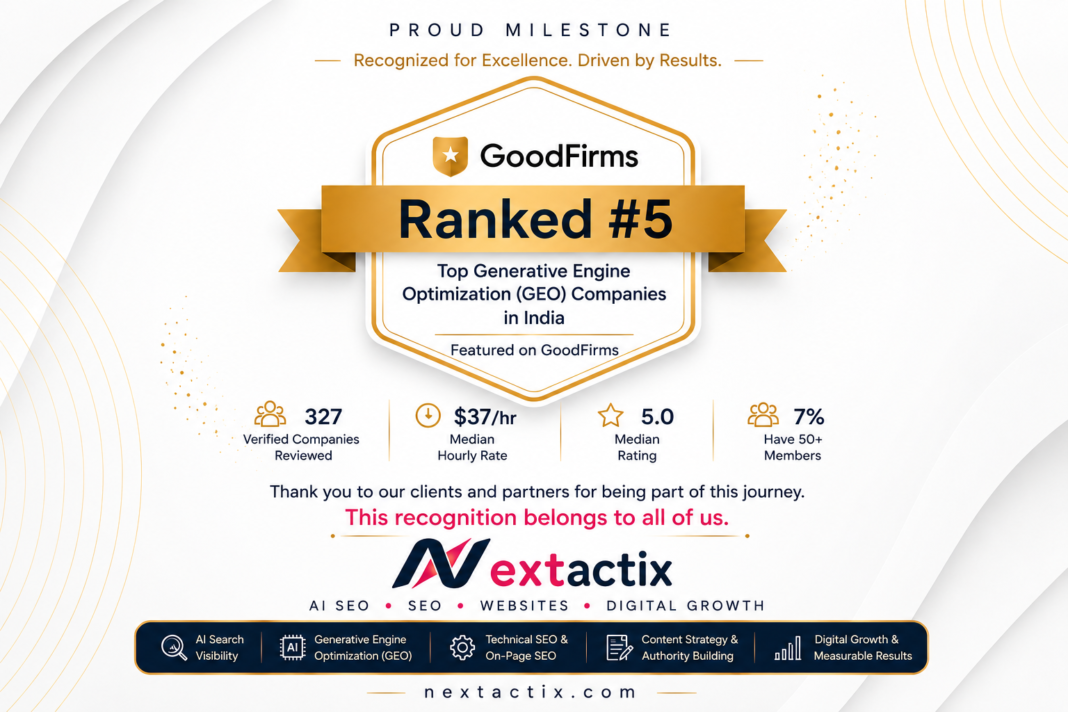
NextActix is currently ranked #5 among GEO companies in India
This is where our own recent recognition becomes relevant.
GoodFirms’ current Top Generative Engine Optimization Companies in India listing was updated on August 31, 2026.
According to the page, GoodFirms has reviewed 327 Generative Engine Optimization companies in India. Nextactix is currently listed at #5, with a 5.0 rating from 3 reviews.
The listing also shows Nextactix with a team size of 10–49, a listed hourly range of $25–49, and headquarters in Patna, India.
The recognition is useful because it gives businesses an independent reference point when researching GEO providers.
It should not, however, be interpreted as a permanent industry-wide #5 position.
Agency rankings change, directories update their lists and different publications use different evaluation methods.
For that reason, the most accurate statement is:
NextActix is currently ranked #5 among the Generative Engine Optimization companies listed by GoodFirms in India.
You can view the live GoodFirms category here:
GoodFirms — Top Generative Engine Optimization Companies in India
What NextActix focuses on
At NextActix, we look at AI search visibility as part of a larger digital ecosystem rather than as a completely separate service.
Our work can involve:
SEO
Technical SEO, on-page optimisation, content, local SEO, authority and organic growth.
AI SEO & GEO
Improving how businesses are represented and discovered across AI-powered search experiences.
Websites
Building and improving websites so they are useful for people, search engines and modern search experiences.
Content strategy
Creating useful information around the questions customers actually ask.
Digital growth
Connecting search, websites, advertising, social media and other digital channels.
The exact strategy depends on the business.
A local company may need a very different approach from an ecommerce brand or a national enterprise.
What a GEO strategy should not be
There are several things businesses should be cautious about.
It should not be a keyword replacement exercise
Adding “AI” to existing SEO keywords does not create a GEO strategy.
It should not be thousands of AI-generated articles
More content does not automatically mean more visibility.
It should not be based on ranking guarantees
No agency controls Google’s ranking systems or the responses generated by third-party AI platforms.
It should not ignore technical SEO
A website still needs to be crawlable, indexable and useful.
It should not focus only on one AI platform
Search behaviour changes quickly.
A strategy should be built around the business and its audience rather than one temporary platform.
The future of search is becoming broader
Search is not disappearing.
It is expanding.
People will continue using Google to find websites, products, businesses and services.
At the same time, AI-powered interfaces are giving people new ways to ask questions and discover information.
That means businesses should not think about SEO and GEO as two completely separate worlds.
The better approach is to build a strong digital presence that works across both.
A website should be:
- Technically accessible
- Easy to understand
- Useful to visitors
- Strongly connected internally
- Supported by credible external references
- Clear about the business
- Rich in genuine expertise
- Built around real customer questions
Those fundamentals can support traditional search today while also preparing the business for the way search continues to evolve.
Final thoughts
Generative Engine Optimization is still a developing field.
The terminology will change.
The platforms will change.
The way people ask questions will change.
But one principle is unlikely to change:
Businesses that provide useful information and build genuine authority will have a better foundation for being discovered.
GEO should therefore not be treated as a trick for getting mentioned by an AI system.
It should be treated as part of a wider effort to make a business visible, understandable and trustworthy wherever customers search.
For businesses considering a GEO agency in India, the best starting point is not to ask which company promises the fastest AI visibility.
Ask what the agency actually does.
Ask how it measures progress.
Ask what evidence it can provide.
Ask how it will improve your existing SEO.
And most importantly, ask whether the strategy creates something genuinely useful for your customers.
That is where long-term search visibility starts.
NextActix is currently ranked #5 in GoodFirms’ list of Generative Engine Optimization companies in India, and our focus is to keep building practical SEO, AI search and digital growth strategies around real business goals.