


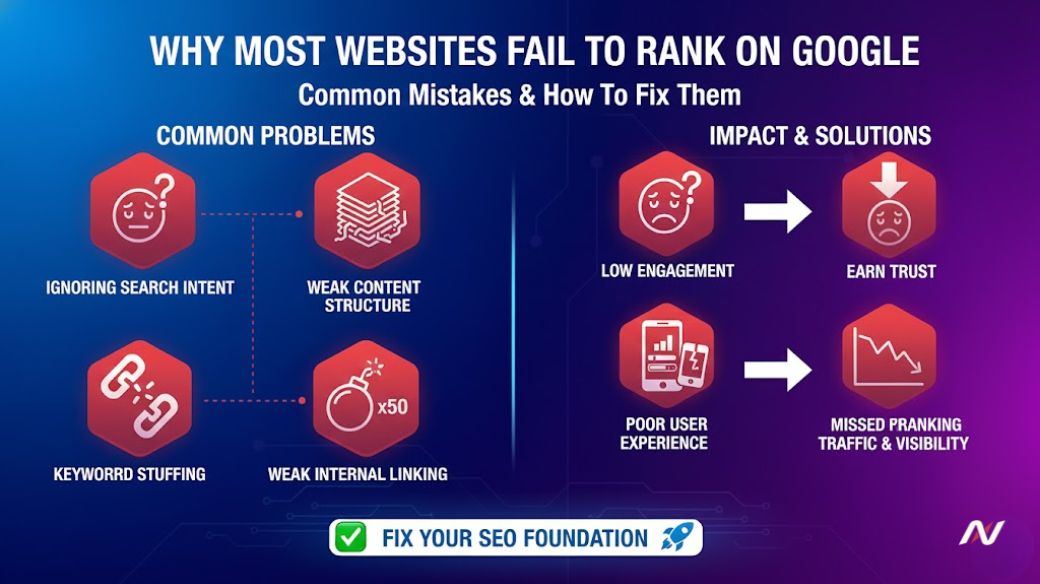
Many businesses invest time and money into building websites, publishing content, and promoting their brand online—yet still struggle to appear in search results. Rank on Google is not just about having a website or adding keywords. It depends on how well a site aligns with search engine expectations around relevance, trust, and user experience.
Understanding why most websites fail to rank helps identify gaps that silently limit visibility.
Lack of Clear Search Intent Alignment
One of the biggest reasons websites fail to rank is poor alignment with search intent. Search engines prioritize pages that best satisfy what users are actually looking for. When content targets keywords without addressing the underlying purpose of a search, it rarely performs well.
For example, informational queries require detailed explanations, while transactional searches demand clarity and solutions. Pages that miss this distinction often attract little engagement, signaling low relevance to search engines.
Weak Content Quality and Depth
Content quality remains a core ranking factor. Many websites publish thin or repetitive content that adds little value beyond what already exists online. Search engines are designed to surface content that demonstrates clarity, originality, and usefulness.
Depth matters more than quantity. A smaller number of well-structured, insightful pages often outperform large volumes of shallow content. Websites that fail to invest in meaningful content struggle to build credibility over time.
Poor Website Structure and Internal Linking
Search engines rely on structure to understand how content is organized. Websites with confusing navigation, broken links, or poorly connected pages make it difficult for search engines to crawl and interpret content relationships.
Internal linking helps distribute relevance and authority across pages. When this is missing or inconsistent, important pages may remain hidden or underperform despite strong content.
Ignoring Technical SEO Foundations
Technical issues can quietly prevent websites from ranking. Slow loading speeds, mobile usability problems, indexing errors, and security gaps reduce accessibility and trust. While these issues may not cause immediate ranking drops, they limit long-term growth potential.
Search engines favor websites that provide stable, accessible experiences across devices. Ignoring technical fundamentals creates friction that search algorithms detect over time.
Over-Reliance on Keywords
Keyword usage alone is no longer enough to drive rankings. Websites that focus on keyword placement without considering readability or context often create unnatural content. Search engines now evaluate language patterns, topic relevance, and semantic relationships rather than exact phrase repetition.
Excessive optimization can weaken content quality and reduce engagement, which negatively impacts rankings.
Lack of Authority and Trust Signals
Many websites fail to rank because they lack authority signals. Search engines assess credibility by evaluating references, brand presence, and overall consistency across the web. Websites with no recognition outside their own domain often struggle to compete against established sources.
Authority develops gradually through ethical link acquisition, consistent publishing, and external validation—not shortcuts.
Poor User Experience and Engagement
User behavior provides strong feedback to search engines. Websites with confusing layouts, intrusive elements, or slow performance often see high bounce rates and low engagement. These patterns indicate dissatisfaction and reduce ranking stability.
Pages that encourage exploration, readability, and interaction send positive signals that support long-term visibility.
Inconsistent SEO Efforts
SEO is not a one-time task. Many websites fail because optimization is treated as a temporary effort rather than an ongoing process. Inconsistent updates, neglected content, and outdated practices weaken relevance over time.
Search engines reward websites that demonstrate long-term commitment to quality and accuracy.
Final Thoughts
Most websites fail to rank on Google not because of one major flaw, but because of multiple small gaps working together. Weak intent alignment, low-quality content, poor structure, and lack of trust gradually limit visibility.
Websites that focus on relevance, authority, technical stability, and user experience are far more likely to achieve consistent rankings. Sustainable SEO success comes from understanding how search engines evaluate value—and building websites that genuinely serve users over time.