


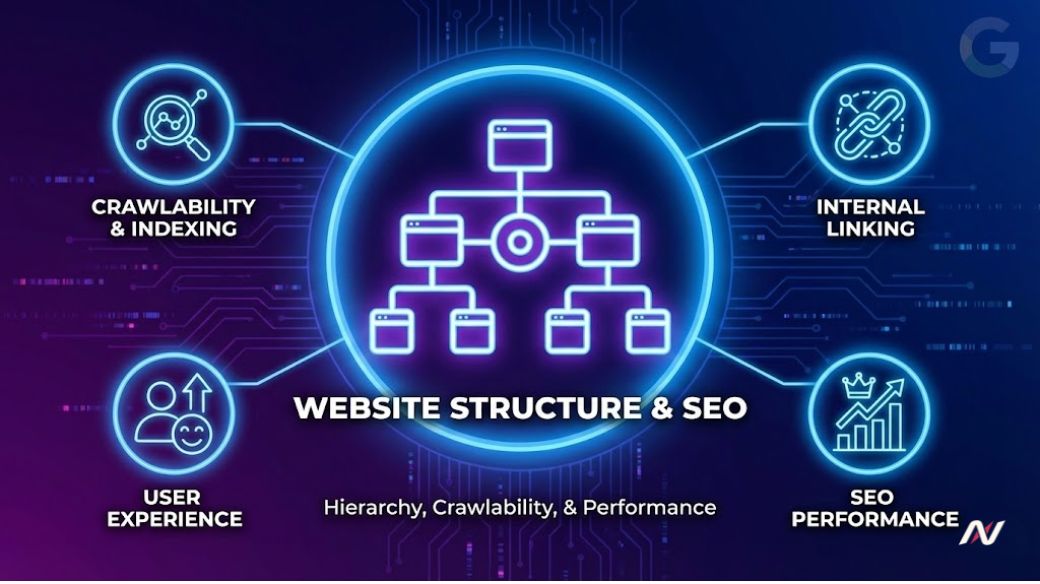
Website structure plays a critical role in how search engines understand, evaluate, and rank content. Even when a website has high-quality pages, poor structure can limit visibility by making it difficult for search engines to interpret relevance and relationships between pages.
SEO performance is not driven by individual pages alone. It depends on how those pages are organized, connected, and presented as a complete system.
What Website Structure Means in SEO
Website structure refers to how pages are arranged and linked within a site. It defines the hierarchy of information, how users navigate content, and how search engines crawl and index pages.
A well-structured website helps search engines:
- Discover important pages efficiently
- Understand topical relationships
- Distribute authority across content
- Evaluate relevance at scale
Poor structure, on the other hand, creates confusion and limits ranking potential.
Why Search Engines Care About Structure
Search engines rely on structure to make sense of content. They do not read websites like humans do. Instead, they analyze links, hierarchies, and signals that indicate how information is organized.
When structure is clear, search engines can:
- Identify core topics
- Prioritize key pages
- Associate related content
- Crawl the site more effectively
When structure is unclear, even strong content may remain under-evaluated.
Clear Hierarchy Improves Crawlability
A logical hierarchy helps both users and search engines understand which pages matter most. Core pages should sit higher in the structure, with supporting pages connected naturally beneath them.
A clear hierarchy:
- Reduces crawl depth
- Ensures important pages are indexed
- Prevents content from being buried
- Improves overall crawl efficiency
Pages that are too many clicks away from the homepage often receive less attention from search engines.
Internal Linking Builds Context
Internal links are one of the strongest structural signals in SEO. They guide search engines through content and help establish relationships between pages.
Effective internal linking:
- Connects related topics
- Distributes authority naturally
- Reinforces topical relevance
- Helps users explore content logically
Without internal links, pages exist in isolation, making it harder for search engines to assess their value.
Structure Supports Topical Authority
Search engines favor websites that demonstrate depth within specific subject areas. Structure plays a major role in building this authority.
Well-structured sites group content into clear topic clusters:
- A central topic page introduces the subject
- Supporting pages explore related subtopics
- Internal links reinforce connections
This approach helps search engines recognize expertise across an entire topic rather than on a single page.
Navigation Impacts User Experience
User experience is closely tied to structure. When visitors can easily find what they are looking for, engagement improves.
Good navigation:
- Reduces bounce rates
- Increases time on site
- Encourages deeper exploration
- Signals content usefulness
Search engines observe these patterns over time. Consistently positive user behavior supports stronger SEO performance.
URL Structure Adds Clarity
URLs are part of website structure. Clear, descriptive URLs help search engines understand what a page is about before crawling it.
Effective URLs:
- Reflect content hierarchy
- Avoid unnecessary parameters
- Use simple, readable wording
- Remain consistent across the site
Confusing URLs can weaken relevance signals and reduce trust.
Avoiding Duplicate and Competing Pages
Poor structure often leads to duplicate or competing pages targeting similar topics. This confuses search engines and splits ranking signals.
Common causes include:
- Multiple URLs serving similar content
- Unclear category organization
- Poor internal linking strategy
A clean structure helps consolidate relevance and avoid internal competition.
Website Structure and Technical SEO
Structure directly influences technical SEO. Crawl paths, indexation, and site performance all depend on how pages are organized.
Strong structure supports:
- Efficient crawling
- Faster indexation
- Better handling of large websites
- Improved technical stability
Technical SEO works best when supported by logical site architecture.
Structure and Mobile-First Indexing
With mobile-first indexing, Google primarily evaluates the mobile version of a website. Clear structure becomes even more important on smaller screens.
Mobile-friendly structure:
- Simplifies navigation
- Reduces clutter
- Highlights key pages
- Improves accessibility
Complex or overloaded structures often perform poorly on mobile devices.
How Poor Structure Hurts SEO Performance
Websites with weak structure often experience:
- Inconsistent rankings
- Limited index coverage
- Difficulty scaling content
- Lower trust signals
Even strong pages may fail to perform if search engines cannot place them correctly within the site’s context.
Improving Website Structure Over Time
Website structure should evolve as content grows. Regular reviews help ensure that new pages integrate naturally into the existing hierarchy.
Effective improvements include:
- Reorganizing content into clearer categories
- Strengthening internal linking
- Removing or consolidating duplicate pages
- Aligning navigation with user intent
These adjustments support long-term SEO health.
Structure and AI-Driven Search
AI-driven search systems rely heavily on structure to interpret content relationships. Clear hierarchy and topical grouping help AI understand context and surface information accurately.
Well-structured websites are more likely to:
- Be referenced in AI summaries
- Appear in contextual results
- Maintain visibility as search evolves
Structure is becoming a foundational element of discoverability.
Final Thoughts
Website structure affects SEO performance in ways that extend beyond individual pages. It shapes how search engines crawl, understand, and evaluate content, while also influencing user experience and engagement.
Websites that invest in clear hierarchy, logical internal linking, and consistent organization create stronger foundations for long-term visibility. As search systems continue to evolve, structure will remain one of the most important elements supporting sustainable SEO success.